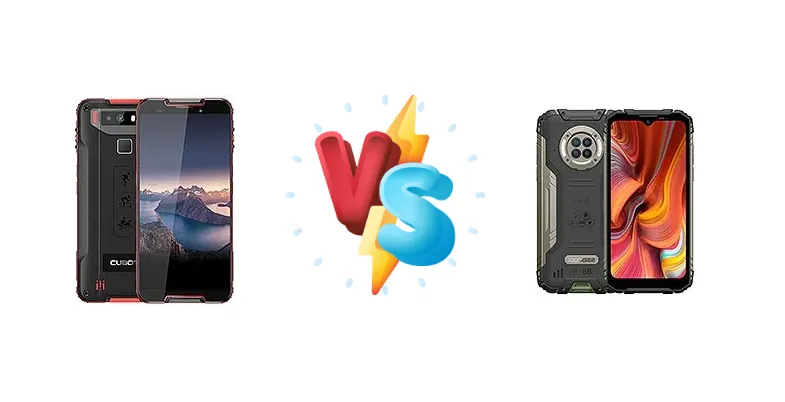
The rugged smartphone market is booming, offering durable devices at increasingly accessible price points. The Cubot Quest and Doogee S96 Pro both aim to deliver toughness without breaking the bank, but they take drastically different approaches to performance. This comparison dissects their core components to determine which phone best suits your needs, focusing on the significant chipset disparity.
🏆 Quick Verdict
For the average user prioritizing responsiveness and gaming, the Doogee S96 Pro is the clear winner. Its Helio G90 chipset offers a substantial performance uplift over the Cubot Quest’s Helio P22, justifying the price difference. However, the Quest remains a viable option for basic tasks and users on a very tight budget.
| Network |
|---|
| 2G bands | GSM 850 / 900 / 1800 / 1900 | GSM 850 / 900 / 1800 / 1900 |
| 3G bands | HSDPA 850 / 900 / 1700(AWS) / 1900 / 2100 | HSDPA 800 / 850 / 900 / 1700(AWS) / 1900 / 2100 |
| 4G bands | 1, 2, 3, 4, 5, 7, 8, 12, 17, 20 | 1, 2, 3, 4, 5, 7, 8, 12, 13, 17, 18, 19, 20, 25, 26, 28, 38, 40, 66 |
| Speed | HSPA, LTE | HSPA, LTE |
| Technology | GSM / HSPA / LTE | GSM / CDMA / HSPA / LTE |
| Launch |
|---|
| Announced | 2020. Released 2020 | 2020, October 26. Released 2020, November |
| Status | Discontinued | Discontinued |
| Body |
|---|
| Dimensions | 157 x 73.7 x 8.8 mm (6.18 x 2.90 x 0.35 in) | 167 x 81.4 x 15.5 mm (6.57 x 3.20 x 0.61 in) |
| SIM | Nano-SIM + Nano-SIM | Nano-SIM + Nano-SIM |
| Weight | 216 g (7.62 oz) | 310 g (10.93 oz) |
| Display |
|---|
| Protection | Corning Gorilla Glass 5 | Corning Gorilla Glass |
| Resolution | 720 x 1440 pixels, 18:9 ratio (~293 ppi density) | 720 x 1520 pixels, 19:9 ratio (~270 ppi density) |
| Size | 5.5 inches, 78.1 cm2 (~67.5% screen-to-body ratio) | 6.22 inches, 96.6 cm2 (~71.0% screen-to-body ratio) |
| Type | IPS LCD | IPS LCD |
| Platform |
|---|
| CPU | Octa-core (4x2.0 GHz Cortex-A53 & 4x1.5 GHz Cortex-A53) | Octa-core (2x2.0 GHz Cortex-A76 & 6x2.0 GHz Cortex-A55) |
| Chipset | Mediatek MT6762 Helio P22 (12 nm) | Mediatek MT6785 Helio G90 (12 nm) |
| GPU | PowerVR GE8320 | Mali-G76 MC4 |
| OS | Android 9.0 (Pie) | Android 10 |
| Memory |
|---|
| Card slot | microSDXC (uses shared SIM slot) | microSDXC (dedicated slot) |
| Internal | 64GB 4GB RAM | 128GB 8GB RAM |
| Main Camera |
|---|
| Dual | 12 MP, f/1.8, (wide), 1/2.9", PDAF
2 MP | - |
| Features | Dual-LED flash | Quad-LED flash, HDR, panorama |
| Quad | - | 48 MP, f/1.8, (wide), PDAF
8 MP, f/2.2, 130˚, (ultrawide)
20 MP, f/2.8, (night vision), 4 infrared night vision lights
2 MP (macro) |
| Video | Yes | 1080p |
| Selfie camera |
|---|
| Single | 8 MP | 16 MP, f/2.0, (wide) |
| Video | Yes | 1080p |
| Sound |
|---|
| 35mm jack | Unspecified | Yes |
| Loudspeaker | Yes | Yes |
| Comms |
|---|
| Bluetooth | 4.2, A2DP | 5.0, A2DP, LE |
| NFC | Yes | Yes |
| Positioning | GPS | GPS, GLONASS, BDS, GALILEO |
| Radio | Unspecified | FM radio |
| USB | USB Type-C | USB Type-C 2.0, OTG |
| WLAN | Wi-Fi 802.11 a/b/g/n | Wi-Fi 802.11 a/b/g/n/ac, dual-band |
| Features |
|---|
| Sensors | Fingerprint (rear-mounted), accelerometer, gyro, proximity, compass | Fingerprint (side-mounted), accelerometer, gyro, proximity, compass |
| Battery |
|---|
| Charging | - | 24W wired
10W wireless |
| Type | 4000 mAh | 6350 mAh |
| Misc |
|---|
| Colors | Red/Black, Black | Black, Orange, Green |
| Price | - | About 280 EUR |
Cubot Quest
- Highly affordable price point
- Rugged build quality
- Suitable for basic smartphone tasks
- Outdated Helio P22 chipset
- Limited gaming performance
- Likely slower charging speeds
Doogee S96 Pro
- Powerful Helio G90 chipset
- Faster 24W wired and 10W wireless charging
- Improved gaming experience
- Higher price compared to the Cubot Quest
- May have a less durable build than some ultra-rugged phones
- Software updates may be infrequent
Display Comparison
Neither device’s display specifications are provided, so a direct comparison is limited. However, given the S96 Pro’s positioning as a more premium device, it likely features a higher quality panel with better color accuracy and potentially higher brightness. The Quest, targeting a lower price point, likely utilizes a more basic LCD. Bezels are expected to be larger on the Quest, reflecting its budget nature. PWM dimming rates are unknown, but a higher rate on the S96 Pro would be preferable for users sensitive to flicker.
Camera Comparison
Without detailed camera specifications, a precise comparison is difficult. However, the S96 Pro, being the more expensive device, likely features a larger main sensor and more sophisticated image processing algorithms. The Quest likely relies on a more basic camera setup. The presence of OIS (Optical Image Stabilization) is unknown for both, but more probable on the S96 Pro. The inclusion of a 2MP macro camera on either device is largely a marketing gimmick, offering limited practical benefit due to the small sensor size and lack of detail. Image quality will likely be noticeably better on the S96 Pro, particularly in low-light conditions.
Performance
The performance gap between these two phones is substantial. The Doogee S96 Pro’s MediaTek Helio G90 utilizes Cortex-A76 performance cores alongside Cortex-A55 efficiency cores, a significant architectural leap over the Cubot Quest’s Helio P22, which relies solely on Cortex-A53 cores. The G90’s CPU offers a noticeable improvement in single-core and multi-core performance, translating to faster app loading times and smoother multitasking. The G90 also boasts a more capable Mali-G76 GPU, enabling a far superior gaming experience compared to the P22’s Mali-T720 MP3. While both chipsets are fabricated on a 12nm process, the G90’s architecture is more efficient, potentially leading to better sustained performance under load. The S96 Pro’s 24W charging is a significant advantage, while the Quest’s charging speed is unknown but likely slower.
Battery Life
Battery capacity is not specified for either device. However, the Doogee S96 Pro’s 24W wired and 10W wireless charging capabilities provide a significant advantage in terms of convenience and recharge speed. The Cubot Quest’s charging speed is unknown, but is likely considerably slower. Even with a similar battery capacity, the S96 Pro’s more efficient chipset could translate to longer real-world battery life, especially during demanding tasks like gaming. The faster charging also mitigates any potential battery life differences.
Buying Guide
Buy the Cubot Quest if you need a highly affordable, durable phone primarily for calls, texts, and light social media use. Its focus is on longevity and basic functionality. Buy the Doogee S96 Pro if you prefer a more responsive experience, enjoy mobile gaming, and value faster charging capabilities. The G90 chipset provides a significant performance boost for demanding applications.
Frequently Asked Questions
❓ Will the Doogee S96 Pro handle demanding games like PUBG or Call of Duty Mobile smoothly?
The Helio G90 chipset in the Doogee S96 Pro is specifically designed for gaming. It should be capable of running PUBG and Call of Duty Mobile at medium to high settings with playable frame rates. However, sustained performance may be limited by thermal throttling, so extended gaming sessions might require some settings adjustments.
❓ Is the Cubot Quest suitable for someone who primarily uses their phone for calls, texts, and basic apps?
Yes, the Cubot Quest is well-suited for users with basic smartphone needs. Its Helio P22 chipset is sufficient for everyday tasks like making calls, sending texts, browsing the web, and using social media apps. However, it will struggle with more demanding applications or multitasking.
❓ Does the Doogee S96 Pro support fast software updates?
Doogee's track record for software updates is not as strong as some larger manufacturers. While the S96 Pro will likely receive security patches, major Android version updates may be infrequent or delayed. Users should not expect the same level of software support as a flagship device.