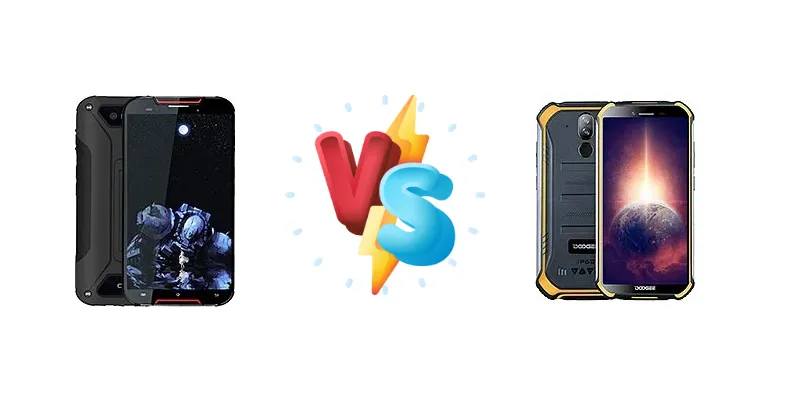
The sub-$200 smartphone market is fiercely competitive, and both the Cubot Quest Lite and Doogee S40 Pro aim to deliver value. While both devices target users needing a durable and affordable phone, they differ significantly in processing power. This comparison dives deep into the specifications to determine which phone offers the best experience for everyday tasks and light use.
🏆 Quick Verdict
For most users, the Doogee S40 Pro is the better choice. Its octa-core Helio A25 processor provides a noticeable performance boost over the Cubot Quest Lite’s quad-core Helio A22, resulting in smoother multitasking and app loading. While both phones are budget-focused, the S40 Pro offers a more responsive user experience.
| Network |
|---|
| 2G bands | GSM 850 / 900 / 1800 / 1900 | GSM 850 / 900 / 1800 / 1900 |
| 3G bands | HSDPA 900 / 2100 | HSDPA 900 / 2100 |
| 4G bands | 1, 3, 7, 8, 20 | 1, 3, 7, 8, 20 |
| Speed | HSPA, LTE | HSPA, LTE |
| Technology | GSM / HSPA / LTE | GSM / HSPA / LTE |
| Launch |
|---|
| Announced | 2020. Released 2020 | 2020, July 17. Released 2020, July |
| Status | Discontinued | Discontinued |
| Body |
|---|
| Dimensions | 152 x 74 x 8.8 mm (5.98 x 2.91 x 0.35 in) | 158.2 x 79.4 x 14.1 mm (6.23 x 3.13 x 0.56 in) |
| SIM | Nano-SIM + Nano-SIM | Nano-SIM + Nano-SIM |
| Weight | 219.7 g (7.76 oz) | 238 g (8.40 oz) |
| Display |
|---|
| Protection | Corning Gorilla Glass 5 | Corning Gorilla Glass |
| Resolution | 720 x 1280 pixels, 16:9 ratio (~294 ppi density) | 720 x 1440 pixels, 18:9 ratio (~295 ppi density) |
| Size | 5.0 inches, 68.9 cm2 (~61.3% screen-to-body ratio) | 5.45 inches, 76.7 cm2 (~61.0% screen-to-body ratio) |
| Type | IPS LCD | IPS LCD |
| Platform |
|---|
| CPU | Quad-core 2.0 GHz Cortex-A53 | Octa-core (4x1.8 GHz Cortex-A53 & 4x1.5 GHz Cortex-A53) |
| Chipset | Mediatek MT6761 Helio A22 (12 nm) | Mediatek MT6762 Helio A25 (12 nm) |
| GPU | PowerVR GE8320 | PowerVR GE8320 |
| OS | Android 9.0 (Pie) | Android 10 |
| Memory |
|---|
| Card slot | microSDXC (uses shared SIM slot) | microSDXC (uses shared SIM slot) |
| Internal | 32GB 3GB RAM | 64GB 4GB RAM |
| Main Camera |
|---|
| Dual | 13 MP, f/2.2, (wide), PDAF
2 MP | 13 MP, f/2.8, (wide)
Auxiliary lens |
| Features | Dual-LED flash | LED flash |
| Video | Yes | 1080p |
| Selfie camera |
|---|
| Single | 8 MP | 5 MP, f/2.8, (wide) |
| Video | Yes | Yes |
| Sound |
|---|
| 35mm jack | Unspecified | Yes |
| Loudspeaker | Yes | Yes |
| Comms |
|---|
| Bluetooth | 4.2, A2DP | 5.0, A2DP, LE |
| NFC | No | Yes |
| Positioning | GPS | GPS, GLONASS, GALILEO, BDS |
| Radio | Unspecified | FM radio |
| USB | USB Type-C | microUSB 2.0, OTG |
| WLAN | Wi-Fi 802.11 a/b/g/n | Wi-Fi 802.11 a/b/g/n |
| Features |
|---|
| Sensors | Fingerprint (rear-mounted), accelerometer, gyro, proximity, compass | Fingerprint (rear-mounted), accelerometer, proximity, compass |
| Battery |
|---|
| Charging | - | 10W wired |
| Type | 3000 mAh | 4650 mAh |
| Misc |
|---|
| Colors | Red/Black, Black | Black, Orange, Green |
| Price | - | About 150 EUR |
Cubot Quest Lite
- Lower price point
- Potentially lighter weight due to simpler components
- Basic functionality for essential tasks
- Significantly slower performance
- Limited multitasking capabilities
- Likely lower build quality
Doogee S40 Pro
- Octa-core processor for smoother performance
- Better multitasking capabilities
- More responsive user experience
- Slightly higher price
- Slow 10W charging
- May have a slightly larger footprint
Display Comparison
Neither Cubot nor Doogee provide detailed display specifications beyond resolution. Given the price point, both likely utilize IPS LCD panels. The absence of information regarding peak brightness or color gamut suggests neither phone will excel in outdoor visibility or color accuracy. Bezels are expected to be substantial on both devices, typical for this segment. The focus here is clearly on durability, not display quality.
Camera Comparison
Detailed camera specifications are lacking for both devices. It’s safe to assume both phones feature basic camera setups geared towards casual photography. Without sensor size or aperture information, it’s difficult to assess image quality. The presence of a 2MP macro camera on either device is largely a marketing tactic, as the image quality from such sensors is typically poor. The primary camera’s performance will be the deciding factor, but without further data, it’s impossible to declare a clear winner.
Performance
The core difference lies in the chipset. The Doogee S40 Pro’s Mediatek Helio A25 is an octa-core processor, featuring four Cortex-A53 cores clocked at 1.8 GHz and another four at 1.5 GHz. This contrasts with the Cubot Quest Lite’s Helio A22, a quad-core processor with four Cortex-A53 cores at 2.0 GHz. While the A22 has a higher clock speed per core, the A25’s eight cores provide superior multitasking capabilities. The A25’s architecture allows for more efficient handling of background processes and demanding applications, leading to a more fluid user experience. The S40 Pro’s 10W charging is standard for this price range, but doesn’t offer any speed advantage.
Battery Life
Battery capacity isn’t specified for either device, but given the target market, both likely house batteries in the 3000-4000 mAh range. The Doogee S40 Pro’s 10W charging is a standard, slow charging speed. Real-world battery life will depend heavily on usage patterns, but the more efficient Helio A25 in the S40 Pro may offer slightly better endurance despite potentially having a similar capacity battery.
Buying Guide
Buy the Cubot Quest Lite if you prioritize absolute affordability and only need a phone for basic communication – calls, texts, and very light web browsing. It’s a suitable option for first-time smartphone users or as a secondary device. Buy the Doogee S40 Pro if you want a more capable device for everyday tasks, occasional social media, and a slightly smoother overall experience. The S40 Pro’s extra processing cores make a tangible difference in responsiveness.
Frequently Asked Questions
❓ Will the Doogee S40 Pro handle popular social media apps like Facebook and Instagram without significant lag?
Yes, the Helio A25’s octa-core architecture in the Doogee S40 Pro is sufficient to run Facebook and Instagram smoothly, even with multiple apps open in the background. The Cubot Quest Lite’s Helio A22 may struggle with these apps, especially when multitasking.
❓ Is either phone suitable for playing demanding mobile games like PUBG or Call of Duty?
Neither phone is ideal for demanding games. The Helio A22 and A25 are entry-level processors and will likely only be able to run these games at the lowest graphics settings with significant frame rate drops. Expect a compromised gaming experience on both devices.
❓ What type of SIM cards do these phones support?
While not explicitly stated, both phones likely support dual SIM cards (Nano-SIM) given the market segment. However, confirm compatibility with your carrier before purchasing.
❓ How durable are these phones, and are they waterproof?
Both phones are marketed as 'rugged,' suggesting some level of drop and shock resistance. However, neither is likely to be fully waterproof. They likely have an IP rating for splash resistance, but submersion should be avoided.