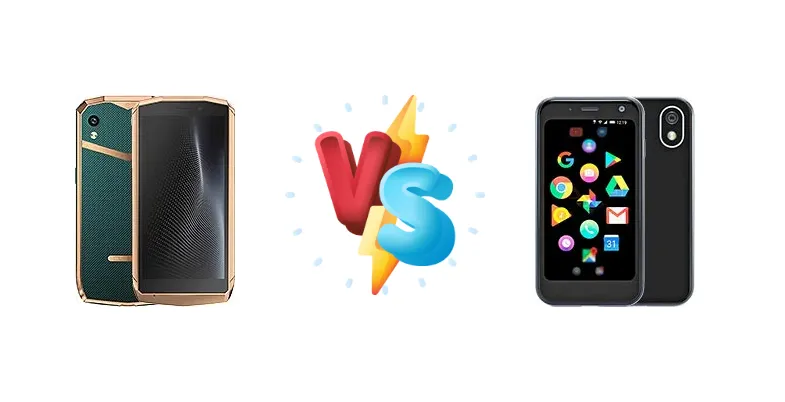
The ultra-compact smartphone niche is a curious one, often prioritizing portability over raw power. Both the Cubot Pocket and the Palm Phone PVG100 cater to this segment, but take drastically different approaches to internal hardware. The Cubot Pocket leverages a newer, more efficient Unisoc chipset, while the Palm Phone relies on the older, but octa-core, Snapdragon 435. This comparison dissects these choices to determine which device delivers the best experience for its target audience.
🏆 Quick Verdict
For the average user seeking a functional, modern compact phone, the Cubot Pocket emerges as the better choice. Its Unisoc Tiger T310, despite having fewer cores, benefits from a more advanced 12nm process, offering a more responsive experience and potentially better battery life than the Palm Phone's aging Snapdragon 435.
| Network |
|---|
| 2G bands | GSM 850 / 900 / 1800 / 1900 | GSM 850 / 900 / 1800 / 1900 |
| 3G bands | HSDPA 900 / 2100 | HSDPA 850 / 1700(AWS) / 1900 / 2100 |
| 4G bands | 1, 3, 5, 7, 8, 19, 20, 40 | 2, 4, 5, 12, 13, 17, 66 |
| Speed | HSPA, LTE | HSPA 42.2/5.76 Mbps, LTE Cat4 150/50 Mbps |
| Technology | GSM / HSPA / LTE | GSM / HSPA / LTE |
| Launch |
|---|
| Announced | 2022 | 2018, October. Released 2018, November |
| Status | Available. Released 2022 | Discontinued |
| Body |
|---|
| Build | - | Glass front (Gorilla Glass 3), glass back (Gorilla Glass 3), aluminum frame |
| Dimensions | 119 x 58 x 12.5 mm (4.69 x 2.28 x 0.49 in) | 96.6 x 50.6 x 7.4 mm (3.80 x 1.99 x 0.29 in) |
| SIM | Nano-SIM + Nano-SIM | Nano-SIM |
| Weight | 128 g (4.52 oz) | 62.5 g (2.22 oz) |
| | - | IP68 dust/water resistant (up to 1m for 30 min) |
| Display |
|---|
| Protection | - | Corning Gorilla Glass 3 |
| Resolution | 540 x 1080 pixels, 18:9 ratio (~302 ppi density) | 720 x 1280 pixels, 16:9 ratio (~445 ppi density) |
| Size | 4.0 inches, 41.3 cm2 (~59.8% screen-to-body ratio) | 3.3 inches, 30.0 cm2 (~61.4% screen-to-body ratio) |
| Type | IPS LCD | IPS LCD |
| Platform |
|---|
| CPU | Quad-core (1x2.0 GHz Cortex-A75 & 3x1.8 GHz Cortex-A55) | Octa-core (4x1.4 GHz & 4x1.1 GHz) |
| Chipset | Unisoc Tiger T310 (12 nm) | Qualcomm MSM8940 Snapdragon 435 (28 nm) |
| GPU | PowerVR GE8300 | Adreno 505 |
| OS | Android 11 | Android 8.1 (Oreo) |
| Memory |
|---|
| Card slot | microSDXC (uses shared SIM slot) | No |
| Internal | 64GB 4GB RAM | 32GB 3GB RAM |
| | - | eMMC 5.1 |
| Main Camera |
|---|
| Features | LED flash | LED flash, HDR |
| Single | 16 MP, (wide), AF | 12 MP, AF |
| Video | Yes | 720p@30fps |
| Selfie camera |
|---|
| Single | 5 MP | 8 MP |
| Video | Yes | 720p@30fps |
| Sound |
|---|
| 3.5mm jack | - | No |
| 35mm jack | No | No |
| Loudspeaker | Yes | Yes, with dual speakers |
| Comms |
|---|
| Bluetooth | 5.0, A2DP | 4.2, A2DP, LE |
| NFC | Yes | No |
| Positioning | GPS, GLONASS, GALILEO | GPS, GLONASS |
| Radio | Unspecified | No |
| USB | USB Type-C | USB Type-C 2.0 |
| WLAN | Wi-Fi 802.11 a/b/g/n/ac, dual-band | Wi-Fi 802.11 a/b/g/n, Wi-Fi Direct |
| Features |
|---|
| Sensors | Accelerometer, gyro, proximity, compass | Infrared Face ID, accelerometer, proximity, gyro, compass |
| Battery |
|---|
| Charging | - | Wired, 50% in 31 min, 100% in 68 min |
| Type | 3000 mAh | Li-Ion 800 mAh, non-removable |
| Misc |
|---|
| Colors | Black, Black/Red, Green/Gold | Gold, Titanium |
| Models | - | PVG100, PVG100E |
| Price | - | About 400 EUR |
| SAR EU | - | 0.98 W/kg (head) |
Cubot Pocket
- More efficient Unisoc Tiger T310 chipset
- Potentially better sustained performance
- Likely improved camera image processing
- Fewer CPU cores than the Palm Phone
- Limited information available on display quality
Palm Phone PVG100
- Octa-core processor (potentially better multitasking)
- Known charging times (50% in 31 min, 100% in 68 min)
- May be available at a lower price point
- Older, less efficient Snapdragon 435 chipset
- 28nm process leads to higher power consumption
- Likely inferior camera performance
Display Comparison
Neither device provides display specifications, but given their target market, we can assume both utilize relatively small LCD panels. The Palm Phone’s age suggests a lower peak brightness and potentially poorer color accuracy compared to what a modern Unisoc-powered device like the Cubot Pocket could achieve. The absence of high refresh rates is expected in this price bracket, but the Cubot Pocket’s newer chipset *could* support more advanced display features if implemented.
Camera Comparison
Without detailed camera specs, a direct comparison is difficult. However, the age of the Palm Phone suggests its camera system will likely be less capable than what’s achievable with a modern Unisoc chipset. Image processing algorithms have improved significantly in recent years, and the Cubot Pocket benefits from this advancement. We can assume the Cubot Pocket will deliver better image quality, particularly in low-light conditions, even with similar sensor sizes. The focus should be on the main sensor performance, as the inclusion of low-resolution auxiliary sensors (often found in budget phones) adds little value.
Performance
The core architectural difference is stark. The Cubot Pocket’s Unisoc Tiger T310 features a quad-core configuration with a Cortex-A75 performance core and three Cortex-A55 efficiency cores, built on a 12nm process. This contrasts with the Palm Phone’s Snapdragon 435, an octa-core (4x1.4 GHz & 4x1.1 GHz) processor fabricated on a significantly older 28nm node. While the Snapdragon 435 boasts more cores, the 12nm process of the Unisoc T310 offers superior power efficiency and transistor density, translating to better sustained performance and reduced thermal throttling. The Cortex-A75 core in the Cubot Pocket is also architecturally more advanced than the cores in the Snapdragon 435, providing a performance boost in single-threaded tasks.
Battery Life
Battery capacity data is unavailable for either device. However, the Unisoc T310’s 12nm process gives the Cubot Pocket a significant advantage in power efficiency. The Palm Phone’s Snapdragon 435, built on a 28nm process, will consume considerably more power for the same tasks. The Palm Phone’s charging data (50% in 31 min, 100% in 68 min) suggests a charging wattage around 10-15W. The Cubot Pocket’s charging speed is unknown, but a more efficient chipset could potentially deliver comparable battery life with a lower capacity battery and similar charging wattage.
Buying Guide
Buy the Cubot Pocket if you prioritize a smoother, more modern Android experience and value efficiency for all-day use. It’s ideal for users who need a secondary device for essential tasks like messaging and calls. Buy the Palm Phone PVG100 if you specifically need a phone that can run older applications that may not be optimized for newer chipsets, or if you find a significantly discounted price that outweighs its performance limitations.
Frequently Asked Questions
❓ Will the Snapdragon 435 in the Palm Phone struggle with modern app updates?
Yes, the Snapdragon 435 is an older chipset and may encounter compatibility issues with newer app updates that are optimized for more recent architectures. While basic apps will likely function, demanding applications or games may experience performance slowdowns or instability.
❓ Does the Unisoc Tiger T310 in the Cubot Pocket support widevine L1 for HD streaming?
While not explicitly stated, Unisoc chipsets in this class often include Widevine L1 support, enabling HD streaming from services like Netflix and Amazon Prime Video. However, it's crucial to verify this functionality through user reports or official documentation before purchasing if HD streaming is a priority.
❓ Is the difference in core count (quad-core vs octa-core) significant in real-world usage?
Not necessarily. The architectural advantages of the Cubot Pocket’s Cortex-A75 core and the efficiency of the 12nm process largely offset the Palm Phone’s higher core count. In most everyday tasks, the difference will be minimal, and the Cubot Pocket may even feel more responsive due to better thermal management.