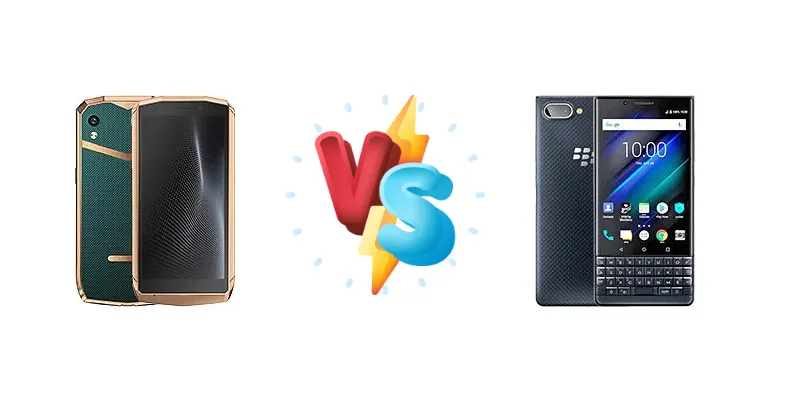
The smartphone landscape is diverse, but often dominated by flagship prices. The Cubot Pocket and BlackBerry KEY2 LE represent different approaches to value. The Cubot Pocket aims for affordability with a modern chipset, while the BlackBerry KEY2 LE offers a unique experience centered around its physical keyboard and a more established, though older, platform. This comparison dissects their strengths and weaknesses to help you decide which best suits your needs.
🏆 Quick Verdict
For the average user prioritizing raw performance and modern software support, the Cubot Pocket offers a better value proposition. Its Unisoc Tiger T310 chipset, despite being less renowned, provides a performance edge over the Snapdragon 636 in the KEY2 LE. However, the KEY2 LE remains a compelling choice for those who specifically desire a physical keyboard and BlackBerry's security features.
| Network |
|---|
| 2G bands | GSM 850 / 900 / 1800 / 1900 | GSM 850 / 900 / 1800 / 1900 |
| 3G bands | HSDPA 900 / 2100 | HSDPA 850 / 900 / 1700(AWS) / 1900 / 2100 |
| 4G bands | 1, 3, 5, 7, 8, 19, 20, 40 | 1, 2, 3, 4, 5, 7, 8, 12, 17, 19, 20, 26, 28, 32, 38, 40, 41 - BBE100-1, BBE100-4 DS (EU, Africa, AU) |
| Speed | HSPA, LTE | HSPA, LTE |
| Technology | GSM / HSPA / LTE | GSM / HSPA / LTE |
| | - | 1, 2, 3, 4, 5, 7, 8, 12, 13, 17, 20, 28, 29, 66, 38, 39, 40, 41 - BBE100-2, BBE100-5 DS (NA, LATAM) |
| Launch |
|---|
| Announced | 2022 | 2018, August. Released 2018, October |
| Status | Available. Released 2022 | Discontinued |
| Body |
|---|
| Build | - | Glass front (Gorilla Glass), plastic back, aluminum frame |
| Dimensions | 119 x 58 x 12.5 mm (4.69 x 2.28 x 0.49 in) | 150.3 x 71.8 x 8.4 mm (5.92 x 2.83 x 0.33 in) |
| Keyboard | - | QWERTY |
| SIM | Nano-SIM + Nano-SIM | · Nano-SIM· Nano-SIM + Nano-SIM |
| Weight | 128 g (4.52 oz) | 156 g (5.50 oz) |
| Display |
|---|
| Protection | - | Corning Gorilla Glass (unspecified version) |
| Resolution | 540 x 1080 pixels, 18:9 ratio (~302 ppi density) | 1080 x 1620 pixels, 3:2 ratio (~434 ppi density) |
| Size | 4.0 inches, 41.3 cm2 (~59.8% screen-to-body ratio) | 4.5 inches, 60.0 cm2 (~55.6% screen-to-body ratio) |
| Type | IPS LCD | IPS LCD |
| Platform |
|---|
| CPU | Quad-core (1x2.0 GHz Cortex-A75 & 3x1.8 GHz Cortex-A55) | Octa-core (4x1.8 GHz Kryo 260 Gold & 4x1.6 GHz Kryo 260 Silver) |
| Chipset | Unisoc Tiger T310 (12 nm) | Qualcomm SDM636 Snapdragon 636 (14 nm) |
| GPU | PowerVR GE8300 | Adreno 509 |
| OS | Android 11 | Android 8.1 (Oreo) |
| Memory |
|---|
| Card slot | microSDXC (uses shared SIM slot) | microSDXC (uses shared SIM slot) |
| Internal | 64GB 4GB RAM | 32GB 4GB RAM, 64GB 4GB RAM |
| | - | eMMC 5.1 |
| Main Camera |
|---|
| Dual | - | 13 MP, f/2.2, 1/3.1", 1.12µm, PDAF
Auxiliary lens |
| Features | LED flash | Dual-LED dual-tone flash, HDR, panorama |
| Single | 16 MP, (wide), AF | - |
| Video | Yes | 4K@30fps, 1080p@30fps |
| Selfie camera |
|---|
| Single | 5 MP | 8 MP |
| Video | Yes | 1080p@30fps |
| Sound |
|---|
| 3.5mm jack | - | Yes |
| 35mm jack | No | Yes |
| Loudspeaker | Yes | Yes |
| Comms |
|---|
| Bluetooth | 5.0, A2DP | 5.0, A2DP, LE, EDR |
| NFC | Yes | Yes |
| Positioning | GPS, GLONASS, GALILEO | GPS, GLONASS |
| Radio | Unspecified | FM radio |
| USB | USB Type-C | USB Type-C 2.0, OTG |
| WLAN | Wi-Fi 802.11 a/b/g/n/ac, dual-band | Wi-Fi 802.11 а/b/g/n/ac, dual-band, Wi-Fi Direct |
| Features |
|---|
| Sensors | Accelerometer, gyro, proximity, compass | Fingerprint (front-mounted), accelerometer, proximity, compass |
| Battery |
|---|
| Type | 3000 mAh | Li-Ion 3000 mAh, non-removable |
| Misc |
|---|
| Colors | Black, Black/Red, Green/Gold | Slate, Champagne, Atomic |
| Models | - | BBE100-4, BBE100-5, BBE100-1, BBE100-2 |
| Price | - | About 440 EUR |
| SAR | - | 1.01 W/kg (head) 1.17 W/kg (body) |
| SAR EU | - | 0.78 W/kg (head) 1.61 W/kg (body) |
| Tests |
|---|
| Performance | - |
AnTuTu: 116764 (v7)
GeekBench: 4965 (v4.4) |
Cubot Pocket
- Potentially better single-core performance with Unisoc T310
- Likely more affordable price point
- Modern chipset architecture (Cortex-A75)
- Limited brand recognition and software support
- Unknown camera and display specifications
BlackBerry KEY2 LE
- Unique physical keyboard for enhanced productivity
- BlackBerry's security features and software
- Compact and ergonomic design
- Older Snapdragon 636 chipset
- Smaller display size
- Limited software updates and potential security vulnerabilities
Display Comparison
Neither device boasts a cutting-edge display. The Cubot Pocket's display specifications are unavailable, but given its price point, it likely utilizes an IPS LCD panel. The BlackBerry KEY2 LE features a 4.5-inch IPS LCD display. The KEY2 LE's smaller size and lower resolution (1080 x 1620) result in a higher pixel density, potentially offering sharper text, but the overall viewing experience is constrained by the smaller screen real estate. Both lack high refresh rates or advanced features like LTPO, focusing on basic functionality.
Camera Comparison
Camera details for the Cubot Pocket are unavailable, making a direct comparison difficult. The BlackBerry KEY2 LE features a dual 12MP rear camera setup. While the megapixel count is respectable, the image processing capabilities of the Snapdragon 636's ISP are dated compared to what modern chipsets offer. Expect decent performance in good lighting conditions, but struggles in low-light scenarios. Without specific camera specs for the Cubot Pocket, it's reasonable to assume its camera performance will be comparable, leaning towards similar limitations.
Performance
The core difference lies in the chipsets. The Cubot Pocket's Unisoc Tiger T310 (12nm) features a quad-core configuration with a Cortex-A75 prime core clocked at 2.0 GHz, paired with three Cortex-A55 efficiency cores. This architecture, while newer, is less proven than the Qualcomm Snapdragon 636 (14nm) in the KEY2 LE, which utilizes an octa-core setup (4x1.8 GHz Kryo 260 Gold & 4x1.6 GHz Kryo 260 Silver). The Snapdragon 636's eight cores offer potential advantages in multi-threaded tasks, but the T310's more modern Cortex-A75 core provides a significant single-core performance boost. The 12nm process of the T310 *should* offer better power efficiency than the 14nm Snapdragon 636, potentially leading to longer battery life under similar workloads. However, real-world performance will depend heavily on software optimization.
Battery Life
Battery capacity for the Cubot Pocket is unknown. The BlackBerry KEY2 LE packs a 3000 mAh battery. Coupled with the Snapdragon 636's efficiency, the KEY2 LE can deliver all-day battery life for moderate users. However, the smaller screen and less demanding software on the Cubot Pocket, combined with the potentially more efficient Unisoc T310, could result in comparable or even better battery life, depending on usage patterns. Charging speeds for both devices are likely to be relatively slow, given their budget-oriented nature.
Buying Guide
Buy the Cubot Pocket if you need a functional, modern Android experience at the lowest possible price point and prioritize performance for everyday tasks and light gaming. Buy the BlackBerry KEY2 LE if you absolutely require a physical QWERTY keyboard for efficient typing, value BlackBerry's security software, and are comfortable with an older Android version and potentially limited software updates. The KEY2 LE is for productivity-focused users who prioritize tactile input.
Frequently Asked Questions
❓ Is the BlackBerry KEY2 LE still secure in 2024, given its age?
While BlackBerry historically prioritized security, the KEY2 LE runs an older version of Android and may no longer receive critical security updates. This makes it potentially vulnerable to modern threats. Users concerned about security should exercise caution and consider alternative devices with ongoing support.
❓ How does the Unisoc Tiger T310 perform in gaming compared to the Snapdragon 636?
The Unisoc Tiger T310's Cortex-A75 core provides a strong single-core performance advantage, which can benefit less-optimized mobile games. However, the Snapdragon 636's Adreno 509 GPU is more mature and generally offers better sustained graphics performance. Expect playable frame rates on both devices for most games, but the Snapdragon 636 may handle graphically demanding titles more smoothly.
❓ Can I easily find replacement parts or get repairs for the BlackBerry KEY2 LE?
Finding replacement parts for the BlackBerry KEY2 LE is becoming increasingly difficult due to its age and limited production. Repair options are also becoming scarce, potentially leading to higher repair costs or the inability to repair the device at all.