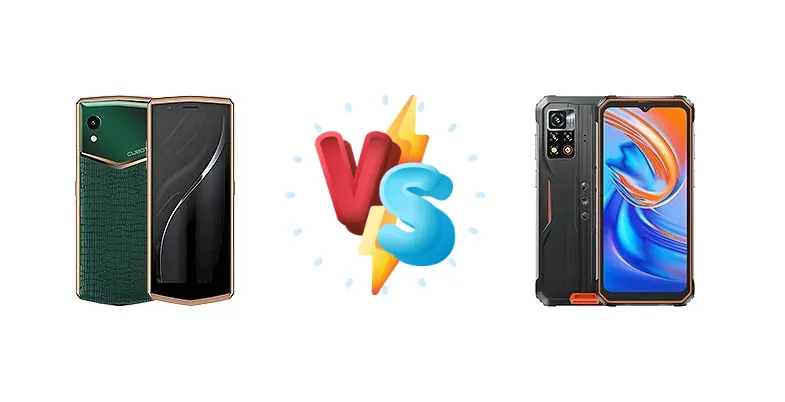
The Cubot Pocket 3 and Blackview BV9200 represent distinct approaches to the budget smartphone market. The Pocket 3 aims for a compact, gaming-focused experience, while the BV9200 prioritizes durability and fast charging. This comparison dissects their key specifications to determine which device delivers the most compelling package for your needs.
🏆 Quick Verdict
For most users, the Blackview BV9200 emerges as the stronger choice. Its Helio G96 chipset provides a noticeable performance uplift over the Pocket 3’s G85, coupled with significantly faster 66W wired and 30W wireless charging. While the Pocket 3 offers a more compact form factor, the BV9200’s broader feature set justifies the slight price premium.
| Network |
|---|
| 2G bands | GSM 850 / 900 / 1800 / 1900 | GSM 850 / 900 / 1800 / 1900 |
| 3G bands | HSDPA 900 / 2100 | HSDPA 850 / 900 / 1700(AWS) / 1900 / 2100 |
| 4G bands | 1, 3, 5, 7, 8, 19, 20, 40 | 1, 2, 3, 4, 5, 7, 8, 12, 13, 17, 18, 19, 20, 25, 26, 28, 34, 38, 39, 40, 41, 66 |
| Speed | HSPA, LTE | HSPA, LTE |
| Technology | GSM / HSPA / LTE | GSM / CDMA / HSPA / LTE |
| | - | CDMA 800 / 1900 |
| Launch |
|---|
| Announced | 2022 | 2022, December 28 |
| Status | Available. Released 2022 | Available. Released 2023, January 09 |
| Body |
|---|
| Dimensions | 133.2 x 58.5 x 12.3 mm (5.24 x 2.30 x 0.48 in) | 174.5 x 81.8 x 13.6 mm (6.87 x 3.22 x 0.54 in) |
| SIM | Nano-SIM + Nano-SIM | Nano-SIM + Nano-SIM |
| Weight | 135 g (4.76 oz) | 310 g (10.93 oz) |
| | - | IP68/IP69K dust/water resistant (up to 1.5m for 30 min)
Drop-to-concrete resistance from up to 1.8m
MIL-STD-810H compliant |
| Display |
|---|
| Protection | - | Corning Gorilla Glass 5 |
| Resolution | 480 x 1170 pixels (~281 ppi density) | 1080 x 2408 pixels, 20:9 ratio (~400 ppi density) |
| Size | 4.5 inches, 45.9 cm2 (~58.9% screen-to-body ratio) | 6.6 inches, 104.9 cm2 (~73.5% screen-to-body ratio) |
| Type | TFT | IPS LCD, 120Hz |
| Platform |
|---|
| CPU | Octa-core (2x2.0 GHz Cortex-A75 & 6x1.8 GHz Cortex-A55) | Octa-core (2x2.05 GHz Cortex-A76 & 6x2.0 GHz Cortex-A55) |
| Chipset | Mediatek MT6769CZ Helio G85 (12 nm) | Mediatek MT6781 Helio G96 (12 nm) |
| GPU | Mali-G52 MC2 | Mali-G52 MC2 |
| OS | Android 12 | Android 12, Doke-OS 3.1 |
| Memory |
|---|
| Card slot | No | microSDXC (dedicated slot) |
| Internal | 64GB 4GB RAM | 256GB 8GB RAM |
| | - | UFS 2.1 |
| Main Camera |
|---|
| Features | LED flash | LED flash, HDR, panorama |
| Single | 20 MP, (wide) | 16 MP, (wide), 1/3", 1.0µm |
| Triple | - | 50 MP, f/1.8, (wide), 1/2.76", 0.64µm, PDAF
8 MP, f/1.8, 120˚, (ultrawide), AF
Auxiliary lens |
| Video | Yes | 1440p@30fps, 1080p@30fps |
| Selfie camera |
|---|
| Single | 5 MP | 16 MP, f/2.0, (wide), 1/3", 1.0µm |
| Video | Yes | 1080p |
| Sound |
|---|
| 3.5mm jack | - | No |
| 35mm jack | Unspecified | No |
| Loudspeaker | Yes | Yes, with dual speakers |
| Comms |
|---|
| Bluetooth | 5.0, A2DP | 5.2, A2DP, LE |
| NFC | Yes | Yes |
| Positioning | GPS, GLONASS, GALILEO, BDS | GPS, GLONASS, GALILEO, BDS |
| Radio | Unspecified | FM radio |
| USB | USB Type-C | USB Type-C, OTG |
| WLAN | Wi-Fi 802.11 a/b/g/n/ac, dual-band | Wi-Fi 802.11 a/b/g/n/ac, dual-band |
| Features |
|---|
| Sensors | Accelerometer, gyro, proximity, compass | Fingerprint (side-mounted), accelerometer, gyro, proximity, compass, barometer |
| Battery |
|---|
| Charging | - | 66W wired
30W wireless |
| Type | 3000 mAh, removable | 5000 mAh |
| Misc |
|---|
| Colors | Blue, Black, Green | Black, Orange, Green |
| Price | - | About 200 EUR |
Cubot Pocket 3
- Compact and pocketable design
- Potentially lower price point
- Gaming-focused chipset (Helio G85)
- Limited display information
- Slower charging speeds (likely)
- Less powerful processor than BV9200
Blackview BV9200
- Faster Helio G96 processor
- 66W wired and 30W wireless charging
- Brighter and higher contrast display
- Larger and heavier form factor
- Potentially higher price
- Rugged design may not appeal to all users
Display Comparison
The Blackview BV9200 boasts a measured peak brightness of 481 nits and a 1423:1 contrast ratio, suggesting a more vibrant and visible display in outdoor conditions compared to the Cubot Pocket 3, which lacks published display specifications. While the Pocket 3’s size is a key selling point, the BV9200’s superior contrast and brightness will provide a better viewing experience for media consumption and gaming. The absence of detailed display specs for the Pocket 3 makes a direct comparison difficult, but the BV9200 clearly has the advantage based on available data.
Camera Comparison
Without detailed camera specifications for either device beyond the chipsets, a precise comparison is challenging. However, given the BV9200’s positioning as a more feature-rich device, it’s reasonable to assume a more sophisticated camera system. The presence of a larger sensor and potentially optical image stabilization (OIS) – common in phones at this price point – would give the BV9200 an edge in low-light photography and video recording. The Pocket 3 likely relies on software processing to compensate for a potentially less capable sensor.
Performance
The Blackview BV9200’s Mediatek Helio G96 chipset represents a clear upgrade over the Cubot Pocket 3’s Helio G85. The G96 utilizes two Cortex-A76 cores clocked at 2.05 GHz, compared to the G85’s Cortex-A75 cores at 2.0 GHz. This architectural improvement, combined with the slightly higher clock speed, translates to faster application loading times and smoother multitasking. While both chips are 12nm, the G96’s more efficient core design should result in better sustained performance under load. The BV9200 is the better choice for users who prioritize responsiveness and gaming performance.
Battery Life
The Blackview BV9200’s charging capabilities are a standout feature, offering 66W wired charging and 30W wireless charging. This allows for significantly faster top-ups compared to the Cubot Pocket 3, which lacks wireless charging and likely has a slower wired charging speed (specifications unavailable). While battery capacity isn’t specified for either device, the BV9200’s rapid charging mitigates concerns about battery life, allowing users to quickly replenish power throughout the day. The convenience of wireless charging is also a significant advantage.
Buying Guide
Buy the Cubot Pocket 3 if you prioritize extreme portability and a smaller phone size for one-handed use, and your gaming needs are limited to casual titles. Buy the Blackview BV9200 if you need a phone that can withstand harsh conditions, demand faster charging speeds, and want a more capable processor for demanding applications and gaming.
Frequently Asked Questions
❓ Does the Blackview BV9200’s Helio G96 chip get excessively hot during prolonged gaming sessions?
While the Helio G96 is a capable processor, it can generate heat under sustained load. However, Blackview typically incorporates thermal management solutions in their rugged devices, such as heat pipes or graphite sheets, to mitigate throttling and maintain stable performance during gaming. User reports suggest the BV9200 handles demanding games reasonably well, though extended sessions may result in some temperature increase.
❓ Is the Cubot Pocket 3’s compact size practical for everyday use, or is it too small for comfortable typing and media consumption?
The Cubot Pocket 3’s primary appeal is its extremely compact form factor. While ideal for one-handed operation and portability, the smaller screen size may present challenges for users accustomed to larger displays. Typing can be more cramped, and media consumption may feel less immersive. It’s best suited for users who prioritize portability above all else.
❓ How long does it realistically take to fully charge the Blackview BV9200 from 0% using the 66W charger?
Blackview claims a full charge from 0% to 100% with the 66W charger takes approximately 46 minutes. Real-world results may vary slightly depending on usage during charging, but it’s significantly faster than standard charging speeds, offering a convenient top-up time for users on the go.