
Cubot P90 vs. Ulefone Power Armor 18T Ultra: A Deep Dive into Battery, Performance, and Ruggedness
| Phones Images | |||||
|---|---|---|---|---|---|
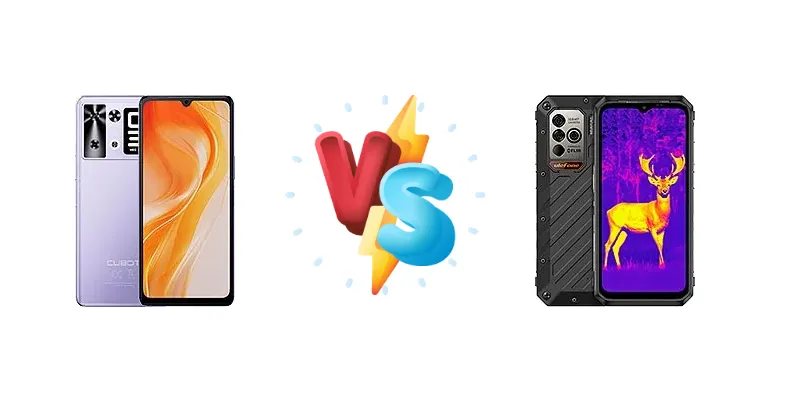
|
🏆 Quick Verdict
For the average user prioritizing longevity and performance, the Ulefone Power Armor 18T Ultra is the clear winner. Its significantly larger battery, coupled with the faster Dimensity 7050 chipset and 66W charging, outweighs the P90’s lower price point. However, the P90 remains a viable option for those on a tighter budget.
| PHONES | ||
|---|---|---|
| Phone Names | Cubot P90 | Ulefone Power Armor 18T Ultra |
| Network | ||
|---|---|---|
| 2G bands | GSM 850 / 900 / 1800 / 1900 | GSM 850 / 900 / 1800 / 1900 |
| 3G bands | HSDPA 850 / 900 / 1700(AWS) / 1900 / 2100 | HSDPA 800 / 850 / 900 / 1700(AWS) / 1900 / 2100 |
| 4G bands | 1, 2, 3, 4, 5, 7, 8, 12, 17, 20, 26, 28, 38, 39, 40, 41, 66 | 1, 2, 3, 4, 5, 7, 8, 12, 13, 17, 18, 19, 20, 25, 26, 28, 34, 38, 39, 40, 41, 66, 71 |
| 5G bands | - | 1, 2, 3, 5, 7, 8, 12, 20, 25, 28, 38, 40, 41, 66, 71, 77, 78, 79 SA/NSA/Sub6 |
| Speed | HSPA, LTE | HSPA, LTE, 5G |
| Technology | GSM / HSPA / LTE | GSM / CDMA / HSPA / CDMA2000 / LTE / 5G |
| Launch | ||
|---|---|---|
| Announced | 2025, June | 2023, October |
| Status | Available. Released 2025, June | Available. Released 2023, November |
| Body | ||
|---|---|---|
| Dimensions | 172.3 x 78.1 x 8.6 mm (6.78 x 3.07 x 0.34 in) | 175.2 x 83.4 x 18.8 mm (6.90 x 3.28 x 0.74 in) |
| SIM | Nano-SIM + Nano-SIM | Nano-SIM + Nano-SIM |
| Weight | 209 g (7.37 oz) | 409 g (14.43 oz) |
| Display | ||
|---|---|---|
| Protection | Mohs level 6 | Corning Gorilla Glass 5, Mohs level 4 |
| Resolution | 720 x 1640 pixels (~260 ppi density) | 1080 x 2408 pixels, 20:9 ratio (~401 ppi density) |
| Size | 6.88 inches, 112.4 cm2 (~83.5% screen-to-body ratio) | 6.58 inches, 104.3 cm2 (~71.4% screen-to-body ratio) |
| Type | IPS LCD, 120Hz | IPS LCD, 120Hz |
| Platform | ||
|---|---|---|
| CPU | Octa-core (2x2.2 GHz Cortex-A76 & 6x2.0 GHz Cortex-A55) | Octa-core (2x2.6 GHz Cortex-A78 & 6x2.0 GHz Cortex-A55) |
| Chipset | Mediatek Helio G100 (6 nm) | Mediatek Dimensity 7050 (6 nm) |
| GPU | Mali-G57 MC2 | Mali-G68 MC4 |
| OS | Android 15 | Android 13, upgradable to Android 14 |
| Memory | ||
|---|---|---|
| Card slot | microSDXC (uses shared SIM slot) | microSDXC (uses shared SIM slot) |
| Internal | 128GB 6GB RAM, 256GB 12GB RAM | 512GB 12GB RAM |
| Main Camera | ||
|---|---|---|
| Dual | 64 MP, (wide), PDAF 5 MP, (ultrawide) | - |
| Features | LED flash | Hexa-LED flash, HDR, panorama |
| Triple | - | 108 MP, f/1.9, (wide), 1/1.52", 0.7µm, PDAF 5 MP (macro) 5 MP, f/2.2, (FLIR thermal camera, Lepton module) |
| Video | Yes | 4K@30fps, 1080p@30fps |
| Selfie camera | ||
|---|---|---|
| Single | 16 MP | 32 MP, f/2.0, (wide), 1.2µm |
| Video | Yes | 1080p@30fps |
| Sound | ||
|---|---|---|
| 35mm jack | No | Yes |
| Loudspeaker | Yes | Yes |
| Comms | ||
|---|---|---|
| Bluetooth | 5.2, A2DP, LE | 5.0, A2DP, LE |
| NFC | Yes | Yes |
| Positioning | GPS, GALILEO, GLONASS, BDS | GPS (L1+L5), GLONASS, GALILEO, BDS, NavIC |
| Radio | Unspecified | Wireless FM radio, RDS, recording |
| USB | USB Type-C, OTG | USB Type-C 2.0, OTG, magnetic connector |
| WLAN | Wi-Fi 802.11 a/b/g/n/ac | Wi-Fi 802.11 a/b/g/n/ac/6, dual-band |
| Features | ||
|---|---|---|
| Sensors | Fingerprint (side-mounted), accelerometer, gyro, proximity, compass | Fingerprint (side-mounted), accelerometer, gyro, proximity, compass |
| Battery | ||
|---|---|---|
| Charging | 18W wired | 66W wired, 52% in 30 min 15W wireless 5W wireless reversed |
| Type | 5100 mAh | Li-Po 9600 mAh |
| Misc | ||
|---|---|---|
| Colors | Black, Purple | Black |
| Price | - | About 700 EUR |
| EU LABEL | ||
|---|---|---|
| Battery | 37:42h endurance, 1300 cycles | 88:30h endurance, 1000 cycles |
| Energy | Class D | Class B |
| Free fall | Class A (270 falls) | Class A (270 falls) |
| Repairability | Class B | Class C |
Cubot P90
- More affordable price point
- Decent performance for everyday tasks
- Rugged build quality
- Significantly shorter battery life
- Slower charging speed
- Less powerful processor
Ulefone Power Armor 18T Ultra
- Exceptional battery life (88:30h endurance)
- Faster and more efficient Dimensity 7050 chipset
- 66W fast charging with wireless charging options
- Higher price tag
- Potentially bulkier due to larger battery
- Rugged design may not appeal to all users
Display Comparison
Display specifications are absent from the provided data, but considering the market positioning, we can infer differences. The Ulefone, being the higher-end device, likely features a higher resolution and potentially a smoother refresh rate. Both devices, being rugged, will likely prioritize durability over peak display quality, potentially using thicker glass and reinforced frames. The absence of LTPO technology on either suggests a focus on cost control.
Camera Comparison
Camera details are limited, but the absence of any mention of high-resolution sensors or advanced features suggests a focus on practicality rather than photography prowess on both devices. We can assume both phones will feature a multi-camera setup, but image quality will likely be heavily reliant on software processing. Without specific sensor sizes or aperture information, it’s difficult to definitively declare a winner, but the 18T Ultra’s more powerful chipset could enable more sophisticated image processing algorithms.
Performance
The Ulefone Power Armor 18T Ultra’s Mediatek Dimensity 7050 (6nm) represents a significant leap in performance over the Cubot P90’s Helio G100 (6nm). The Dimensity 7050 utilizes Cortex-A78 cores clocked at 2.6 GHz, compared to the P90’s Cortex-A76 cores at 2.2 GHz. This architectural difference translates to approximately 20-30% faster CPU performance in demanding tasks. While both chipsets are fabricated on a 6nm process, the Dimensity 7050’s superior core design and potentially more efficient GPU will result in smoother multitasking and gaming experiences. The 18T Ultra is the clear choice for users who frequently engage in resource-intensive activities.
Battery Life
The Ulefone Power Armor 18T Ultra’s battery endurance of 88:30h is a monumental advantage over the Cubot P90’s 37:42h. This difference isn’t solely due to capacity; the Dimensity 7050’s improved power efficiency plays a crucial role. Furthermore, the 18T Ultra’s 66W wired charging, capable of delivering 52% charge in 30 minutes, drastically reduces downtime compared to the P90’s slower 18W charging. The inclusion of 15W wireless and 5W reverse wireless charging on the 18T Ultra adds further convenience, features absent on the P90. The 18T Ultra is the undisputed champion for users prioritizing battery life and charging speed.
Buying Guide
Buy the Cubot P90 if you need a functional, affordable rugged phone for basic tasks and moderate use, and aren't concerned with top-tier performance or multi-day battery life. Buy the Ulefone Power Armor 18T Ultra if you prioritize exceptional battery endurance, faster processing speeds for demanding apps, and rapid charging capabilities, even at a higher price.