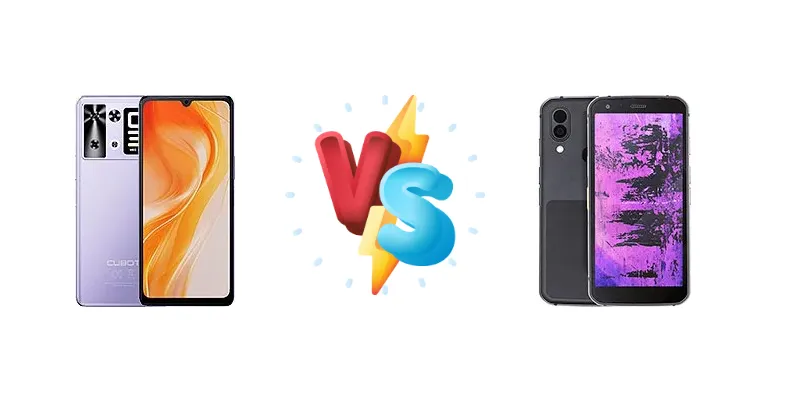
The smartphone market offers a wide spectrum of choices, from ultra-premium flagships to robust, affordable options. The Cubot P90 and Cat S62 Pro represent opposite ends of this spectrum – the P90 aiming for strong performance at a low price, while the S62 Pro focuses on extreme durability and reliability. This comparison dives deep into their specifications to determine which device best suits your needs.
🏆 Quick Verdict
For the average user prioritizing gaming and everyday tasks, the Cubot P90 emerges as the winner. Its newer Mediatek Helio G100 chipset, built on a 6nm process, delivers significantly better performance than the Cat S62 Pro’s aging Snapdragon 660. However, if ruggedness and long-term reliability in harsh environments are paramount, the Cat S62 Pro remains a compelling choice.
| Network |
|---|
| 2G bands | GSM 850 / 900 / 1800 / 1900 | GSM 850 / 900 / 1800 / 1900 |
| 3G bands | HSDPA 850 / 900 / 1700(AWS) / 1900 / 2100 | HSDPA 850 / 900 / 1700(AWS) / 1900 / 2100 |
| 4G bands | 1, 2, 3, 4, 5, 7, 8, 12, 17, 20, 26, 28, 38, 39, 40, 41, 66 | 1, 2, 3, 4, 5, 7, 8, 20, 28, 38, 40 |
| Speed | HSPA, LTE | HSPA 42.2/5.76 Mbps, LTE (2CA) Cat13 400/150 Mbps |
| Technology | GSM / HSPA / LTE | GSM / HSPA / LTE |
| Launch |
|---|
| Announced | 2025, June | 2020, June 28. Released 2020, August 17 |
| Status | Available. Released 2025, June | Discontinued |
| Body |
|---|
| Build | - | Glass front (Gorilla Glass 6), plastic back, aluminum frame |
| Dimensions | 172.3 x 78.1 x 8.6 mm (6.78 x 3.07 x 0.34 in) | 158.5 x 76.7 x 11.9 mm (6.24 x 3.02 x 0.47 in) |
| SIM | Nano-SIM + Nano-SIM | · Nano-SIM· Nano-SIM + Nano-SIM |
| Weight | 209 g (7.37 oz) | 248 g (8.75 oz) |
| | - | IP68/IP69 dust/water resistant (up to 1.5m for 35 mins)
Drop-to-concrete resistance from up to 1.8m
MIL-STD-810H compliant |
| Display |
|---|
| Protection | Mohs level 6 | Corning Gorilla Glass 6 |
| Resolution | 720 x 1640 pixels (~260 ppi density) | 1080 x 2160 pixels, 18:9 ratio (~424 ppi density) |
| Size | 6.88 inches, 112.4 cm2 (~83.5% screen-to-body ratio) | 5.7 inches, 83.8 cm2 (~69.0% screen-to-body ratio) |
| Type | IPS LCD, 120Hz | IPS LCD |
| Platform |
|---|
| CPU | Octa-core (2x2.2 GHz Cortex-A76 & 6x2.0 GHz Cortex-A55) | Octa-core (4x2.2 GHz Kryo 260 Gold & 4x1.8 GHz Kryo 260 Silver) |
| Chipset | Mediatek Helio G100 (6 nm) | Qualcomm SDM660 Snapdragon 660 (14 nm) |
| GPU | Mali-G57 MC2 | Adreno 512 |
| OS | Android 15 | Android 10 |
| Memory |
|---|
| Card slot | microSDXC (uses shared SIM slot) | microSDXC (dedicated slot) |
| Internal | 128GB 6GB RAM, 256GB 12GB RAM | 128GB 6GB RAM |
| Main Camera |
|---|
| Dual | 64 MP, (wide), PDAF
5 MP, (ultrawide) | 12 MP, f/1.8, (wide), 1/2.55", 1.4µm, dual pixel PDAF
FLIR thermal camera (Lepton 3.5 module) |
| Features | LED flash | Thermal imaging, heat palettes, temp. spot meter, LED flash |
| Video | Yes | 1080p@30fps, gyro-EIS |
| Selfie camera |
|---|
| Single | 16 MP | 8 MP |
| Video | Yes | 1080p@30fps |
| Sound |
|---|
| 3.5mm jack | - | No |
| 35mm jack | No | No |
| Loudspeaker | Yes | Yes |
| Comms |
|---|
| Bluetooth | 5.2, A2DP, LE | 5.0, A2DP, LE |
| NFC | Yes | Yes |
| Positioning | GPS, GALILEO, GLONASS, BDS | GPS, GLONASS, GALILEO, BDS |
| Radio | Unspecified | FM radio |
| USB | USB Type-C, OTG | USB Type-C 2.0, OTG |
| WLAN | Wi-Fi 802.11 a/b/g/n/ac | Wi-Fi 802.11 a/b/g/n/ac, dual-band, Wi-Fi Direct |
| Features |
|---|
| Sensors | Fingerprint (side-mounted), accelerometer, gyro, proximity, compass | Fingerprint (rear-mounted), accelerometer, gyro, proximity, compass |
| Battery |
|---|
| Charging | 18W wired | - |
| Type | 5100 mAh | Li-Ion 4000 mAh |
| Misc |
|---|
| Colors | Black, Purple | Black |
| Price | - | About 530 EUR |
| EU LABEL |
|---|
| Battery | 37:42h endurance, 1300 cycles | - |
| Energy | Class D | - |
| Free fall | Class A (270 falls) | - |
| Repairability | Class B | - |
Cubot P90
- Superior processing power with the Helio G100 chipset
- Excellent battery endurance and longevity (1300 cycles)
- More modern architecture for improved efficiency
- Likely less durable than the Cat S62 Pro
- May lack specialized rugged features
Cat S62 Pro
- Exceptional durability and ruggedness
- Reliable performance for basic tasks
- Designed for harsh environments
- Outdated Snapdragon 660 chipset
- Lower performance compared to the Cubot P90
Display Comparison
Neither device's display specifications are provided, so a direct comparison is limited. However, given the Cat S62 Pro's rugged focus, it likely prioritizes a durable, scratch-resistant panel over high refresh rates or peak brightness. The Cubot P90, targeting a broader market, may offer a more visually appealing display, potentially with higher resolution and color accuracy. The absence of LTPO technology on either device suggests neither will offer variable refresh rates for power saving.
Camera Comparison
Without detailed camera specifications, a comprehensive comparison is difficult. However, the market positioning suggests the Cubot P90 will likely feature a more versatile camera system, potentially with higher resolution sensors and more advanced image processing algorithms. The Cat S62 Pro’s camera is likely geared towards functional image capture rather than high-quality photography, prioritizing reliability over cutting-edge features. The inclusion of a 2MP macro lens on either device is likely a marketing tactic, offering limited practical benefit due to the small sensor size.
Performance
The core difference lies in the chipsets. The Cubot P90’s Mediatek Helio G100 (6nm) boasts a modern architecture – two Cortex-A76 cores clocked at 2.2 GHz and six Cortex-A55 cores at 2.0 GHz. This contrasts sharply with the Cat S62 Pro’s Qualcomm Snapdragon 660 (14nm), utilizing older Kryo 260 cores. The 6nm fabrication process of the Helio G100 translates to significantly improved power efficiency and thermal performance, allowing for sustained peak performance during demanding tasks. While both are octa-core CPUs, the architectural advancements in the G100 provide a clear advantage in processing speed and graphics capabilities.
Battery Life
The Cubot P90 claims an impressive 37:42h endurance and 1300 charge cycles, indicating a focus on long-term battery health and usability. While the Cat S62 Pro’s battery capacity isn’t specified, its rugged design likely incorporates a substantial battery to support its target user’s needs. The P90’s 18W wired charging is relatively standard, but the emphasis on 1300 cycles suggests a commitment to minimizing battery degradation over time. The Snapdragon 660’s less efficient architecture may necessitate a larger battery in the S62 Pro to achieve comparable endurance.
Buying Guide
Buy the Cubot P90 if you need a phone for mobile gaming, streaming, and general use, and value processing power and battery endurance. You're willing to trade some durability for a more modern chipset. Buy the Cat S62 Pro if you work in construction, outdoor professions, or frequently find yourself in environments where a phone is likely to be dropped, exposed to water, or subjected to extreme temperatures. Performance takes a backseat to survivability.
Frequently Asked Questions
❓ Will the Mediatek Helio G100 in the Cubot P90 struggle with graphically intensive games after prolonged use?
The Helio G100’s 6nm process and improved thermal efficiency should mitigate throttling during extended gaming sessions. While it’s not a flagship-level chipset, it’s capable of handling most mobile games at medium to high settings without significant performance drops, especially compared to the Snapdragon 660.
❓ Is the Cat S62 Pro’s ruggedness worth the performance trade-off if I only use my phone for calls, texts, and occasional photos?
If your primary use case is basic communication and you frequently work or spend time in challenging environments, the S62 Pro’s durability is a significant benefit. The Snapdragon 660 is sufficient for these tasks, and the peace of mind knowing your phone can withstand drops, water, and extreme temperatures may outweigh the performance difference.
❓ How does the charging speed of the Cubot P90 compare to other phones in its price range?
The 18W charging on the Cubot P90 is fairly standard for phones in its price bracket. It won't be the fastest charging experience available, but it's adequate for topping up the battery overnight or during downtime. The focus on 1300 charge cycles suggests a prioritization of long-term battery health over rapid charging speeds.