
Cubot P80 vs Samsung Galaxy A34: A Detailed Comparison for Budget-Conscious Buyers
| Phones Images | |||||
|---|---|---|---|---|---|
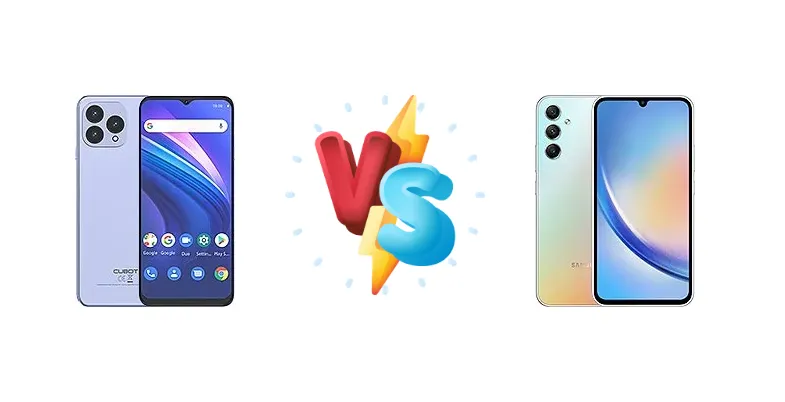
|
🏆 Quick Verdict
For the average user prioritizing a smoother overall experience and a brighter, more vibrant display, the Samsung Galaxy A34 is the better choice. Its Mediatek Dimensity 1080 chipset provides a noticeable performance edge, and the 1009 nit display offers superior visibility. However, the Cubot P80 presents a compelling option for those on a very tight budget.
| PHONES | ||
|---|---|---|
| Phone Names | Cubot P80 | Samsung Galaxy A34 |
| Network | ||
|---|---|---|
| 2G bands | GSM 850 / 900 / 1800 / 1900 | GSM 850 / 900 / 1800 / 1900 |
| 3G bands | HSDPA 800 / 850 / 900 / 1700(AWS) / 1900 / 2100 | HSDPA 850 / 900 / 1700(AWS) / 1900 / 2100 |
| 4G bands | 1, 2, 3, 4, 5, 7, 8, 12, 13, 17, 18, 19, 20, 26, 28, 38, 39, 40, 41, 66 | 1, 2, 3, 4, 5, 7, 8, 12, 17, 20, 26, 28, 32, 38, 40, 41, 66 |
| 5G bands | - | 1, 3, 7, 8, 20, 28, 38, 40, 41, 77, 78 SA/NSA/Sub6 |
| Speed | HSPA, LTE | HSPA, LTE, 5G |
| Technology | GSM / HSPA / LTE | GSM / HSPA / LTE / 5G |
| Launch | ||
|---|---|---|
| Announced | 2023 | 2023, March 14 |
| Status | Available. Released 2023 | Available. Released 2023, March 24 |
| Body | ||
|---|---|---|
| Build | - | Glass front (Gorilla Glass 5), plastic frame, plastic back |
| Dimensions | 165.8 x 75.8 x 9.8 mm (6.53 x 2.98 x 0.39 in) | 161.3 x 78.1 x 8.2 mm (6.35 x 3.07 x 0.32 in) |
| SIM | Nano-SIM + Nano-SIM | · Nano-SIM· Nano-SIM + Nano-SIM |
| Weight | 217 g (7.65 oz) | 199 g (7.02 oz) |
| - | IP67 dust/water resistant (up to 1m for 30 min) | |
| Display | ||
|---|---|---|
| Protection | - | Corning Gorilla Glass 5 |
| Resolution | 1080 x 2408 pixels, 20:9 ratio (~401 ppi density) | 1080 x 2340 pixels, 19.5:9 ratio (~390 ppi density) |
| Size | 6.58 inches, 104.3 cm2 (~83.0% screen-to-body ratio) | 6.6 inches, 106.9 cm2 (~84.9% screen-to-body ratio) |
| Type | IPS LCD | Super AMOLED, 120Hz, 1000 nits (HBM) |
| Platform | ||
|---|---|---|
| CPU | Octa-core (4x2.0 GHz Cortex-A73 & 4x2.0 GHz Cortex-A53) | Octa-core (2x2.6 GHz Cortex-A78 & 6x2.0 GHz Cortex-A55) |
| Chipset | Mediatek MT8788V/WA | Mediatek Dimensity 1080 (6 nm) |
| GPU | - | Mali-G68 MC4 |
| OS | Android 13 | Android 13, up to 4 major Android upgrades, One UI 6.1 |
| Memory | ||
|---|---|---|
| Card slot | microSDXC (uses shared SIM slot) | microSDXC (uses shared SIM slot) |
| Internal | 256GB 8GB RAM, 512GB 8GB RAM | 128GB 4GB RAM, 128GB 6GB RAM, 128GB 8GB RAM, 256GB 6GB RAM, 256GB 8GB RAM |
| Main Camera | ||
|---|---|---|
| Features | LED flash | LED flash, panorama, HDR |
| Triple | 48 MP, (wide), PDAF 2 MP (macro) 0.3 MP | 48 MP, f/1.8, 26mm (wide), 1/2.0", 0.8µm, PDAF, OIS 8 MP, f/2.2, 123˚, (ultrawide), 1/4.0", 1.12µm 5 MP (macro) |
| Video | Yes | 4K@30fps, 1080p@30/60fps, 720p@480fps |
| Selfie camera | ||
|---|---|---|
| Single | 24 MP | 13 MP, f/2.2, 26mm (wide), 1/3.1", 1.12µm |
| Video | Yes | 4K@30fps, 1080p@30fps |
| Sound | ||
|---|---|---|
| 3.5mm jack | - | No |
| 35mm jack | Unspecified | No |
| Loudspeaker | Yes | Yes, with stereo speakers |
| Comms | ||
|---|---|---|
| Bluetooth | 4.2, A2DP | 5.3, A2DP, LE |
| NFC | Yes | Yes (market/region dependent) |
| Positioning | GPS, GLONASS, GALILEO | GPS, GLONASS, GALILEO, BDS |
| Radio | Unspecified | No |
| USB | USB Type-C, OTG | USB Type-C 2.0, OTG |
| WLAN | Wi-Fi 802.11 a/b/g/n/ac, dual-band | Wi-Fi 802.11 a/b/g/n/ac, dual-band, Wi-Fi Direct |
| Features | ||
|---|---|---|
| Sensors | Fingerprint (side-mounted), accelerometer, gyro, proximity, compass | Fingerprint (under display, optical), accelerometer, gyro, compass |
| - | Virtual proximity sensing | |
| Battery | ||
|---|---|---|
| Charging | - | 25W wired |
| Type | 5200 mAh | Li-Ion 5000 mAh |
| Misc | ||
|---|---|---|
| Colors | Black, Blue, Purple, Pink, Light Blue | Lime, Graphite, Violet, Silver |
| Models | - | SM-A346E, SM-A346B, SM-A346B/DS, SM-A346B/DSN, SM-A346E/DS, SM-A346E/DSN, SM-A346M, SM-A346M/N, SM-A346M/DSN, SM-A3460 |
| Price | About 160 EUR | € 169.99 / $ 175.00 / £ 164.99 / ₹ 23,999 |
| SAR EU | - | 0.55 W/kg (head) 1.49 W/kg (body) |
| Tests | ||
|---|---|---|
| Battery life | - | Endurance rating 133h |
| Camera | - | Photo / Video |
| Display | - | Contrast ratio: Infinite (nominal) |
| Loudspeaker | - | -26.1 LUFS (Good) |
| Performance | - | AnTuTu: 472126 (v9) GeekBench: 2316 (v5.5), 2518 (v6) GFXBench: 23fps (ES 3.1 onscreen) |
Cubot P80
- Potentially lower price point
- Acceptable battery life (133h endurance)
- Functional for basic smartphone tasks
- Outdated chipset (MT8788V)
- Likely inferior display quality
- Limited performance for demanding apps
Samsung Galaxy A34
- Superior performance (Dimensity 1080)
- Brighter and more vibrant display (1009 nits)
- Faster charging (25W)
- Samsung’s software and support
- Higher price compared to Cubot P80
- May still exhibit some throttling under heavy load
- Software bloatware (typical of Samsung)
Display Comparison
The Samsung Galaxy A34 boasts a significantly brighter display, reaching a measured 1009 nits, compared to the Cubot P80’s unspecified brightness. This translates to better outdoor visibility, especially in direct sunlight. While the Cubot P80’s display specs are missing, the A34’s ‘Infinite’ contrast ratio (nominal) suggests a typical AMOLED panel, offering deep blacks and vibrant colors. The A34’s panel technology likely supports higher refresh rates, contributing to smoother scrolling and animations, a feature absent from the P80’s specifications. This difference in display quality will be most noticeable when consuming media or gaming.
Camera Comparison
Both devices offer photo and video capabilities, but detailed camera specifications are limited for the Cubot P80. The Samsung Galaxy A34 likely benefits from Samsung’s image processing algorithms, which are known for producing vibrant and detailed images. Without knowing the sensor size or aperture of the P80’s camera, it’s difficult to assess its low-light performance. The A34’s camera system likely includes Optical Image Stabilization (OIS), a feature that helps reduce blur in photos and videos, particularly in challenging lighting conditions. The presence of a 2MP macro camera on either device is largely inconsequential, as image quality is typically poor.
Performance
The Samsung Galaxy A34’s Mediatek Dimensity 1080 (6nm) chipset represents a substantial upgrade over the Cubot P80’s Mediatek MT8788V/WA. The Dimensity 1080 utilizes a more modern CPU architecture – 2x2.6 GHz Cortex-A78 cores and 6x2.0 GHz Cortex-A55 cores – compared to the P80’s 4x2.0 GHz Cortex-A73 and 4x2.0 GHz Cortex-A53 configuration. The Cortex-A78 cores in the A34 offer significantly improved single-core performance, crucial for responsive app launches and general usability. The 6nm manufacturing process of the Dimensity 1080 also contributes to better power efficiency and thermal management, reducing the likelihood of performance throttling during sustained workloads. The P80’s older chipset will struggle with demanding tasks and multitasking.
Battery Life
Both the Cubot P80 and Samsung Galaxy A34 share an endurance rating of 133 hours, suggesting comparable battery life under similar usage conditions. However, the Samsung Galaxy A34 supports 25W wired charging, allowing for faster replenishment of the battery compared to the Cubot P80, whose charging speed is unspecified. While both phones offer similar overall battery endurance, the A34’s faster charging capability provides a more convenient user experience, minimizing downtime.
Buying Guide
Buy the Cubot P80 if you need a functional smartphone for basic tasks like calling, texting, and light social media use, and your budget is extremely limited. You'll be making compromises on performance and display quality. Buy the Samsung Galaxy A34 if you prioritize a smoother user experience, better gaming performance, a brighter and more enjoyable display, and the reliability of the Samsung brand, even if it means spending a bit more.