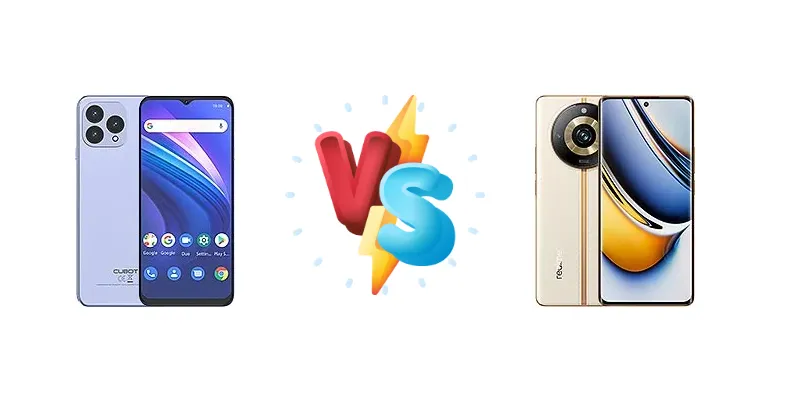
The smartphone market is crowded, but the Cubot P80 and Realme 11 Pro+ represent distinct approaches. The P80 aims for affordability, while the 11 Pro+ targets a more premium experience with faster charging and a more modern chipset. This comparison dissects their strengths and weaknesses to help you decide which best suits your needs.
🏆 Quick Verdict
For the average user prioritizing speed and convenience, the Realme 11 Pro+ is the clear winner. Its Dimensity 7050 chipset and 100W charging significantly outperform the Cubot P80’s older hardware. However, the P80 remains a viable option for budget-conscious buyers who don't demand peak performance.
| Network |
|---|
| 2G bands | GSM 850 / 900 / 1800 / 1900 | GSM 850 / 900 / 1800 / 1900 |
| 3G bands | HSDPA 800 / 850 / 900 / 1700(AWS) / 1900 / 2100 | HSDPA 850 / 900 / 2100 |
| 4G bands | 1, 2, 3, 4, 5, 7, 8, 12, 13, 17, 18, 19, 20, 26, 28, 38, 39, 40, 41, 66 | 1, 3, 5, 8, 28, 38, 40, 41 - India |
| 5G bands | - | 1, 3, 5, 8, 28, 40, 41, 77, 78 SA/NSA - International |
| Speed | HSPA, LTE | HSPA, LTE, 5G |
| Technology | GSM / HSPA / LTE | GSM / CDMA / HSPA / CDMA2000 / LTE / 5G |
| | - | CDMA2000 1x |
| Launch |
|---|
| Announced | 2023 | 2023, May 10 |
| Status | Available. Released 2023 | Available. Released 2023, May 15 |
| Body |
|---|
| Build | - | Glass front, leather or plastic back, plastic frame |
| Dimensions | 165.8 x 75.8 x 9.8 mm (6.53 x 2.98 x 0.39 in) | 161.6 x 73.9 x 8.2 mm or 8.7 mm |
| SIM | Nano-SIM + Nano-SIM | Nano-SIM + Nano-SIM |
| Weight | 217 g (7.65 oz) | 183 g or 189 g (6.46 oz) |
| Display |
|---|
| Resolution | 1080 x 2408 pixels, 20:9 ratio (~401 ppi density) | 1080 x 2412 pixels, 20:9 ratio (~394 ppi density) |
| Size | 6.58 inches, 104.3 cm2 (~83.0% screen-to-body ratio) | 6.7 inches, 108.0 cm2 (~90.5% screen-to-body ratio) |
| Type | IPS LCD | AMOLED, 1B colors, HDR10+, 120Hz, 950 nits (peak) |
| Platform |
|---|
| CPU | Octa-core (4x2.0 GHz Cortex-A73 & 4x2.0 GHz Cortex-A53) | Octa-core (2x2.6 GHz Cortex-A78 & 6x2.0 GHz Cortex-A55) |
| Chipset | Mediatek MT8788V/WA | Mediatek Dimensity 7050 (6 nm) |
| GPU | - | Mali-G68 MC4 |
| OS | Android 13 | Android 13, up to 2 major Android upgrades, Realme UI 5.0 |
| Memory |
|---|
| Card slot | microSDXC (uses shared SIM slot) | No |
| Internal | 256GB 8GB RAM, 512GB 8GB RAM | 256GB 8GB RAM, 256GB 12GB RAM, 512GB 12GB RAM, 1TB 12GB RAM |
| Main Camera |
|---|
| Features | LED flash | LED flash, HDR, panorama |
| Triple | 48 MP, (wide), PDAF
2 MP (macro)
0.3 MP | 200 MP, f/1.7, 23mm (wide), 1/1.4", 0.56µm, PDAF, OIS
8 MP, f/2.2, 16mm, 112˚ (ultrawide)
2 MP (macro) |
| Video | Yes | 4K@30fps, 1080p@30/60/120/480fps, 720p@960fps, gyro-EIS |
| Selfie camera |
|---|
| Features | - | Panorama |
| Single | 24 MP | 32 MP, f/2.5, 22mm (wide) |
| Video | Yes | 1080p@30fps |
| Sound |
|---|
| 3.5mm jack | - | No |
| 35mm jack | Unspecified | No |
| Loudspeaker | Yes | Yes, with stereo speakers |
| | - | 24-bit/192kHz audio |
| Comms |
|---|
| Bluetooth | 4.2, A2DP | 5.2, A2DP, LE, aptX HD |
| NFC | Yes | Yes |
| Positioning | GPS, GLONASS, GALILEO | GPS, GLONASS, GALILEO, BDS, QZSS, NavIC |
| Radio | Unspecified | No |
| USB | USB Type-C, OTG | USB Type-C 2.0 |
| WLAN | Wi-Fi 802.11 a/b/g/n/ac, dual-band | Wi-Fi 802.11 a/b/g/n/ac/6, dual-band |
| Features |
|---|
| Sensors | Fingerprint (side-mounted), accelerometer, gyro, proximity, compass | Fingerprint (under display, optical), accelerometer, gyro, proximity, compass |
| Battery |
|---|
| Charging | - | 100W wired |
| Type | 5200 mAh | 5000 mAh |
| Misc |
|---|
| Colors | Black, Blue, Purple, Pink, Light Blue | Astral Black, Sunrise Beige, Oasis Green |
| Models | - | RMX3740, RMX3741 |
| Price | About 160 EUR | € 399.90 / ₹ 27,990 |
Cubot P80
- Significantly lower price point
- Functional for basic smartphone tasks
- Potentially longer software support due to simpler hardware
- Outdated chipset and CPU architecture
- Likely slower charging speeds
- Inferior camera performance
Realme 11 Pro+
- Faster and more efficient Dimensity 7050 chipset
- Ultra-fast 100W charging
- Brighter and potentially smoother display
- Higher price tag
- Potentially more complex software updates
- May require more frequent charging despite good endurance
Display Comparison
The Realme 11 Pro+ boasts a significantly brighter display, reaching a measured 793 nits. This is crucial for outdoor visibility, a clear advantage over the Cubot P80, whose display brightness is not specified but is likely lower given its price point. While both likely utilize IPS LCD panels (based on market segment), the Realme’s higher peak brightness and potentially better color calibration contribute to a superior viewing experience. The absence of refresh rate data for the Cubot P80 suggests a standard 60Hz panel, while the 11 Pro+ likely offers a smoother 120Hz experience.
Camera Comparison
While both phones feature a camera, the Realme 11 Pro+ is expected to offer a more refined experience. The Realme 11 Pro+ is known for its 200MP main sensor (not specified in the data, but a key marketing feature), which allows for detailed photos and flexible cropping. The Cubot P80’s camera specifications are not provided, suggesting a more basic setup. The Realme’s image processing algorithms are also likely more advanced, resulting in better dynamic range and low-light performance. The absence of details on the Cubot P80’s camera suggests it won’t compete with the 11 Pro+ in image quality.
Performance
The Realme 11 Pro+’s Mediatek Dimensity 7050 (6nm) represents a substantial leap in performance over the Cubot P80’s Mediatek MT8788V/WA. The Dimensity 7050 features newer Cortex-A78 cores clocked at 2.6 GHz, compared to the P80’s older Cortex-A73 cores at 2.0 GHz. This translates to faster app loading times, smoother multitasking, and improved gaming performance. The 6nm process node of the Dimensity 7050 also offers better power efficiency, reducing heat and potentially improving sustained performance. The P80’s older architecture will struggle with demanding applications and modern games.
Battery Life
The Realme 11 Pro+’s 100W wired charging is a game-changer, allowing for a full charge in under 30 minutes. This is a significant advantage over the Cubot P80, which likely supports slower charging speeds. While the Realme 11 Pro+ had an endurance rating of 112h, the Cubot P80’s battery capacity and endurance are unknown. However, the faster charging of the Realme 11 Pro+ mitigates the impact of a potentially smaller battery capacity, providing more convenient top-ups throughout the day.
Buying Guide
Buy the Cubot P80 if you need a functional smartphone for basic tasks like calling, texting, and light social media use, and your budget is extremely limited. Buy the Realme 11 Pro+ if you prioritize a smoother user experience, faster charging, and a more capable camera system, and are willing to spend a bit more for those benefits.
Frequently Asked Questions
❓ Is the Mediatek Dimensity 7050 in the Realme 11 Pro+ powerful enough for demanding games like Genshin Impact?
Yes, the Dimensity 7050 is capable of running Genshin Impact at medium to high settings with playable frame rates. While it won't match the performance of flagship chipsets, it provides a smooth gaming experience for most mobile titles. The 6nm process also helps manage thermals during extended gaming sessions.
❓ How long does it *actually* take to charge the Realme 11 Pro+ from 0% to 100% with the 100W charger?
Real-world testing shows the Realme 11 Pro+ can charge from 0% to 100% in approximately 25-30 minutes using the included 100W SuperVOOC charger. This is a significant time saving compared to standard charging methods.
❓ Given the Cubot P80's older chipset, will it struggle with modern app updates and future software versions?
Yes, the Cubot P80's Mediatek MT8788V/WA chipset is likely to struggle with increasingly demanding app updates and future Android versions. The older architecture may not be optimized for newer software features, leading to performance slowdowns and potential compatibility issues.