
Cubot P80 vs Nokia G42: A Deep Dive into Budget 5G Performance
| Phones Images | |||||
|---|---|---|---|---|---|
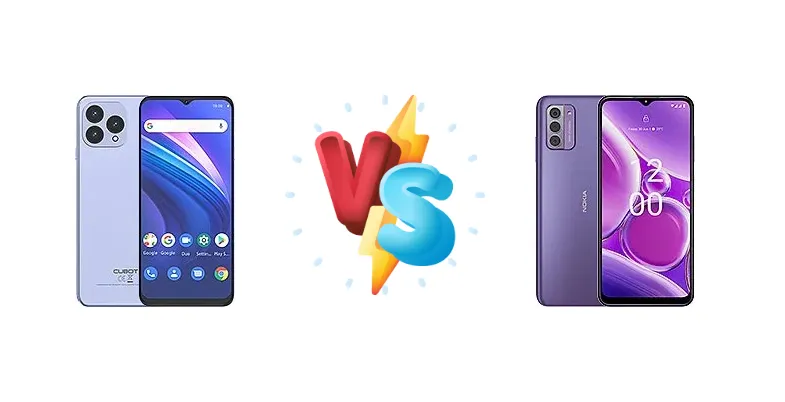
|
🏆 Quick Verdict
For the average user prioritizing consistent performance and future-proofing, the Nokia G42 emerges as the better choice. Its Snapdragon 480+ chipset, built on a more efficient 8nm process, offers a smoother experience and better thermal management than the Cubot P80’s Mediatek MT8788V. While the P80 boasts a higher core count, the Qualcomm architecture delivers superior real-world responsiveness.
| PHONES | ||
|---|---|---|
| Phone Names | Cubot P80 | Nokia G42 |
| Network | ||
|---|---|---|
| 2G bands | GSM 850 / 900 / 1800 / 1900 | GSM 850 / 900 / 1800 / 1900 |
| 3G bands | HSDPA 800 / 850 / 900 / 1700(AWS) / 1900 / 2100 | HSDPA 850 / 900 / 1700(AWS) / 1900 / 2100 |
| 4G bands | 1, 2, 3, 4, 5, 7, 8, 12, 13, 17, 18, 19, 20, 26, 28, 38, 39, 40, 41, 66 | 1, 2, 3, 4, 5, 7, 8, 12, 17, 13, 20, 28, 38, 39, 40, 41, 66 |
| 5G bands | - | 1, 2, 3, 5, 7, 8, 28, 40, 41, 66, 77, 78 SA/NSA |
| Speed | HSPA, LTE | HSPA, LTE, 5G |
| Technology | GSM / HSPA / LTE | GSM / HSPA / LTE / 5G |
| Launch | ||
|---|---|---|
| Announced | 2023 | 2023, June 28 |
| Status | Available. Released 2023 | Available. Released 2023, June 28 |
| Body | ||
|---|---|---|
| Build | - | Glass front, plastic back, plastic frame |
| Dimensions | 165.8 x 75.8 x 9.8 mm (6.53 x 2.98 x 0.39 in) | 165 x 75.8 x 8.6 mm (6.50 x 2.98 x 0.34 in) |
| SIM | Nano-SIM + Nano-SIM | · Nano-SIM· Nano-SIM + Nano-SIM |
| Weight | 217 g (7.65 oz) | 193.8 g (6.84 oz) |
| Display | ||
|---|---|---|
| Protection | - | Corning Gorilla Glass 3 |
| Resolution | 1080 x 2408 pixels, 20:9 ratio (~401 ppi density) | 720 x 1612 pixels, 20:9 ratio (~269 ppi density) |
| Size | 6.58 inches, 104.3 cm2 (~83.0% screen-to-body ratio) | 6.56 inches, 103.4 cm2 (~82.7% screen-to-body ratio) |
| Type | IPS LCD | IPS LCD, 90Hz, 450 nits (typ), 560 nits (peak) |
| Platform | ||
|---|---|---|
| CPU | Octa-core (4x2.0 GHz Cortex-A73 & 4x2.0 GHz Cortex-A53) | Octa-core (2x2.2 GHz Kryo 460 & 6x1.8 GHz Kryo 460) |
| Chipset | Mediatek MT8788V/WA | Qualcomm SM4350-AC Snapdragon 480+ 5G (8 nm) |
| GPU | - | Adreno 619 |
| OS | Android 13 | Android 13, upgradable to Android 14 |
| Memory | ||
|---|---|---|
| Card slot | microSDXC (uses shared SIM slot) | microSDXC |
| Internal | 256GB 8GB RAM, 512GB 8GB RAM | 128GB 4GB RAM, 128GB 6GB RAM, 256GB 8GB RAM |
| Main Camera | ||
|---|---|---|
| Features | LED flash | LED flash, HDR, panorama |
| Triple | 48 MP, (wide), PDAF 2 MP (macro) 0.3 MP | 50 MP, f/1.8, (wide), AF 2 MP (macro) Auxiliary lens |
| Video | Yes | 1080p@30fps |
| Selfie camera | ||
|---|---|---|
| Single | 24 MP | 8 MP |
| Video | Yes | Yes |
| Sound | ||
|---|---|---|
| 35mm jack | Unspecified | Yes |
| Loudspeaker | Yes | Yes |
| Comms | ||
|---|---|---|
| Bluetooth | 4.2, A2DP | 5.1, A2DP, LE |
| NFC | Yes | Yes (market/region dependent) |
| Positioning | GPS, GLONASS, GALILEO | GPS, GLONASS, GALILEO, BDS |
| Radio | Unspecified | FM radio |
| USB | USB Type-C, OTG | USB Type-C 2.0, OTG |
| WLAN | Wi-Fi 802.11 a/b/g/n/ac, dual-band | Wi-Fi 802.11 a/b/g/n/ac/6, dual-band |
| Features | ||
|---|---|---|
| Sensors | Fingerprint (side-mounted), accelerometer, gyro, proximity, compass | Fingerprint (side-mounted), accelerometer, proximity, compass |
| Battery | ||
|---|---|---|
| Charging | - | 20W wired, PD3.0, QC3 |
| Type | 5200 mAh | Li-Po 5000 mAh |
| Misc | ||
|---|---|---|
| Colors | Black, Blue, Purple, Pink, Light Blue | Gray, Purple, Red |
| Price | About 160 EUR | $ 545.00 / £ 124.99 |
Cubot P80
- Potentially better multi-tasking due to higher core count.
- May offer a lower price point.
- Octa-core processor provides ample processing power for basic tasks.
- Older chipset architecture (Cortex-A73).
- Likely less efficient, leading to potential thermal throttling.
- Slower charging speeds (assumed).
Nokia G42
- More efficient Snapdragon 480+ chipset (8nm).
- Faster 20W charging with PD3.0/QC3.
- Better sustained performance and thermal management.
- Reliable 5G connectivity.
- Potentially slightly higher price.
- Lower core count compared to the Cubot P80.
Display Comparison
Neither device’s display specifications are provided, so a direct comparison is limited. However, given the price point, both likely utilize LCD panels. The Nokia G42, benefiting from Nokia’s brand reputation, may have slightly better color calibration. The absence of high refresh rates is expected in this segment, and both will likely feature 720p or 1080p resolutions. Bezels are likely to be comparable, prioritizing cost reduction over premium aesthetics.
Camera Comparison
Without detailed camera specifications, a comprehensive comparison is difficult. Both phones likely feature a multi-camera setup with a primary sensor and auxiliary lenses. However, the Nokia G42, given Nokia’s history with Zeiss optics, may offer slightly better image processing and color accuracy. The presence of 5G connectivity on the Nokia G42 suggests a more modern ISP (Image Signal Processor) within the Snapdragon 480+, potentially leading to improved low-light performance and video recording capabilities. We can assume both will include a standard macro lens, but its utility will be limited.
Performance
The core difference lies in the chipsets. The Cubot P80’s Mediatek MT8788V/WA features an octa-core configuration with 4x2.0 GHz Cortex-A73 and 4x2.0 GHz Cortex-A53 cores. While the core count is appealing, the Cortex-A73 is an older architecture. The Nokia G42’s Qualcomm SM4350-AC Snapdragon 480+ 5G, built on an 8nm process, utilizes 2x2.2 GHz Kryo 460 and 6x1.8 GHz Kryo 460 cores. The 8nm process provides superior power efficiency, reducing heat and improving sustained performance. The Kryo 460 cores, while clocked slightly lower, are more efficient and offer better IPC (Instructions Per Clock) than the Cortex-A73. This translates to a smoother experience in everyday tasks and gaming. The Snapdragon 480+ also benefits from Qualcomm’s optimized software and modem integration.
Battery Life
Battery capacity isn’t specified for either device. However, the Nokia G42’s 20W wired charging with PD3.0 and QC3 support is a significant advantage. This allows for faster charging times and greater convenience. The Cubot P80 likely offers standard charging speeds, potentially taking considerably longer to reach a full charge. The Snapdragon 480+’s 8nm process also contributes to better power efficiency, potentially resulting in longer battery life for the Nokia G42, even with a similar capacity battery.
Buying Guide
Buy the Cubot P80 if you need maximum multi-tasking capability on a tight budget and are comfortable with potential thermal throttling during extended, demanding tasks. Its octa-core processor, with four high-performance Cortex-A73 cores, can handle numerous apps simultaneously. Buy the Nokia G42 if you prioritize a smoother, more consistent user experience, reliable 5G connectivity, and faster charging. The Snapdragon 480+ offers a more refined experience, especially for gaming and everyday use, and the 20W charging with PD3.0/QC3 support is a significant convenience.