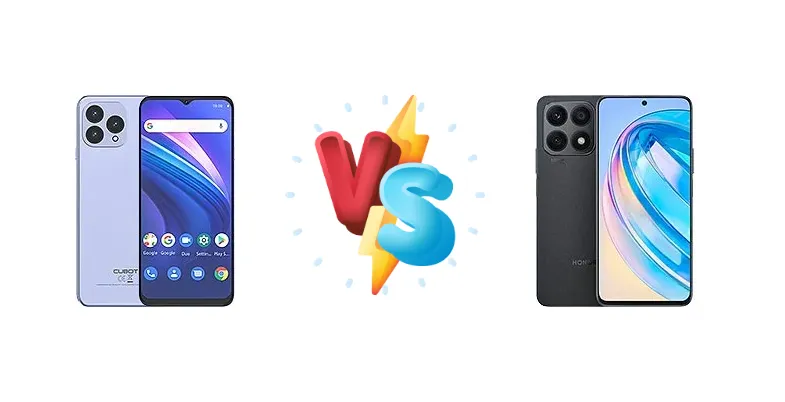
The sub-$200 smartphone market is fiercely competitive. The Cubot P80 and Honor X8a represent compelling options, but cater to slightly different priorities. The P80 leverages a Mediatek MT8788V chipset, while the X8a opts for the Helio G88. This comparison dissects their strengths and weaknesses to determine which device delivers the best overall experience.
🏆 Quick Verdict
For the average user prioritizing consistent performance and faster charging, the Honor X8a emerges as the better choice. Its Helio G88 chipset, while not a flagship performer, offers a more refined architecture and benefits from 22.5W charging, providing a quicker top-up than the Cubot P80.
| Network |
|---|
| 2G bands | GSM 850 / 900 / 1800 / 1900 | GSM 850 / 900 / 1800 / 1900 |
| 3G bands | HSDPA 800 / 850 / 900 / 1700(AWS) / 1900 / 2100 | HSDPA 850 / 900 / 2100 |
| 4G bands | 1, 2, 3, 4, 5, 7, 8, 12, 13, 17, 18, 19, 20, 26, 28, 38, 39, 40, 41, 66 | LTE |
| Speed | HSPA, LTE | HSPA, LTE |
| Technology | GSM / HSPA / LTE | GSM / HSPA / LTE |
| | - | Virtual proximity sensing |
| Launch |
|---|
| Announced | 2023 | 2023, February 08 |
| Status | Available. Released 2023 | Available. Released 2023, February 11 |
| Body |
|---|
| Build | - | Glass front, plastic frame, plastic back |
| Dimensions | 165.8 x 75.8 x 9.8 mm (6.53 x 2.98 x 0.39 in) | 162.9 x 74.5 x 7.5 mm (6.41 x 2.93 x 0.30 in) |
| SIM | Nano-SIM + Nano-SIM | Nano-SIM + Nano-SIM |
| Weight | 217 g (7.65 oz) | 179 g (6.31 oz) |
| Display |
|---|
| Resolution | 1080 x 2408 pixels, 20:9 ratio (~401 ppi density) | 1080 x 2388 pixels (~391 ppi density) |
| Size | 6.58 inches, 104.3 cm2 (~83.0% screen-to-body ratio) | 6.7 inches, 108.7 cm2 (~89.6% screen-to-body ratio) |
| Type | IPS LCD | IPS LCD, 90Hz |
| Platform |
|---|
| CPU | Octa-core (4x2.0 GHz Cortex-A73 & 4x2.0 GHz Cortex-A53) | Octa-core (2x2.0 GHz Cortex-A75 & 6x1.8 GHz Cortex-A55) |
| Chipset | Mediatek MT8788V/WA | Mediatek MT6769H Helio G88 (12 nm) |
| GPU | - | Mali-G52 MC2 |
| OS | Android 13 | Android 12, Magic UI 6.1 |
| Memory |
|---|
| Card slot | microSDXC (uses shared SIM slot) | No |
| Internal | 256GB 8GB RAM, 512GB 8GB RAM | 128GB 4GB RAM, 128GB 6GB RAM, 128GB 8GB RAM, 128GB 12GB RAM, 256GB 4GB RAM, 256GB 8GB RAM |
| Main Camera |
|---|
| Features | LED flash | LED flash, panorama, HDR |
| Single | - | 16 MP, f/2.5 |
| Triple | 48 MP, (wide), PDAF
2 MP (macro)
0.3 MP | 100 MP, f/1.9, (wide), AF
5 MP, f/2.2, (ultrawide)
2 MP (macro) |
| Video | Yes | 1080p@30fps |
| Selfie camera |
|---|
| Single | 24 MP | 16 MP, f/2.5 |
| Video | Yes | 1080p@30fps |
| Sound |
|---|
| 3.5mm jack | - | No |
| 35mm jack | Unspecified | No |
| Loudspeaker | Yes | Yes |
| Comms |
|---|
| Bluetooth | 4.2, A2DP | 5.1, A2DP, LE |
| NFC | Yes | Yes (CRT-LX1 only) |
| Positioning | GPS, GLONASS, GALILEO | GPS, GLONASS, GALILEO, BDS |
| Radio | Unspecified | No |
| USB | USB Type-C, OTG | USB Type-C 2.0, OTG |
| WLAN | Wi-Fi 802.11 a/b/g/n/ac, dual-band | Wi-Fi 802.11 a/b/g/n/ac, dual-band, Wi-Fi Direct |
| Features |
|---|
| Sensors | Fingerprint (side-mounted), accelerometer, gyro, proximity, compass | Fingerprint (side-mounted), accelerometer, compass |
| Battery |
|---|
| Charging | - | 22.5W wired, 50% in 30 min |
| Type | 5200 mAh | Li-Po 4500 mAh |
| Misc |
|---|
| Colors | Black, Blue, Purple, Pink, Light Blue | Cyan Lake, Titanium Silver, Midnight Black |
| Models | - | CRT-LX1, CRT-LX2, CRT-LX3 |
| Price | About 160 EUR | About 170 EUR |
Cubot P80
- Potentially lower price point
- Octa-core processor for multitasking
- May offer larger storage options
- Older chipset architecture (MT8788V)
- Slower charging speeds
- Potentially less efficient CPU
Honor X8a
- More modern chipset (Helio G88)
- Faster 22.5W charging
- Improved GPU performance for gaming
- May be slightly more expensive
- Potentially smaller battery capacity
- Brand reputation not as established as some competitors
Display Comparison
Neither device boasts a standout display. Both likely utilize IPS LCD panels, common in this price bracket. Without specific nit brightness data, it's difficult to declare a clear winner. However, Honor's brand reputation suggests potentially better color calibration. The absence of high refresh rates on both devices indicates a focus on battery life over visual fluidity.
Camera Comparison
Without detailed camera specs beyond the chipsets, a direct comparison is limited. Both devices likely feature a primary camera and supporting lenses. The image signal processor (ISP) within the Helio G88 is likely more advanced, potentially leading to better image processing and noise reduction. The Cubot P80's ISP, tied to the older MT8788V, may struggle in low-light conditions. The presence of a 2MP macro lens on either device is largely a marketing tactic, offering minimal practical benefit.
Performance
The core difference lies in the chipsets. The Cubot P80’s Mediatek MT8788V uses a combination of Cortex-A73 and A53 cores. While the A73 offers decent performance, it's an older architecture. The Honor X8a’s Helio G88, built on a 12nm process, features Cortex-A75 cores, which are more efficient and powerful than the A73. The G88’s architecture translates to better multi-tasking and smoother app launches. The P80's CPU clock speed of 2.0GHz is matched by the X8a's A75 cores, but the architectural advantage favors Honor. The G88 also benefits from a more modern GPU, offering a better gaming experience.
Battery Life
Battery capacity is not specified for either device. However, the Honor X8a’s 22.5W charging is a significant advantage. This allows for a 50% charge in just 30 minutes, a crucial benefit for users who need a quick power boost. The Cubot P80 likely relies on slower charging speeds, potentially requiring several hours for a full charge. Even with a larger battery capacity, the slower charging could be a drawback.
Buying Guide
Buy the Cubot P80 if you prioritize a potentially lower price point and are comfortable with a chipset that may show its age in demanding tasks. Buy the Honor X8a if you prefer a more modern chipset architecture, faster charging speeds, and a generally smoother user experience, even if it means spending slightly more.
Frequently Asked Questions
❓ Will the Helio G88 in the Honor X8a handle demanding games like PUBG Mobile?
The Helio G88 is capable of running PUBG Mobile, but you'll likely need to use medium graphics settings for a smooth experience. It's not a gaming powerhouse, but it offers a playable experience for casual gamers.
❓ Is the Mediatek MT8788V in the Cubot P80 sufficient for everyday tasks like browsing and social media?
Yes, the MT8788V is adequate for basic tasks like web browsing, social media, and messaging. However, you may experience slowdowns when multitasking or running more demanding applications.
❓ How long does it realistically take to fully charge the Cubot P80, given its likely slower charging speed?
Without specific charging wattage, it's difficult to pinpoint. However, based on similar devices, a full charge for the Cubot P80 could take between 2.5 to 4 hours.
❓ Does the Honor X8a support fast charging protocols beyond its 22.5W capability?
The Honor X8a supports 22.5W Honor SuperCharge. Compatibility with other fast charging protocols (like Power Delivery) is not widely advertised and may be limited.