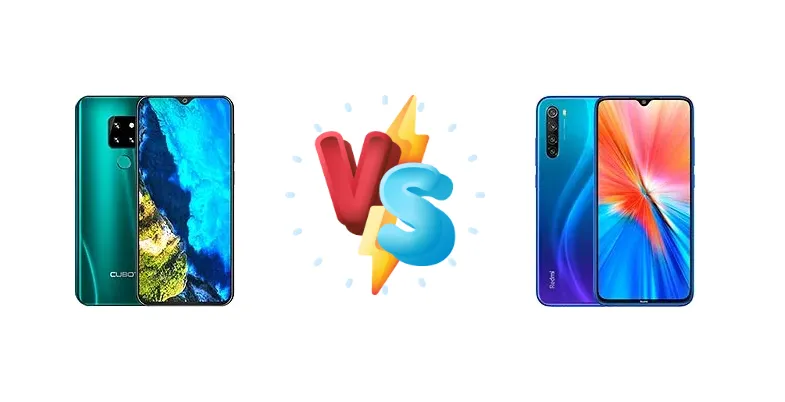
Both the Cubot P30 and the Xiaomi Redmi Note 8 2021 occupy the ultra-budget smartphone space, but represent different approaches. The Cubot P30, utilizing an older chipset, aims for affordability, while the Redmi Note 8 2021 leverages a more recent processor to offer a better balance of performance and features. This comparison will dissect their key differences to help you determine which device best suits your needs.
🏆 Quick Verdict
For most users, the Xiaomi Redmi Note 8 2021 is the superior choice. Its Mediatek Helio G85 chipset, built on a more efficient 12nm process, delivers noticeably better performance than the Cubot P30’s Helio P23. While both offer similar battery endurance, the Redmi Note 8 2021’s faster 18W charging provides a more convenient user experience.
| Network |
|---|
| 2G bands | GSM 850 / 900 / 1800 / 1900 | GSM 850 / 900 / 1800 / 1900 |
| 3G bands | HSDPA 900 / 2100 | HSDPA 850 / 900 / 1700(AWS) / 1900 / 2100 |
| 4G bands | 1, 3, 7, 8, 19, 20 | 1, 2, 3, 4, 5, 7, 8, 20, 28, 38, 40 |
| Speed | HSPA, LTE | HSPA, LTE |
| Technology | GSM / HSPA / LTE | GSM / HSPA / LTE |
| Launch |
|---|
| Announced | 2020. Released 2020 | 2021, May 25 |
| Status | Discontinued | Available. Released 2021, May 27 |
| Body |
|---|
| Build | - | Glass front (Gorilla Glass 5), glass back (Gorilla Glass 5), plastic frame |
| Dimensions | 156.6 x 74.3 x 8.1 mm (6.17 x 2.93 x 0.32 in) | 158.3 x 75.3 x 8.4 mm (6.23 x 2.96 x 0.33 in) |
| SIM | Nano-SIM + Nano-SIM | Nano-SIM + Nano-SIM |
| Weight | 186.4 g (6.56 oz) | 190 g (6.70 oz) |
| Display |
|---|
| Protection | - | Corning Gorilla Glass 5 |
| Resolution | 1080 x 2340 pixels, 19.5:9 ratio (~409 ppi density) | 1080 x 2340 pixels, 19.5:9 ratio (~409 ppi density) |
| Size | 6.3 inches, 97.4 cm2 (~83.7% screen-to-body ratio) | 6.3 inches, 97.4 cm2 (~81.7% screen-to-body ratio) |
| Type | IPS LCD | IPS LCD, 500 nits (typ) |
| Platform |
|---|
| CPU | Octa-core 2.5 GHz Cortex-A53 | Octa-core (2x2.0 GHz Cortex-A75 & 6x1.8 GHz Cortex-A55) |
| Chipset | Mediatek MT6763 Helio P23 (16 nm) | Mediatek MT6769Z Helio G85 (12 nm) |
| GPU | Mali-G71 MP2 | Mali-G52 MC2 |
| OS | Android 9.0 (Pie) | Android 11, MIUI 12.5 |
| Memory |
|---|
| Card slot | microSDXC (uses shared SIM slot) | microSDXC (dedicated slot) |
| Internal | 64GB 4GB RAM | 64GB 3GB RAM, 64GB 4GB RAM, 128GB 4GB RAM |
| | - | eMMC 5.1 |
| Main Camera |
|---|
| Features | LED flash | LED flash, HDR, panorama |
| Quad | - | 48 MP, f/1.8, 26mm (wide), 1/2.0", 0.8µm, PDAF
8 MP, f/2.2, 120˚ (ultrawide), 1/4.0", 1.12µm
2 MP (macro)
Auxiliary lens |
| Single | - | 13 MP, f/2.0, (wide), 1/3.1", 1.12µm |
| Triple | 12 MP, (wide), 1/2.9", AF
8 MP, 125˚ (ultrawide)
20 MP, (depth), 1/2.78" | - |
| Video | Yes | 1080p@30/120fps; gyro-EIS |
| Selfie camera |
|---|
| Features | - | HDR, panorama |
| Single | 13 MP | 13 MP, f/2.0, (wide), 1/3.1", 1.12µm |
| Video | Yes | 1080p@30fps |
| Sound |
|---|
| 3.5mm jack | - | Yes |
| 35mm jack | Unspecified | Yes |
| Loudspeaker | Yes | Yes |
| Comms |
|---|
| Bluetooth | 4.2, A2DP | 5.2, A2DP, LE |
| Infrared port | - | Yes |
| NFC | No | No |
| Positioning | GPS | GPS, GLONASS, GALILEO, BDS |
| Radio | Unspecified | FM radio |
| USB | USB Type-C, OTG | USB Type-C 2.0, OTG |
| WLAN | Wi-Fi 802.11 a/b/g/n | Wi-Fi 802.11 a/b/g/n/ac, dual-band, Wi-Fi Direct |
| Features |
|---|
| Sensors | Fingerprint (rear-mounted), accelerometer, gyro, proximity, compass | Fingerprint (rear-mounted), accelerometer, gyro, proximity, compass |
| Battery |
|---|
| Charging | - | 18W wired |
| Type | 4000 mAh | Li-Po 4000 mAh |
| Misc |
|---|
| Colors | Blue, Black, Green | Neptune Blue, Moonlight White, Space Black |
| Models | - | M1908C3JGG |
| Price | - | About 160 EUR |
| SAR | - | 0.97 W/kg (head) 0.75 W/kg (body) |
| SAR EU | - | 0.57 W/kg (head) 0.94 W/kg (body) |
| Tests |
|---|
| Battery life | - |
Endurance rating 102h
|
| Camera | - |
Photo / Video |
| Display | - |
Contrast ratio: 1487:1 (nominal) |
| Loudspeaker | - |
-28.6 LUFS (Average)
|
| Performance | - |
AnTuTu: 180195 (v8), 165779 (v9)
GeekBench: 5259 (v4.4), 1314 (v5.1)
GFXBench: 8.7fps (ES 3.1 onscreen) |
Cubot P30
- Extremely affordable price point
- Decent battery life (102h endurance)
- Functional for basic smartphone tasks
- Outdated Helio P23 chipset
- Likely slower charging speeds
- Inferior performance compared to competitors
Xiaomi Redmi Note 8 2021
- More powerful Helio G85 chipset
- Faster 18W wired charging
- Brighter display for better outdoor visibility
- Slightly higher price than the Cubot P30
- Still a budget device with limitations
- Camera performance likely limited by sensor quality
Display Comparison
Both devices share a contrast ratio of 1487:1, suggesting similar image quality in terms of black levels. However, the Redmi Note 8 2021 boasts a measured peak brightness of 620 nits, significantly brighter than what we'd expect from the P30, resulting in better visibility outdoors. While neither device is likely to feature high refresh rate panels, the Redmi Note 8 2021’s brighter display provides a more pleasant viewing experience in various lighting conditions.
Camera Comparison
Both phones are listed as having 'Photo / Video' capabilities, but lack specific details. Given the price point, image quality will likely be similar in good lighting conditions. However, the Redmi Note 8 2021’s more powerful ISP (Image Signal Processor) within the Helio G85 chipset will likely result in better noise reduction and dynamic range, particularly in low-light scenarios. The absence of details makes it difficult to assess the quality of the camera modules themselves.
Performance
The core difference lies in the chipsets. The Cubot P30’s Mediatek MT6763 Helio P23 (2.5 GHz Cortex-A53) is based on an older 16nm process. The Xiaomi Redmi Note 8 2021’s Mediatek MT6769Z Helio G85 (12nm) features a more modern architecture with a mix of Cortex-A75 and A55 cores. The A75 cores in the G85 provide a substantial performance boost in CPU-intensive tasks, while the 12nm process improves power efficiency. This translates to faster app loading times, smoother multitasking, and a more responsive user experience on the Redmi Note 8 2021.
Battery Life
Both devices achieve an endurance rating of 102 hours, indicating comparable battery life under similar usage patterns. However, the Redmi Note 8 2021 supports 18W wired charging, a significant advantage over the likely slower charging speeds of the Cubot P30. This faster charging capability reduces downtime and provides a more convenient user experience, allowing for quicker top-ups when needed.
Buying Guide
Buy the Cubot P30 if your primary need is an extremely affordable device for basic tasks like calls, texts, and light social media, and you're willing to compromise on performance. Buy the Xiaomi Redmi Note 8 2021 if you prioritize smoother multitasking, occasional gaming, and faster charging, even if it means spending a bit more. The Redmi Note 8 2021 is the better all-rounder for most users.
Frequently Asked Questions
❓ Is the Helio G85 in the Redmi Note 8 2021 capable of playing demanding games like PUBG Mobile?
The Helio G85 is a capable gaming chipset for its price range. While it won't deliver flagship-level performance, it can run PUBG Mobile at medium settings with reasonable frame rates. Expect some frame drops during intense action, but it's a playable experience.
❓ How significant is the difference in performance between the 16nm Helio P23 and the 12nm Helio G85?
The move from a 16nm to a 12nm process node is substantial. The 12nm process is more efficient, meaning the Helio G85 consumes less power for the same level of performance, or delivers more performance at the same power consumption. This translates to a noticeable improvement in responsiveness and multitasking on the Redmi Note 8 2021.
❓ Does the Redmi Note 8 2021 support fast charging with any charger other than the one included in the box?
The Redmi Note 8 2021 supports 18W fast charging using the Power Delivery (PD) protocol. While the included charger may be 18W, you can use any compatible PD charger to achieve the same fast charging speeds. Ensure the charger supports the correct voltage and current output.