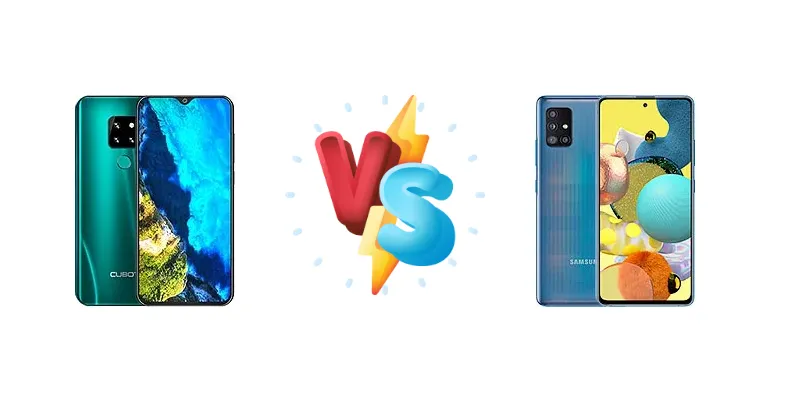
The smartphone landscape is crowded with options, particularly in the budget and mid-range segments. We're pitting the Cubot P30, a value-focused device, against the Samsung Galaxy A51 5G UW, a carrier-specific offering aiming to bring 5G connectivity to a wider audience. This comparison will dissect their core components to determine which phone delivers the best experience for your money.
🏆 Quick Verdict
For the average user prioritizing performance and future-proofing, the Samsung Galaxy A51 5G UW is the clear winner. Its Snapdragon 765G chipset provides a substantial performance advantage over the Cubot P30’s Helio P23. However, the P30 remains a viable option for those on an extremely tight budget and with very basic smartphone needs.
| Network |
|---|
| 2G bands | GSM 850 / 900 / 1800 / 1900 | GSM 850 / 900 / 1800 / 1900 |
| 3G bands | HSDPA 900 / 2100 | HSDPA 850 / 900 / 1900 / 2100 |
| 4G bands | 1, 3, 7, 8, 19, 20 | 2, 4, 5, 13, 66 |
| 5G bands | - | 260, 261 mmWave |
| Speed | HSPA, LTE | HSPA, LTE, 5G |
| Technology | GSM / HSPA / LTE | GSM / HSPA / LTE / 5G |
| Launch |
|---|
| Announced | 2020. Released 2020 | 2020, August 14 |
| Status | Discontinued | Available. Released 2020, August 14 |
| Body |
|---|
| Build | - | Glass front (Gorilla Glass 3), plastic back, aluminum frame |
| Dimensions | 156.6 x 74.3 x 8.1 mm (6.17 x 2.93 x 0.32 in) | 158.8 x 73.4 x 8.6 mm (6.25 x 2.89 x 0.34 in) |
| SIM | Nano-SIM + Nano-SIM | Nano-SIM (pre-installed) |
| Weight | 186.4 g (6.56 oz) | 188.8 g (6.67 oz) |
| Display |
|---|
| Protection | - | Corning Gorilla Glass 3 |
| Resolution | 1080 x 2340 pixels, 19.5:9 ratio (~409 ppi density) | 1080 x 2400 pixels, 20:9 ratio (~405 ppi density) |
| Size | 6.3 inches, 97.4 cm2 (~83.7% screen-to-body ratio) | 6.5 inches, 102.0 cm2 (~87.5% screen-to-body ratio) |
| Type | IPS LCD | Super AMOLED |
| Platform |
|---|
| CPU | Octa-core 2.5 GHz Cortex-A53 | Octa-core (1x2.4 GHz Kryo 475 Prime & 1x2.2 GHz Kryo 475 Gold & 6x1.8 GHz Kryo 475 Silver) |
| Chipset | Mediatek MT6763 Helio P23 (16 nm) | Qualcomm SM7250 Snapdragon 765G 5G (7 nm) |
| GPU | Mali-G71 MP2 | Adreno 620 |
| OS | Android 9.0 (Pie) | Android 10, One UI 2 |
| Memory |
|---|
| Card slot | microSDXC (uses shared SIM slot) | microSDXC (uses shared SIM slot) |
| Internal | 64GB 4GB RAM | 128GB 6GB RAM |
| | - | UFS 2.1 |
| Main Camera |
|---|
| Features | LED flash | LED flash, panorama, HDR |
| Quad | - | 48 MP, f/2.0, 26mm (wide), 1/2.0", 0.8µm, PDAF
12 MP, f/2.2, 123˚ (ultrawide)
5 MP (macro)
Auxiliary lens |
| Single | - | 5 MP, AF |
| Triple | 12 MP, (wide), 1/2.9", AF
8 MP, 125˚ (ultrawide)
20 MP, (depth), 1/2.78" | - |
| Video | Yes | 4K@30fps, 1080p@30/120fps; gyro-EIS |
| Selfie camera |
|---|
| Features | - | HDR |
| Single | 13 MP | 32 MP, f/2.2, 26mm (wide), 1/2.8", 0.8µm |
| Video | Yes | 4K@30fps, 1080p@30fps |
| Sound |
|---|
| 3.5mm jack | - | Yes |
| 35mm jack | Unspecified | Yes |
| Loudspeaker | Yes | Yes |
| Comms |
|---|
| Bluetooth | 4.2, A2DP | 5.0, A2DP, LE |
| NFC | No | Yes |
| Positioning | GPS | GPS, GLONASS, GALILEO, BDS |
| Radio | Unspecified | FM radio, RDS, recording |
| USB | USB Type-C, OTG | USB Type-C 2.0, OTG |
| WLAN | Wi-Fi 802.11 a/b/g/n | Wi-Fi 802.11 a/b/g/n/ac, dual-band, Wi-Fi Direct |
| Features |
|---|
| Sensors | Fingerprint (rear-mounted), accelerometer, gyro, proximity, compass | Fingerprint (under display, optical), accelerometer, gyro, proximity, compass |
| | - | ANT+ |
| Battery |
|---|
| Charging | - | 15W wired |
| Stand-by | - | Up to 672 h |
| Talk time | - | Up to 5 h |
| Type | 4000 mAh | Li-Po 4500 mAh |
| Misc |
|---|
| Colors | Blue, Black, Green | Prism Bricks Blue |
| Models | - | SM-A516V |
| Price | - | About 470 EUR |
| SAR | - | 0.70 W/kg (head) 1.25 W/kg (body) |
| SAR EU | - | 0.59 W/kg (head) 1.32 W/kg (body) |
Cubot P30
- Potentially lower price point
- May offer slightly longer battery life with light use
- Functional for basic smartphone tasks
- Significantly weaker performance
- Outdated chipset architecture
- Likely inferior camera quality
Samsung Galaxy A51 5G UW
- Much faster and more responsive performance
- 5G connectivity for faster data speeds
- Superior image processing capabilities
- Higher price tag
- 15W charging is relatively slow
- May have slightly shorter battery life under heavy load
Display Comparison
Neither device boasts a particularly standout display. While specific display specs for the Cubot P30 are unavailable, its market positioning suggests a basic LCD panel. The Samsung Galaxy A51 5G UW, similarly, utilizes an LCD. The key difference lies in processing power impacting UI smoothness. The A51 5G UW’s more powerful chipset will translate to a more fluid scrolling experience, even if the panel technology itself isn’t cutting-edge. Bezels are likely comparable, reflecting the budget nature of both devices.
Camera Comparison
Camera performance is another area where the A51 5G UW holds an advantage, though detailed sensor information is limited for both. The A51 5G UW benefits from Qualcomm’s image signal processor (ISP) integrated within the Snapdragon 765G, offering superior image processing capabilities. While both phones likely feature multiple rear cameras, the A51 5G UW’s ISP will likely deliver better dynamic range, noise reduction, and overall image quality. The Cubot P30’s camera system will likely struggle in low-light conditions due to the limitations of its chipset and sensor.
Performance
The performance gap between these two phones is significant. The Cubot P30’s Mediatek MT6763 Helio P23 (16nm) with its Cortex-A53 cores is a relatively old architecture. While the octa-core configuration sounds impressive, the 2.5 GHz clock speed doesn’t compensate for the dated process node and core design. In contrast, the Samsung Galaxy A51 5G UW’s Qualcomm SM7250 Snapdragon 765G (7nm) is built on a much more efficient and powerful architecture. The Kryo 475 cores – Prime, Gold, and Silver – offer a tiered approach to performance, balancing power and efficiency. This translates to significantly faster app loading times, smoother multitasking, and a better gaming experience on the A51 5G UW. The 7nm process also means better thermal management, reducing the likelihood of throttling under sustained load.
Battery Life
Battery life is a complex equation. While the exact mAh capacity of the Cubot P30 is unknown, its less power-hungry chipset suggests it could offer comparable, or even slightly better, battery life than the Samsung Galaxy A51 5G UW. However, the A51 5G UW’s 15W wired charging is a notable advantage. The P30’s charging speed is likely slower, meaning longer times to reach a full charge. The Snapdragon 765G’s efficiency also means the A51 5G UW won’t drain the battery as quickly during intensive tasks, offsetting any potential capacity disadvantage.
Buying Guide
Buy the Cubot P30 if you need a functional smartphone for essential tasks like calls, texts, and light social media, and your budget is under $150. Buy the Samsung Galaxy A51 5G UW if you prioritize 5G connectivity, smoother multitasking, and a more responsive user experience, and are willing to spend closer to $300.
Frequently Asked Questions
❓ Is the Snapdragon 765G in the A51 5G UW powerful enough for modern mobile games?
Yes, the Snapdragon 765G is capable of running most modern mobile games at medium to high settings. While it won't match the performance of flagship chipsets, it provides a smooth and enjoyable gaming experience, especially considering the phone's price point. Expect playable frame rates in titles like PUBG Mobile and Call of Duty: Mobile.
❓ How much of a real-world difference will the 5G connectivity make on the A51 5G UW?
The benefit of 5G depends heavily on your location and carrier coverage. In areas with strong 5G signals, you'll experience significantly faster download and upload speeds compared to 4G LTE. This translates to quicker app downloads, smoother streaming, and lower latency for online gaming. However, if 5G coverage is limited, you'll primarily be using 4G LTE, diminishing the advantage.
❓ Will the Cubot P30 receive software updates?
Software update support for the Cubot P30 is likely to be limited. Cubot, as a smaller manufacturer, typically doesn't provide the same level of long-term software support as larger brands like Samsung. Expect minimal security updates and potentially no major Android version upgrades.