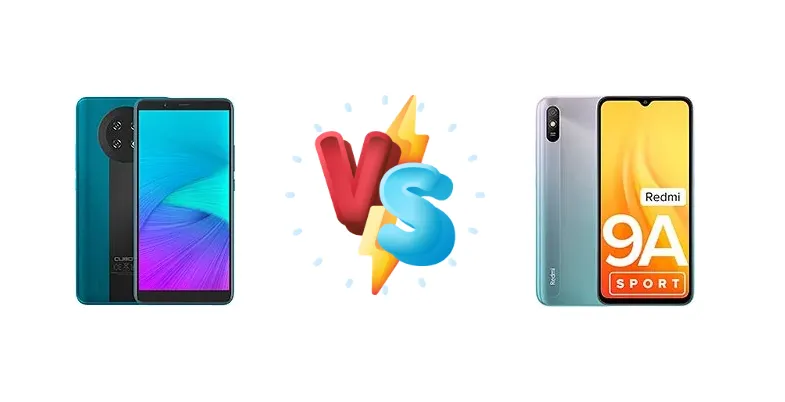
The sub-$150 smartphone market is fiercely competitive. Both the Cubot Note 9 and the Xiaomi Redmi 9A Sport aim to deliver essential smartphone functionality at an incredibly affordable price. However, they take different approaches to achieving this, primarily through their chipset choices. This comparison will dissect the key differences to help you determine which device best suits your needs.
🏆 Quick Verdict
For the average user prioritizing basic tasks and media consumption, the Xiaomi Redmi 9A Sport offers a slight edge. Its 12nm Helio G25 chipset provides a noticeable performance boost over the Cubot Note 9’s 28nm Unisoc SC9863A, translating to smoother app loading and multitasking, despite the Cubot's potentially more efficient architecture.
| Network |
|---|
| 2G bands | GSM 850 / 900 / 1800 / 1900 | GSM 850 / 900 / 1800 / 1900 |
| 3G bands | HSDPA 900 / 2100 | HSDPA 850 / 900 / 2100 |
| 4G bands | 1, 3, 5, 7, 8, 19, 20, 40 | 1, 3, 5, 8, 40, 41 |
| Speed | HSPA, LTE | HSPA, LTE |
| Technology | GSM / HSPA / LTE | GSM / HSPA / LTE |
| Launch |
|---|
| Announced | 2022 | 2021, September 28 |
| Status | Available. Released 2022 | Available. Released 2021, September 28 |
| Body |
|---|
| Dimensions | 153 x 77 x 11 mm (6.02 x 3.03 x 0.43 in) | 164.9 x 77.1 x 9 mm (6.49 x 3.04 x 0.35 in) |
| SIM | Nano-SIM + Nano-SIM | Nano-SIM + Nano-SIM |
| Weight | - | 194 g (6.84 oz) |
| | - | Water-repellent coating |
| Display |
|---|
| Resolution | Unspecified | 720 x 1600 pixels, 20:9 ratio (~269 ppi density) |
| Size | 5.99 inches | 6.53 inches, 102.9 cm2 (~81.0% screen-to-body ratio) |
| Type | IPS LCD | IPS LCD, 400 nits (typ) |
| Platform |
|---|
| CPU | Octa-core (4x1.6 GHz Cortex-A55 & 4x1.2 GHz Cortex-A55) | Octa-core (4x2.0 GHz Cortex-A53 & 4x1.5 GHz Cortex-A53) |
| Chipset | Unisoc SC9863A (28 nm) | Mediatek MT6762G Helio G25 (12 nm) |
| GPU | IMG8322 | PowerVR GE8320 |
| OS | Android 11 | Android 10, MIUI 12 |
| Memory |
|---|
| Card slot | microSDXC (dedicated slot) | microSDXC (dedicated slot) |
| Internal | 32GB 3GB RAM | 32GB 2GB RAM, 32GB 3GB RAM |
| | - | eMMC 5.1 |
| Main Camera |
|---|
| Features | LED flash | LED flash, HDR |
| Single | - | 13 MP, f/2.2, 28mm (wide), 1.0µm, PDAF |
| Triple | 16 MP, (wide), AF
other unspecified cameras | - |
| Video | Yes | 1080p@30/60fps |
| Selfie camera |
|---|
| Features | - | HDR |
| Single | 5 MP | 5 MP, f/2.2, (wide), 1.12µm |
| Video | Yes | 1080p@30fps |
| Sound |
|---|
| 3.5mm jack | - | Yes |
| 35mm jack | Yes | Yes |
| Loudspeaker | Yes | Yes |
| Comms |
|---|
| Bluetooth | 4.2, A2DP | 5.0, A2DP, LE |
| NFC | No | No |
| Positioning | GPS, GLONASS, BDS | GPS, GLONASS, BDS |
| Radio | Unspecified | FM radio |
| USB | USB Type-C | microUSB 2.0, OTG |
| WLAN | Wi-Fi 802.11 b/g/n | Wi-Fi 802.11 a/b/g/n, Wi-Fi Direct |
| Features |
|---|
| Sensors | Accelerometer, proximity | Accelerometer, proximity |
| Battery |
|---|
| Charging | - | 10W wired |
| Type | 5900 mAh, removable | Li-Po 5000 mAh |
| Misc |
|---|
| Colors | Black, Green | Carbon Black, Coral Green, Metallic Blue |
| Price | - | About 100 EUR |
Cubot Note 9
- Potentially longer standby time due to older, less power-hungry chipset.
- May be more affordable depending on retailer.
- Simple, straightforward user experience.
- Significantly slower performance compared to the Redmi 9A Sport.
- Likely lacks fast charging.
- Older chipset architecture.
Xiaomi Redmi 9A Sport
- Faster and more responsive performance thanks to the Helio G25.
- 10W wired charging for quicker top-ups.
- More efficient chipset for moderate usage.
- May have slightly shorter battery life under heavy load.
- Potentially higher price point.
- Basic camera performance.
Display Comparison
Neither device boasts a standout display. Both are likely to feature LCD panels, typical for this price bracket. The lack of specified display specs (resolution, brightness) suggests both prioritize cost savings over visual fidelity. Bezels are expected to be substantial on both, impacting the overall screen-to-body ratio. Color accuracy is unlikely to be a strong point on either device, and we anticipate standard sRGB coverage.
Camera Comparison
Camera performance is expected to be basic on both devices. Without detailed sensor information, it’s safe to assume both rely on low-resolution primary sensors. The Redmi 9A Sport likely benefits from MediaTek’s image signal processor (ISP), which generally offers better noise reduction and dynamic range compared to Unisoc’s ISP. Any secondary cameras (depth, macro) are likely to be of minimal quality and should not be a primary consideration. Image processing will be crucial, and Xiaomi’s software optimizations may give it a slight edge.
Performance
The core difference lies in the chipsets. The Xiaomi Redmi 9A Sport’s MediaTek Helio G25, built on a 12nm process, offers a significant advantage in transistor density and efficiency compared to the Cubot Note 9’s Unisoc SC9863A (28nm). While both are octa-core CPUs, the Helio G25 utilizes Cortex-A53 cores clocked at 2.0 GHz, versus the Note 9’s Cortex-A55 cores at 1.6 GHz and 1.2 GHz. This translates to faster single-core and multi-core performance for the Redmi 9A Sport. The 12nm process also contributes to better thermal management, potentially reducing throttling during sustained use. The Unisoc chip, while potentially more power-efficient at idle, will likely struggle with demanding applications.
Battery Life
Battery capacity isn’t specified for either device, but both likely house batteries in the 4000-5000 mAh range, common for this segment. However, the Redmi 9A Sport’s 10W wired charging provides a clear advantage over the Cubot Note 9, which likely lacks fast charging capabilities. The more efficient Helio G25 chipset may also contribute to slightly better battery life under moderate usage, but the older, larger process node of the Unisoc chip could potentially offer longer standby times.
Buying Guide
Buy the Cubot Note 9 if you prioritize potentially longer battery life due to the older, less power-hungry chipset, and are primarily focused on very basic smartphone functions like calls, texts, and light social media. Buy the Xiaomi Redmi 9A Sport if you value a more responsive user experience, even for moderately demanding tasks, and appreciate the convenience of 10W wired charging for quicker top-ups.
Frequently Asked Questions
❓ Will the Redmi 9A Sport handle popular games like PUBG Mobile?
While the Helio G25 can run PUBG Mobile, expect to play at the lowest graphics settings and potentially experience frame drops during intense action. It's not a gaming-focused chipset, but it's capable of casual gaming.
❓ Is the Unisoc SC9863A in the Cubot Note 9 sufficient for everyday tasks like WhatsApp and browsing?
Yes, the Unisoc SC9863A is adequate for basic tasks like WhatsApp, web browsing, and making calls. However, multitasking and opening multiple apps simultaneously will likely result in noticeable slowdowns.
❓ Does the Redmi 9A Sport support dual SIM functionality?
Yes, the Xiaomi Redmi 9A Sport does support dual SIM functionality, allowing you to use two SIM cards simultaneously. This is a common feature in this price range.
❓ What type of charging port do both phones use?
Both the Cubot Note 9 and the Xiaomi Redmi 9A Sport are expected to use a micro-USB port for charging and data transfer, which is standard for budget smartphones.