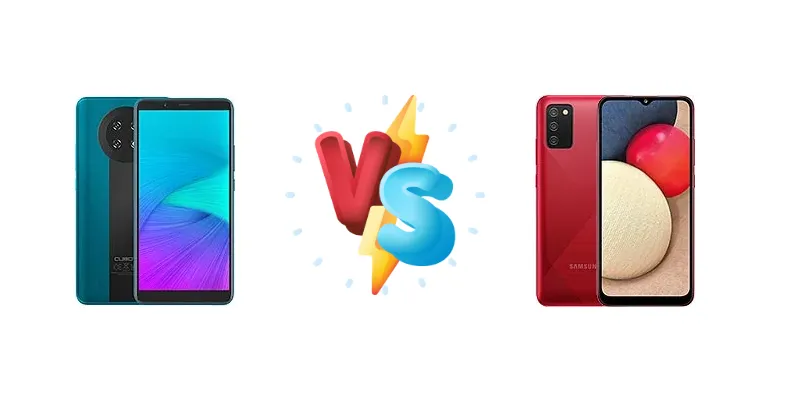
The sub-$150 smartphone market is fiercely competitive. Both the Cubot Note 9 and the Samsung Galaxy A02s aim to deliver essential smartphone functionality at an incredibly accessible price point. This comparison dissects their key specifications to determine which device offers the best value for users prioritizing affordability without completely sacrificing usability.
🏆 Quick Verdict
For the average user, the Samsung Galaxy A02s emerges as the slightly better choice. While the Cubot Note 9 attempts to offer a newer chipset, the Snapdragon 450 in the A02s, built on a smaller 14nm process, provides a more refined and efficient experience, coupled with a measured 406 nits of brightness.
| Network |
|---|
| 2G bands | GSM 850 / 900 / 1800 / 1900 | GSM 850 / 900 / 1800 / 1900 |
| 3G bands | HSDPA 900 / 2100 | HSDPA 850 / 900 / 2100 |
| 4G bands | 1, 3, 5, 7, 8, 19, 20, 40 | 1, 3, 5, 7, 8, 20, 28, 38, 40, 41 |
| Speed | HSPA, LTE | HSPA 42.2/5.76 Mbps, LTE Cat4 150/50 Mbps |
| Technology | GSM / HSPA / LTE | GSM / HSPA / LTE |
| Launch |
|---|
| Announced | 2022 | 2020, November 24. Released 2021, January 04 |
| Status | Available. Released 2022 | Discontinued |
| Body |
|---|
| Build | - | Glass front, plastic back, plastic frame |
| Dimensions | 153 x 77 x 11 mm (6.02 x 3.03 x 0.43 in) | 164.2 x 75.9 x 9.1 mm (6.46 x 2.99 x 0.36 in) |
| SIM | Nano-SIM + Nano-SIM | · Nano-SIM· Nano-SIM + Nano-SIM |
| Weight | - | 196 g (6.91 oz) |
| Display |
|---|
| Protection | - | Scratch-resistant glass |
| Resolution | Unspecified | 720 x 1600 pixels, 20:9 ratio (~270 ppi density) |
| Size | 5.99 inches | 6.5 inches, 102.0 cm2 (~81.8% screen-to-body ratio) |
| Type | IPS LCD | PLS LCD |
| Platform |
|---|
| CPU | Octa-core (4x1.6 GHz Cortex-A55 & 4x1.2 GHz Cortex-A55) | Octa-core 1.8 GHz Cortex-A53 |
| Chipset | Unisoc SC9863A (28 nm) | Qualcomm SDM450 Snapdragon 450 (14 nm) |
| GPU | IMG8322 | Adreno 506 |
| OS | Android 11 | Android 10, upgradable to Android 12, One UI 4.1 |
| Memory |
|---|
| Card slot | microSDXC (dedicated slot) | microSDXC (dedicated slot) |
| Internal | 32GB 3GB RAM | 16GB 1GB RAM, 32GB 2GB RAM, 32GB 3GB RAM, 32GB 4GB RAM, 64GB 3GB RAM, 64GB 4GB RAM |
| | - | eMMC 5.1 |
| Main Camera |
|---|
| Features | LED flash | LED flash |
| Single | - | 3.15 MP |
| Triple | 16 MP, (wide), AF
other unspecified cameras | 13 MP, f/2.2, (wide), AF
2 MP (macro)
Auxiliary lens |
| Video | Yes | 1080p@30fps |
| Selfie camera |
|---|
| Single | 5 MP | 5 MP, f/2.2 |
| Video | Yes | - |
| Sound |
|---|
| 3.5mm jack | - | Yes |
| 35mm jack | Yes | Yes |
| Loudspeaker | Yes | Yes |
| Comms |
|---|
| Bluetooth | 4.2, A2DP | 4.2, A2DP |
| NFC | No | No |
| Positioning | GPS, GLONASS, BDS | GPS, GLONASS, GALILEO, BDS |
| Radio | Unspecified | Unspecified |
| USB | USB Type-C | USB Type-C 2.0 |
| WLAN | Wi-Fi 802.11 b/g/n | Wi-Fi 802.11 b/g/n, Wi-Fi Direct |
| Features |
|---|
| Sensors | Accelerometer, proximity | Accelerometer, proximity |
| Battery |
|---|
| Charging | - | 15W wired |
| Stand-by | - | Up to 530 h (2G) / Up to 530 h (3G) |
| Talk time | - | Up to 6 h 12 min (2G) / Up to 6 h 18 min (3G) |
| Type | 5900 mAh, removable | Li-Po 5000 mAh |
| Misc |
|---|
| Colors | Black, Green | Black, White, Red, Blue |
| Models | - | SM-A025F, SM-A025F/DS, SM-A025G, SM-A025G/DS, SM-A025M, SM-A025M/DS, SM-A025U, SM-A025V, SM-A025A, SM-A025U1, SM-A025AZ, SM-S124DL |
| Price | - | About 110 EUR |
| SAR | - | 1.15 W/kg (head) 0.79 W/kg (body) |
| SAR EU | - | 0.40 W/kg (head) 1.37 W/kg (body) |
| Tests |
|---|
| Audio quality | - |
Noise -81.4dB / Crosstalk -80.5dB |
| Battery life | - |
Endurance rating 114h
|
| Camera | - |
Photo / Video |
| Display | - |
Contrast ratio: 1765:1 (nominal) |
| Loudspeaker | - |
-29.8 LUFS (Average)
|
| Performance | - |
AnTuTu: 90811 (v8)
GeekBench: 495 (v5.1)
GFXBench: 6.1fps (ES 3.1 onscreen) |
Cubot Note 9
- Potentially newer software updates (depending on Cubot's support)
- May offer slightly lower price point
- Octa-core processor
- Less established brand reputation
- Larger 28nm fabrication process leads to lower efficiency
- Missing display brightness data
Samsung Galaxy A02s
- Stronger brand reputation and support
- More efficient 14nm Snapdragon 450 processor
- Measured 406 nits display brightness
- Older processor architecture
- May be slightly more expensive
- Basic camera specifications
Display Comparison
The Samsung Galaxy A02s boasts a measured peak brightness of 406 nits, a significant advantage over the Cubot Note 9, which lacks published brightness data. Both displays share a 1765:1 contrast ratio, suggesting similar black levels and color depth. However, the A02s’ higher brightness translates to better visibility under direct sunlight, a crucial factor for outdoor use. The lack of detailed display specifications for the Cubot Note 9, such as panel type (IPS vs. TFT) and color gamut coverage, puts it at a disadvantage.
Camera Comparison
Both devices list 'Photo / Video' capabilities, but lack specific details regarding sensor size, aperture, or image processing algorithms. This makes a direct comparison difficult. The absence of information suggests both phones likely employ basic camera setups geared towards casual photography. The prevalence of 2MP macro lenses in this segment suggests both devices likely include one, but its utility is questionable given the limited resolution and image quality. Without further data, it's safe to assume camera performance will be similar – adequate for basic snapshots but not for demanding photography.
Performance
The core difference lies in the chipsets: the Cubot Note 9 utilizes the Unisoc SC9863A (28nm) with an octa-core configuration split between 1.6GHz and 1.2GHz Cortex-A55 cores, while the Samsung Galaxy A02s features the Qualcomm Snapdragon 450 (14nm) with eight 1.8GHz Cortex-A53 cores. Despite the higher clock speed on the A02s, the 14nm fabrication process offers superior power efficiency compared to the 28nm Unisoc chip. This translates to potentially better thermal management and sustained performance under load. While both CPUs utilize Cortex-A series cores, the A53 architecture in the Snapdragon 450 is generally considered more efficient than the A55 in the Unisoc chip, despite the clock speed difference.
Battery Life
Both the Cubot Note 9 and Samsung Galaxy A02s achieve an endurance rating of 114 hours, indicating comparable battery life under similar usage conditions. The A02s supports 15W wired charging, a feature absent from the Cubot Note 9’s specifications. While 15W isn’t fast charging by modern standards, it’s a notable advantage over a potentially slower charging solution on the Cubot Note 9. The similar endurance ratings suggest that despite the different chipsets, power consumption is relatively balanced between the two devices.
Buying Guide
Buy the Cubot Note 9 if you prioritize a potentially newer software experience and are comfortable with a less established brand. Its Unisoc chipset might offer marginal gains in certain synthetic benchmarks. Buy the Samsung Galaxy A02s if you value brand reliability, a brighter and more usable display in outdoor conditions (406 nits), and a more mature software ecosystem, even if the processor is older.
Frequently Asked Questions
❓ Is the Snapdragon 450 in the Galaxy A02s powerful enough for casual gaming?
The Snapdragon 450 is capable of handling less demanding mobile games at lower settings. While it won't deliver a high-end gaming experience, it's sufficient for titles like Candy Crush or basic puzzle games. More graphically intensive games may require significant compromises in graphics settings to maintain playable frame rates.
❓ How does the Unisoc SC9863A handle multitasking compared to the Snapdragon 450?
The Snapdragon 450, despite being an older chip, generally handles multitasking more smoothly due to its more efficient architecture and optimized software support. The Unisoc SC9863A may experience slight slowdowns when running multiple apps simultaneously, especially memory-intensive ones.
❓ Does the Samsung Galaxy A02s receive regular software updates?
Samsung provides infrequent but consistent security updates for the Galaxy A02s. Major Android version updates are unlikely, but security patches help protect against vulnerabilities. Cubot's update schedule is less predictable and may vary depending on the model and region.
❓ What type of charging port do both phones use?
Both the Cubot Note 9 and Samsung Galaxy A02s utilize a micro-USB port for charging and data transfer. This is a standard for budget smartphones, but it's slower and less convenient than the USB-C port found on more premium devices.