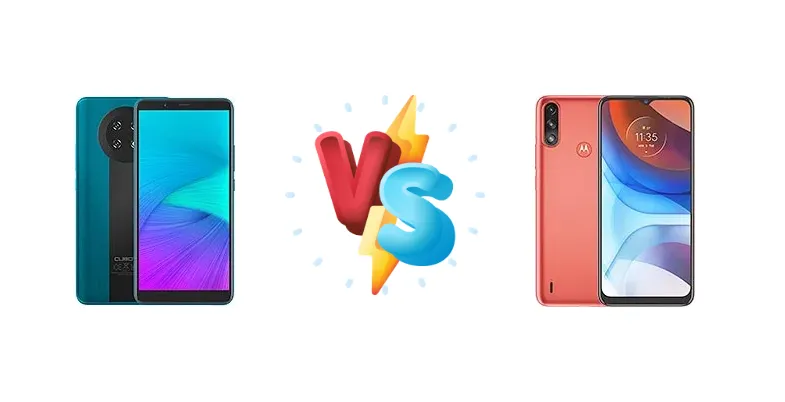
The Cubot Note 9 and Motorola Moto E7i Power represent the extreme end of the smartphone price spectrum. Both devices target first-time smartphone buyers or those needing a reliable secondary device. Crucially, both are powered by the same Unisoc SC9863A chipset, making this a comparison of software optimization, battery management, and subtle feature differences.
🏆 Quick Verdict
For the average user, the Motorola Moto E7i Power is the slightly better choice. While both phones offer identical processing power thanks to the Unisoc SC9863A, Motorola’s inclusion of 10W charging provides a more convenient and reliable charging experience, a critical factor for budget-conscious users.
| Network |
|---|
| 2G bands | GSM 850 / 900 / 1800 / 1900 | GSM 850 / 900 / 1800 / 1900 |
| 3G bands | HSDPA 900 / 2100 | HSDPA 850 / 900 / 1700(AWS) / 1900 / 2100 |
| 4G bands | 1, 3, 5, 7, 8, 19, 20, 40 | LTE |
| Speed | HSPA, LTE | HSPA, LTE |
| Technology | GSM / HSPA / LTE | GSM / HSPA / LTE |
| Launch |
|---|
| Announced | 2022 | 2021, February 23 |
| Status | Available. Released 2022 | Available. Released 2021, March 15 |
| Body |
|---|
| Build | - | Glass front, plastic back, plastic frame |
| Dimensions | 153 x 77 x 11 mm (6.02 x 3.03 x 0.43 in) | 165.1 x 75.9 x 9.2 mm (6.5 x 2.99 x 0.36 in) |
| SIM | Nano-SIM + Nano-SIM | Nano-SIM + Nano-SIM |
| Weight | - | 200 g (7.05 oz) |
| | - | Water-repellent design |
| Display |
|---|
| Resolution | Unspecified | 720 x 1600 pixels, 20:9 ratio (~270 ppi density) |
| Size | 5.99 inches | 6.51 inches, 102.3 cm2 (~81.7% screen-to-body ratio) |
| Type | IPS LCD | IPS LCD, 380 nits (typ) |
| Platform |
|---|
| CPU | Octa-core (4x1.6 GHz Cortex-A55 & 4x1.2 GHz Cortex-A55) | Octa-core (4x1.6 GHz Cortex-A55 & 4x1.2 GHz Cortex-A55) |
| Chipset | Unisoc SC9863A (28 nm) | Unisoc SC9863A (28 nm) |
| GPU | IMG8322 | IMG8322 |
| OS | Android 11 | Android 10 (Go edition) |
| Memory |
|---|
| Card slot | microSDXC (dedicated slot) | microSDXC (uses shared SIM slot) |
| Internal | 32GB 3GB RAM | 32GB 2GB RAM |
| | - | eMMC 5.1 |
| Main Camera |
|---|
| Dual | - | 13 MP, f/2.0, 26mm (wide), 1/3.1", 1.12µm, PDAF
2 MP (macro) |
| Features | LED flash | LED flash, HDR, panorama |
| Triple | 16 MP, (wide), AF
other unspecified cameras | - |
| Video | Yes | 1080p@30fps |
| Selfie camera |
|---|
| Features | - | HDR |
| Single | 5 MP | 5 MP, f/2.2, 27mm (wide), 1.12µm |
| Video | Yes | 1080p@30fps |
| Sound |
|---|
| 3.5mm jack | - | Yes |
| 35mm jack | Yes | Yes |
| Loudspeaker | Yes | Yes |
| Comms |
|---|
| Bluetooth | 4.2, A2DP | 4.2, A2DP |
| NFC | No | No |
| Positioning | GPS, GLONASS, BDS | GPS, GLONASS, GALILEO |
| Radio | Unspecified | Unspecified |
| USB | USB Type-C | USB Type-C 2.0 |
| WLAN | Wi-Fi 802.11 b/g/n | Wi-Fi 802.11 b/g/n |
| Features |
|---|
| Sensors | Accelerometer, proximity | Fingerprint (rear-mounted), accelerometer, proximity |
| Battery |
|---|
| Charging | - | 10W wired |
| Type | 5900 mAh, removable | Li-Ion 5000 mAh |
| Misc |
|---|
| Colors | Black, Green | Tahiti Blue, Coral Red |
| Models | - | XT2097-13 |
| Price | - | About 120 EUR |
Cubot Note 9
- Potentially lower price point
- May offer larger storage options (depending on configuration)
- Likely a lightweight design
- Uncertain charging standard and speed
- Less established brand reputation
- Potentially less optimized software
Motorola Moto E7i Power
- 10W wired charging for reliable power
- Established Motorola brand and software support
- Generally better software optimization
- May be slightly more expensive
- Limited performance headroom due to the chipset
- Basic camera capabilities
Display Comparison
Neither Cubot nor Motorola provide display specifications beyond size. Given the price point, both likely utilize IPS LCD panels with 720p+ resolution. Expect similar color accuracy and viewing angles. The absence of higher refresh rates or advanced features like PWM dimming control suggests both displays are geared towards basic visibility rather than immersive viewing. Bezels are likely to be substantial on both devices, maximizing screen real estate within a compact form factor.
Camera Comparison
Camera details are sparse for both devices. It's highly probable that both feature a primary camera alongside basic auxiliary sensors (likely a depth or macro lens). Given the price bracket, image quality will be acceptable in good lighting conditions but will struggle in low light. Expect limited dynamic range and detail. The absence of Optical Image Stabilization (OIS) on both devices further limits low-light performance. Focusing on the primary sensor's megapixel count is misleading; sensor size and image processing algorithms are far more critical.
Performance
The core of both devices is the Unisoc SC9863A, a 28nm octa-core processor featuring four Cortex-A55 cores clocked at 1.6 GHz and another four at 1.2 GHz. This configuration is designed for efficiency rather than raw power. Performance will be adequate for basic tasks like web browsing, social media, and light messaging. Demanding applications or multitasking will likely result in noticeable slowdowns. The shared chipset means performance differences will be minimal, largely dictated by software optimization and RAM management – an area where Motorola typically holds an advantage.
Battery Life
Battery capacity is not specified for the Cubot Note 9, but the Moto E7i Power’s battery life is a key selling point. While the exact capacity is unknown for the Cubot, the Moto E7i Power benefits from 10W wired charging. This is a significant advantage over potentially slower or non-standard charging solutions on the Cubot Note 9. 10W charging, while not fast, provides a predictable and reliable charging experience, ensuring the device can be topped up conveniently throughout the day.
Buying Guide
Buy the Cubot Note 9 if you prioritize potentially lower upfront cost and are comfortable with slower charging speeds. It's a viable option for users who primarily use their phone for basic tasks and don't mind a less refined software experience. Buy the Motorola Moto E7i Power if you value a more established brand reputation, a slightly more optimized software experience, and the convenience of 10W wired charging, even if it means paying a small premium.
Frequently Asked Questions
❓ Is the Unisoc SC9863A chipset capable of running popular apps like WhatsApp and Facebook smoothly?
Yes, the Unisoc SC9863A is sufficient for running basic applications like WhatsApp and Facebook. However, expect some lag when switching between multiple apps or using more demanding features within these applications. It's designed for light to moderate usage.
❓ How long will it take to fully charge the Motorola Moto E7i Power with the 10W charger?
While the exact 0-100% charge time isn't officially specified, expect it to take approximately 3-4 hours to fully charge the Motorola Moto E7i Power using the included 10W charger. This is a standard charging time for devices in this price range.
❓ Can I play games like PUBG Mobile on either of these phones?
While technically possible to *launch* PUBG Mobile, the Unisoc SC9863A chipset is not powerful enough to provide a smooth or enjoyable gaming experience. Expect very low frame rates and significant lag, even on the lowest graphics settings. These phones are not designed for gaming.