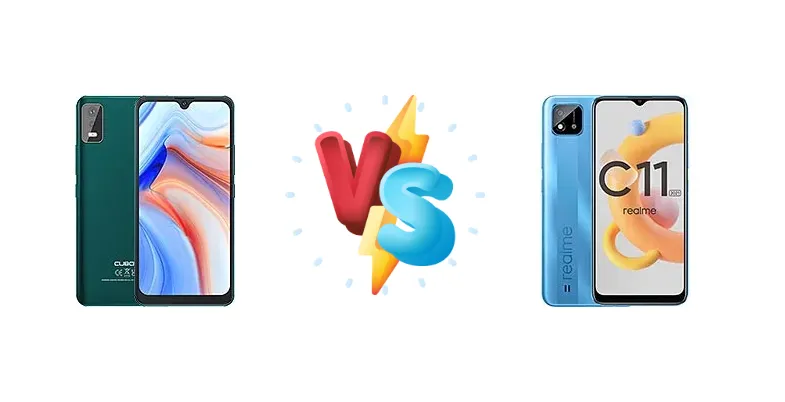
The sub-$150 smartphone market is fiercely competitive. Both the Cubot Note 8 and the Realme C11 (2021) aim to deliver essential smartphone functionality at an incredibly low price point. However, they take different approaches to achieving this, with significant differences in processing power and features. This comparison will dissect those differences to help you determine which device best suits your needs.
🏆 Quick Verdict
For the average user prioritizing responsiveness and multitasking, the Realme C11 (2021) is the clear winner. Its octa-core Unisoc SC9863A processor provides a substantial performance advantage over the Cubot Note 8’s quad-core Mediatek MT6739WW, making everyday tasks smoother and more enjoyable. While both phones are limited, the Realme offers a better user experience.
| Network |
|---|
| 2G bands | GSM 850 / 900 / 1800 / 1900 | GSM 850 / 900 / 1800 / 1900 |
| 3G bands | HSDPA 900 / 2100 | HSDPA 850 / 900 / 1900 / 2100 |
| 4G bands | 1, 3, 5, 7, 8, 19, 20 | 1, 3, 5, 8, 38, 40, 41 |
| Speed | HSPA, LTE | HSPA, LTE |
| Technology | GSM / HSPA / LTE | GSM / HSPA / LTE |
| Launch |
|---|
| Announced | 2022 | 2021, June 28 |
| Status | Available. Released 2022 | Available. Released 2021, June 28 |
| Body |
|---|
| Build | - | Glass front, plastic frame, plastic back |
| Dimensions | 138 x 65 x 10.8 mm (5.43 x 2.56 x 0.43 in) | 165.2 x 76.4 x 8.9 mm (6.50 x 3.01 x 0.35 in) |
| SIM | Nano-SIM + Nano-SIM | Nano-SIM + Nano-SIM |
| Weight | 143 g (5.04 oz) | 190 g (6.70 oz) |
| | - | Splash resistant design |
| Display |
|---|
| Resolution | 442 x 960 pixels, 19.5:9 ratio (~192 ppi density) | 720 x 1600 pixels, 20:9 ratio (~269 ppi density) |
| Size | 5.5 inches, 74.1 cm2 (~82.7% screen-to-body ratio) | 6.52 inches, 102.6 cm2 (~81.3% screen-to-body ratio) |
| Type | IPS LCD | IPS LCD, 400 nits (typ) |
| Platform |
|---|
| CPU | Quad-core 1.3 GHz Cortex-A53 | Octa-core (4x1.6 GHz Cortex-A55 & 4x1.2 GHz Cortex-A55) |
| Chipset | Mediatek MT6739WW (28 nm) | Unisoc SC9863A (28 nm) |
| GPU | PowerVR GE8100 | IMG8322 |
| OS | Android 11 | Android 11, Realme Go UI |
| Memory |
|---|
| Card slot | microSDXC (dedicated slot) | microSDXC (dedicated slot) |
| Internal | 16GB 2GB RAM | 32GB 2GB RAM, 64GB 4GB RAM |
| | - | eMMC 5.1 |
| Main Camera |
|---|
| Dual | 13 MP, (wide), AF
0.3 MP | - |
| Features | LED flash | LED flash, HDR, panorama |
| Single | - | 8 MP, f/2.0, (wide), AF |
| Video | Yes | 1080p@30fps |
| Selfie camera |
|---|
| Features | - | HDR, panorama |
| Single | 5 MP | 5 MP, f/2.2, (wide) |
| Video | Yes | 1080p@30fps |
| Sound |
|---|
| 3.5mm jack | - | Yes |
| 35mm jack | Yes | Yes |
| Loudspeaker | Yes | Yes |
| Comms |
|---|
| Bluetooth | 4.2, A2DP | 4.2, A2DP |
| NFC | No | No |
| Positioning | GPS, GLONASS | GPS, GLONASS, GALILEO, BDS |
| Radio | Unspecified | Unspecified |
| USB | Yes | microUSB 2.0, OTG |
| WLAN | Wi-Fi 802.11 a/b/g/n | Wi-Fi 802.11 b/g/n |
| Features |
|---|
| Sensors | Accelerometer, proximity | Accelerometer, gyro, proximity, compass |
| Battery |
|---|
| Charging | - | 10W wired
Reverse wired |
| Type | 3100 mAh, removable | 5000 mAh |
| Misc |
|---|
| Colors | Black, Green | Cool Blue, Cool Grey |
| Models | - | RMX3231 |
| Price | - | About 80 EUR |
Cubot Note 8
- Potentially lower price point
- Basic smartphone functionality
- May include features not found on the Realme (depending on specific model variations)
- Significantly slower processor
- Less responsive user experience
- Likely inferior camera performance
Realme C11 (2021)
- Faster octa-core processor
- Larger 5000mAh battery
- Reverse wired charging capability
- 10W charging is relatively slow
- Camera performance is still limited
- May be slightly more expensive than the Cubot Note 8
Display Comparison
Neither device boasts a standout display. Both utilize 28nm chipsets, suggesting a focus on cost reduction over display quality. Specifics like panel type (IPS vs. TFT) and resolution are not provided, but given the price point, expect 720p resolution. The Realme C11 (2021) doesn't benefit from features like high refresh rates or HDR support, and the Cubot Note 8 is likely similar. Bezels are expected to be substantial on both, maximizing screen real estate within a compact form factor.
Camera Comparison
Camera performance on both devices will be limited. Details regarding sensor size and image processing are unavailable. However, given the price bracket, expect basic 8-13MP main sensors. The Realme C11 (2021) may offer slightly better image processing capabilities due to its more modern chipset, but don't expect flagship-level results. The presence of a 2MP macro camera on either device is largely a marketing gimmick, offering minimal practical benefit due to the low resolution and lack of optical image stabilization (OIS).
Performance
The core difference lies in the chipset. The Realme C11 (2021) features the Unisoc SC9863A, an octa-core processor with a combination of 1.6 GHz and 1.2 GHz Cortex-A55 cores. This configuration provides a significant advantage over the Cubot Note 8’s Mediatek MT6739WW, a quad-core 1.3 GHz Cortex-A53 processor. The Cortex-A55 architecture in the Realme is more efficient and offers better performance per clock cycle than the older Cortex-A53. This translates to faster app loading times, smoother multitasking, and a more responsive user interface on the Realme. While neither is a gaming powerhouse, the Realme will handle less demanding games with greater ease.
Battery Life
Battery capacity is not specified for the Cubot Note 8, but the Realme C11 (2021) packs a 5000mAh battery. Coupled with the more efficient Unisoc SC9863A processor, the Realme should deliver all-day battery life for moderate usage. The Realme C11 (2021) also supports 10W wired charging and, crucially, reverse wired charging, allowing it to act as a power bank for other devices – a feature absent on the Cubot Note 8. While 10W charging isn’t fast, it’s sufficient for overnight charging.
Buying Guide
Buy the Cubot Note 8 if you need a basic, functional smartphone for calls, texts, and very light app usage, and are constrained by the absolute lowest possible budget. Buy the Realme C11 (2021) if you prefer a more responsive experience for social media, browsing, and occasional gaming, and value the convenience of reverse wired charging.
Frequently Asked Questions
❓ Will the Realme C11 (2021) be able to run popular social media apps like TikTok and Instagram smoothly?
Yes, the Realme C11 (2021)'s octa-core Unisoc SC9863A processor is significantly more capable than the Cubot Note 8's processor and should handle TikTok, Instagram, and similar apps with acceptable smoothness. Expect some occasional slowdowns with multiple apps open, but it will be a far more pleasant experience than on the Cubot Note 8.
❓ Can the Realme C11 (2021) be used for basic mobile gaming?
The Realme C11 (2021) can handle less demanding mobile games like Candy Crush or Subway Surfers. However, graphically intensive games like PUBG Mobile will likely require very low settings and may still experience frame rate drops. The Cubot Note 8 will struggle even more with gaming due to its weaker processor.
❓ What type of charging port do both phones use?
Both the Cubot Note 8 and the Realme C11 (2021) utilize a micro-USB port for charging and data transfer. This is standard for phones in this price range, though it's slower and less convenient than the USB-C port found on more expensive devices.
❓ Does the Realme C11 (2021)'s reverse charging feature work with any device?
The Realme C11 (2021)'s reverse wired charging feature works with any device that can be charged via a micro-USB cable. However, the 10W charging speed is relatively slow, so it's best suited for topping up smaller devices like wireless earbuds or smartwatches, rather than fully charging another smartphone.