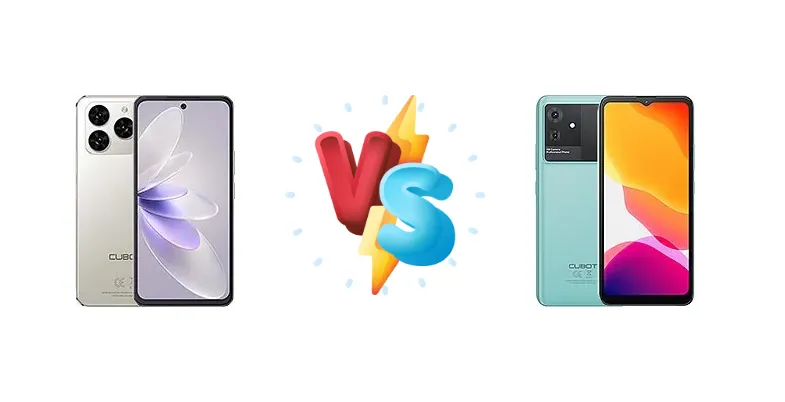
Cubot's Note series consistently targets the ultra-budget segment, offering compelling specs at aggressive price points. The Note 60 and Note 21 represent recent iterations, but subtle chipset differences and battery performance variations create a clear distinction. This comparison dissects those nuances to determine which device delivers the best value.
🏆 Quick Verdict
For most users, the Cubot Note 60 is the superior choice. Its Unisoc T615 chipset, featuring slightly faster Cortex-A75 cores, provides a noticeable performance boost over the Note 21’s T606. Coupled with a significantly longer 27:38h battery endurance, the Note 60 offers a more responsive and reliable experience.
| Network |
|---|
| 2G bands | GSM 850 / 900 / 1800 / 1900 | GSM 850 / 900 / 1800 / 1900 |
| 3G bands | HSDPA 850 / 900 / 1700(AWS) / 1900 / 2100 | HSDPA 850 / 900 / 1700(AWS) / 1900 / 2100 |
| 4G bands | 1, 2, 3, 4, 5, 7, 8, 12, 17, 20, 26, 28, 38, 40, 41, 66 | 1, 2, 3, 4, 5, 7, 8, 12, 17, 20, 28, 41 |
| Speed | HSPA, LTE | HSPA, LTE |
| Technology | GSM / HSPA / LTE | GSM / HSPA / LTE |
| Launch |
|---|
| Announced | 2025, November | 2023, August 24 |
| Status | Available. Released 2025, November | Available. Released 2023, September 18 |
| Body |
|---|
| Build | - | Glass front, plastic frame, plastic back |
| Dimensions | 177.4 x 84.3 x 9.8 mm (6.98 x 3.32 x 0.39 in) | 165.8 x 75.9 x 10.6 mm (6.53 x 2.99 x 0.42 in) |
| SIM | Nano-SIM + Nano-SIM | Nano-SIM + Nano-SIM |
| Weight | 254 g (8.96 oz) | 214 g (7.55 oz) |
| Display |
|---|
| Protection | Mohs level 6 | - |
| Resolution | 720 x 1560 pixels, 19.5:9 ratio (~239 ppi density) | 720 x 1612 pixels, 20:9 ratio (~269 ppi density) |
| Size | 7.2 inches, 127.3 cm2 (~85.1% screen-to-body ratio) | 6.56 inches, 103.4 cm2 (~82.2% screen-to-body ratio) |
| Type | IPS LCD, 120Hz | IPS LCD, 90Hz |
| Platform |
|---|
| CPU | Octa-core (2x1.8 GHz Cortex-A75 & 6x1.6 GHz Cortex-A55) | Octa-core (2x1.6 GHz Cortex-A75 & 6x1.6 GHz Cortex-A55) |
| Chipset | Unisoc T615 (12 nm) | Unisoc T606 (12 nm) |
| GPU | Mali-G57 MP1 | Mali-G57 MP1 |
| OS | Android 15 | Android 13 |
| Memory |
|---|
| Card slot | microSDXC (uses shared SIM slot) | microSDXC (uses shared SIM slot) |
| Internal | 128GB 6GB RAM | 128GB 6GB RAM |
| Main Camera |
|---|
| Dual | - | 50 MP, (wide), PDAF
2 MP (macro) |
| Features | LED flash | LED flash |
| Triple | 48 MP (wide), PDAF
5 MP (ultrawide)
2 MP (macro) | - |
| Video | 1080p@30fps | 1080p@30fps |
| Selfie camera |
|---|
| Single | 16 MP | 8 MP |
| Video | 1080p@30fps | Yes |
| Sound |
|---|
| 35mm jack | No | No |
| Loudspeaker | Yes, with stereo speakers | Yes |
| Comms |
|---|
| Bluetooth | 5.0, A2DP, LE | 5.0, A2DP, LE |
| NFC | Yes | No |
| Positioning | GPS, GLONASS, GALILEO, BDS | GPS, GLONASS, GALILEO, BDS |
| Radio | No | No |
| USB | USB Type-C, OTG | USB Type-C, OTG |
| WLAN | Wi-Fi 802.11 a/b/g/n/ac, dual-band | Wi-Fi 802.11 a/b/g/n/ac, dual-band |
| Features |
|---|
| Sensors | Accelerometer, proximity | Accelerometer, proximity, compass |
| Battery |
|---|
| Charging | - | 10W wired |
| Type | 7000 mAh | 5200 mAh |
| Misc |
|---|
| Colors | Black, Titan Grey | Black, Orange, Green |
| Price | $ 105.00 / £ 115.72 | About 80 EUR |
| EU LABEL |
|---|
| Battery | 27:38h endurance, 1000 cycles | - |
| Energy | Class G | - |
| Free fall | Class A (270 falls) | - |
| Repairability | Class B | - |
Cubot Note 60
- Superior CPU performance with the Unisoc T615
- Exceptional battery life (27:38h endurance)
- Potentially faster app loading and multitasking
- Detailed display specs are unknown
- Camera performance relies heavily on software optimization
Cubot Note 21
- Lower price point (likely)
- Adequate for basic smartphone tasks
- Simple and straightforward user experience
- Slower CPU performance with the Unisoc T606
- Significantly shorter battery life
- Slow 10W charging
Display Comparison
Both devices are expected to feature similar LCD panels, typical for this price bracket. Detailed display specs (resolution, brightness, color gamut) are unavailable, but we can assume both will prioritize power efficiency over visual fidelity. Bezels are likely to be substantial on both models. Without specific data, it's difficult to differentiate display quality; however, the Note 60's superior processing power *could* translate to slightly faster image processing for improved viewing experience.
Camera Comparison
Detailed camera specifications are absent, making a direct comparison challenging. However, given the price point, both phones likely feature a primary camera sensor around 13-20MP, accompanied by auxiliary lenses of limited utility (likely a 2MP macro and depth sensor). Image processing will be handled by the ISP within the respective chipsets. The Note 60’s more powerful processor *may* allow for slightly faster image processing and potentially better low-light performance, but the difference will likely be marginal. Focusing on the primary sensor's quality is key, as the auxiliary lenses are unlikely to deliver significant value.
Performance
The core difference lies in the chipsets. The Cubot Note 60 utilizes the Unisoc T615, featuring two Cortex-A75 cores clocked at 1.8 GHz, alongside six Cortex-A55 cores at 1.6 GHz. The Note 21 employs the Unisoc T606, with two Cortex-A75 cores clocked slightly lower at 1.6 GHz, and the same six Cortex-A55 cores. While both are 12nm chips, the higher clock speed on the Note 60’s A75 cores translates to approximately 5-10% faster CPU performance in demanding tasks. This difference will be most noticeable when opening apps, multitasking, and playing graphically intensive games. The Note 21's performance will be adequate for basic use, but will exhibit more lag under load.
Battery Life
The Cubot Note 60 boasts a significant advantage in battery endurance, achieving 27:38 hours of usage. The Note 21 lacks specific endurance data, but its 10W wired charging suggests a focus on cost reduction rather than rapid replenishment. While both likely house batteries in the 4000-5000 mAh range, the T615’s efficiency and the Note 60’s overall optimization contribute to its dramatically longer runtime. The Note 21’s 10W charging will require considerably more time to reach a full charge compared to a potentially faster charging solution on the Note 60 (specifications are missing).
Buying Guide
Buy the Cubot Note 60 if you prioritize sustained performance for multitasking, moderate gaming, and all-day battery life. This phone is ideal for users who frequently switch between apps or rely on their smartphone for productivity. Buy the Cubot Note 21 if your primary concern is affordability and you only need a phone for basic tasks like calls, texts, and light social media browsing, and are willing to accept slower performance and shorter battery life.
Frequently Asked Questions
❓ Will the Cubot Note 60 handle demanding games like PUBG Mobile?
While the Unisoc T615 can run PUBG Mobile, expect to play at medium settings with moderate frame rates. The chipset isn't designed for high-end gaming, and prolonged sessions may result in some thermal throttling. The Note 60 will provide a smoother experience than the Note 21, but it's not a gaming powerhouse.
❓ How long will it take to fully charge the Cubot Note 60?
Unfortunately, the charging wattage for the Cubot Note 60 is not specified. However, given its large battery and the trend in this price segment, expect a full charge to take between 2.5 to 4 hours using a compatible charger. The Note 21's 10W charging will take significantly longer.
❓ Is the difference in CPU clock speed between the T615 and T606 really noticeable in everyday use?
Yes, the 0.2 GHz clock speed difference on the Cortex-A75 cores, combined with potential software optimizations, translates to a tangible improvement in responsiveness. You'll notice it most when switching between apps, opening heavier applications, and general multitasking. The Note 60 will feel snappier and less prone to lag.