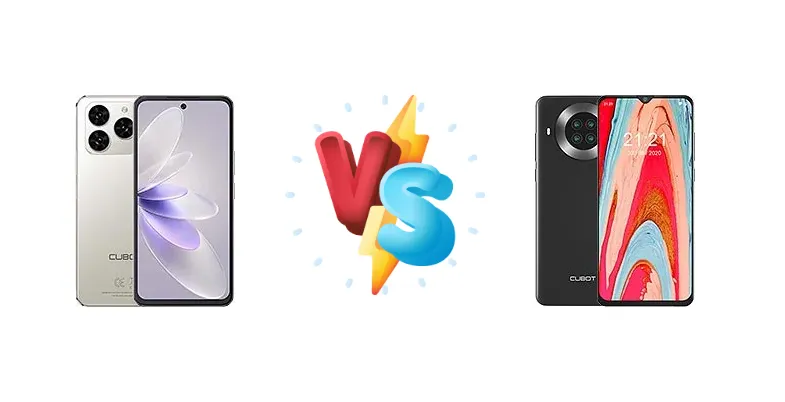
Cubot's Note series consistently targets the budget-conscious consumer, but the Note 60 and Note 20 Pro represent distinct approaches. The Note 60 prioritizes extended battery life, while the Note 20 Pro aims for a performance edge with its older, but potentially more potent, Helio P60 chipset. This comparison dissects these differences to determine which device delivers the best value.
🏆 Quick Verdict
For the average user prioritizing all-day battery life and consistent performance for everyday tasks, the Cubot Note 60 is the better choice. Its Unisoc T615 chipset, coupled with exceptional 27:38h endurance, outweighs the Note 20 Pro’s slightly faster CPU cores, especially considering the latter’s potentially higher power consumption.
| Network |
|---|
| 2G bands | GSM 850 / 900 / 1800 / 1900 | GSM 850 / 900 / 1800 / 1900 |
| 3G bands | HSDPA 850 / 900 / 1700(AWS) / 1900 / 2100 | HSDPA 900 / 2100 |
| 4G bands | 1, 2, 3, 4, 5, 7, 8, 12, 17, 20, 26, 28, 38, 40, 41, 66 | 1, 3, 7, 8, 19, 20 |
| Speed | HSPA, LTE | HSPA, LTE |
| Technology | GSM / HSPA / LTE | GSM / HSPA / LTE |
| Launch |
|---|
| Announced | 2025, November | 2020. Released 2020 |
| Status | Available. Released 2025, November | Discontinued |
| Body |
|---|
| Dimensions | 177.4 x 84.3 x 9.8 mm (6.98 x 3.32 x 0.39 in) | 162.8 x 75.4 x 9.1 mm (6.41 x 2.97 x 0.36 in) |
| SIM | Nano-SIM + Nano-SIM | Nano-SIM + Nano-SIM |
| Weight | 254 g (8.96 oz) | 200 g (7.05 oz) |
| Display |
|---|
| Protection | Mohs level 6 | - |
| Resolution | 720 x 1560 pixels, 19.5:9 ratio (~239 ppi density) | 720 x 1600 pixels, 20:9 ratio (~270 ppi density) |
| Size | 7.2 inches, 127.3 cm2 (~85.1% screen-to-body ratio) | 6.5 inches, 102.0 cm2 (~83.1% screen-to-body ratio) |
| Type | IPS LCD, 120Hz | IPS LCD |
| Platform |
|---|
| CPU | Octa-core (2x1.8 GHz Cortex-A75 & 6x1.6 GHz Cortex-A55) | Octa-core (4x2.0 GHz Cortex-A73 & 4x2.0 GHz Cortex-A53) |
| Chipset | Unisoc T615 (12 nm) | Mediatek MT6771 Helio P60 (12 nm) |
| GPU | Mali-G57 MP1 | Mali-G72 MP3 |
| OS | Android 15 | Android 10 |
| Memory |
|---|
| Card slot | microSDXC (uses shared SIM slot) | microSDXC (dedicated slot) |
| Internal | 128GB 6GB RAM | 128GB 8GB RAM |
| Main Camera |
|---|
| Features | LED flash | LED flash |
| Quad | - | 12 MP, (wide), 1/2.9", AF
20 MP, (depth), 1/2.78"
Auxiliary lenses |
| Triple | 48 MP (wide), PDAF
5 MP (ultrawide)
2 MP (macro) | - |
| Video | 1080p@30fps | Yes |
| Selfie camera |
|---|
| Single | 16 MP | 8 MP |
| Video | 1080p@30fps | Yes |
| Sound |
|---|
| 35mm jack | No | Yes |
| Loudspeaker | Yes, with stereo speakers | Yes |
| Comms |
|---|
| Bluetooth | 5.0, A2DP, LE | 4.2, A2DP |
| NFC | Yes | Yes |
| Positioning | GPS, GLONASS, GALILEO, BDS | GPS |
| Radio | No | Unspecified |
| USB | USB Type-C, OTG | microUSB, OTG |
| WLAN | Wi-Fi 802.11 a/b/g/n/ac, dual-band | Wi-Fi 802.11 a/b/g/n |
| Features |
|---|
| Sensors | Accelerometer, proximity | Accelerometer, gyro, proximity, compass |
| Battery |
|---|
| Type | 7000 mAh | 4200 mAh, removable |
| Misc |
|---|
| Colors | Black, Titan Grey | Black, Blue, Green |
| Price | $ 105.00 / £ 115.72 | - |
| EU LABEL |
|---|
| Battery | 27:38h endurance, 1000 cycles | - |
| Energy | Class G | - |
| Free fall | Class A (270 falls) | - |
| Repairability | Class B | - |
Cubot Note 60
- Exceptional battery life (27:38h endurance)
- Modern CPU architecture (Cortex-A75 cores)
- Potentially better long-term battery health (1000 cycles)
- Potentially lower peak performance compared to the Note 20 Pro
- Limited information on display quality
Cubot Note 20 Pro
- Slightly faster CPU clock speeds (Cortex-A73 cores)
- Potentially smoother multitasking
- May handle older games slightly better
- Likely shorter battery life
- Older chipset may struggle with future software updates
Display Comparison
Neither device’s display specifications are provided, so a direct comparison is limited. However, given the price point, both likely utilize IPS LCD panels. The focus here shifts to internal processing, as display quality is unlikely to be a major differentiator. Expect standard 60Hz refresh rates on both, and color accuracy will likely be adequate for everyday use but not professional-grade.
Camera Comparison
Without specific camera sensor details, a detailed comparison is impossible. However, it’s safe to assume both phones feature budget-oriented camera systems. The presence of a 2MP macro lens on either device is likely more for marketing than practical use. Image quality will heavily rely on software processing, and the Note 60’s more efficient chipset could allow for slightly better image processing without significantly impacting battery life. Expect decent results in good lighting conditions, but performance will degrade in low-light scenarios.
Performance
The core difference lies in the chipsets. The Cubot Note 60’s Unisoc T615 (12nm) features a dual-cluster configuration with 2x 1.8 GHz Cortex-A75 cores and 6x 1.6 GHz Cortex-A55 cores. The Note 20 Pro utilizes the MediaTek Helio P60 (12nm) with 4x 2.0 GHz Cortex-A73 cores and 4x 2.0 GHz Cortex-A53 cores. While the Helio P60’s A73 cores have a slightly higher clock speed, the A75 cores in the T615 offer a more modern architecture, potentially leading to better single-core performance despite the lower clock speed. The T615’s efficiency gains from its architecture are crucial, directly impacting battery life. The Note 20 Pro’s older chipset may struggle with newer software updates and demanding applications over time.
Battery Life
This is where the Cubot Note 60 truly shines. Its 27:38h endurance is a significant advantage over what we’d expect from the Note 20 Pro, which lacks a specified endurance rating. The Unisoc T615’s power efficiency, combined with a likely optimized software experience, contributes to this exceptional battery life. While the Note 20 Pro’s Helio P60 might offer a slight performance boost, it will come at the cost of reduced uptime. The Note 60’s stated 1000 charge cycles also suggest a focus on long-term battery health.
Buying Guide
Buy the Cubot Note 60 if you need a phone that can reliably last through a full day – and then some – of moderate use, including streaming, social media, and calls. It’s ideal for users who value longevity over raw processing power. Buy the Cubot Note 20 Pro if you prioritize slightly faster app loading times and smoother multitasking, and are willing to accept potentially shorter battery life. This phone is better suited for users who occasionally engage in light gaming or demand quicker responsiveness from their device.
Frequently Asked Questions
❓ Will the Unisoc T615 in the Note 60 struggle with demanding games like PUBG Mobile?
While the Unisoc T615 isn't a gaming powerhouse, it should be capable of running PUBG Mobile at medium settings with reasonable frame rates. However, expect some frame drops during intense action. The Note 20 Pro’s Helio P60 might offer a slightly smoother experience, but the difference won’t be dramatic.
❓ How does the power efficiency of the Unisoc T615 impact the overall user experience of the Note 60?
The Unisoc T615’s power efficiency translates directly into significantly longer battery life. This means you can use the Note 60 for a full day of moderate use without needing to worry about finding a charger. It also means less heat generation, leading to a more comfortable user experience during prolonged use.
❓ Is the Helio P60 in the Note 20 Pro likely to receive future software updates?
Given the Helio P60 is an older chipset, the likelihood of receiving major Android updates is low. Cubot may provide security patches for a limited time, but don’t expect the Note 20 Pro to stay current with the latest Android features for an extended period.