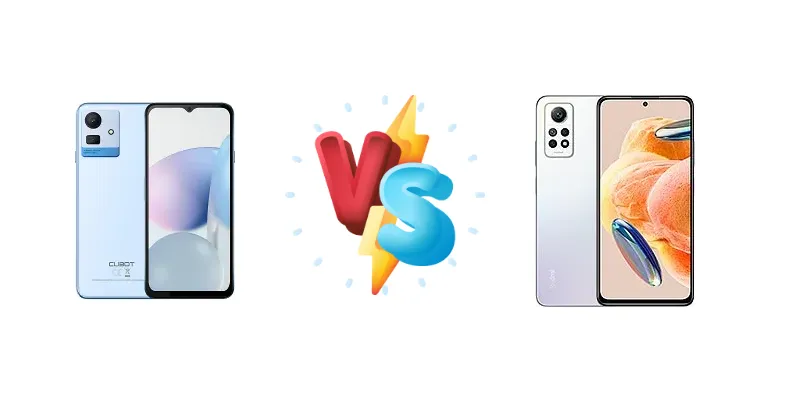
The sub-$200 smartphone market is fiercely competitive. The Cubot Note 50 aims to deliver essential features at an aggressive price point, while the Xiaomi Redmi Note 12 Pro 4G offers a more established brand and a potentially more refined experience. This comparison dives deep into the core differences – specifically the chipset and charging capabilities – to determine which device offers the best value for your money.
🏆 Quick Verdict
For the average user prioritizing consistent performance and fast charging, the Xiaomi Redmi Note 12 Pro 4G is the clear winner. Its Snapdragon 732G chipset, built on an 8nm process, provides a noticeable performance advantage over the Cubot Note 50’s Unisoc T606, and the 67W charging significantly reduces downtime.
| Network |
|---|
| 2G bands | GSM 850 / 900 / 1800 / 1900 | GSM 850 / 900 / 1800 / 1900 |
| 3G bands | HSDPA 850 / 900 / 1700(AWS) / 1900 / 2100 | HSDPA 850 / 900 / 1700(AWS) / 1900 / 2100 |
| 4G bands | 1, 2, 3, 4, 5, 7, 8, 12, 17, 20, 28, 41 | 1, 2, 3, 4, 5, 7, 8, 20, 28, 38, 40, 41, 66 |
| Speed | HSPA, LTE | HSPA, LTE |
| Technology | GSM / HSPA / LTE | GSM / HSPA / LTE |
| Launch |
|---|
| Announced | 2023, July | 2023, March 03 |
| Status | Available. Released 2023, August 07 | Available. Released 2023, April 11 |
| Body |
|---|
| Build | Glass front, plastic frame, plastic back | - |
| Dimensions | 165.8 x 75.8 x 10.1 mm (6.53 x 2.98 x 0.40 in) | 164.2 x 76.1 x 8.1 mm (6.46 x 3.00 x 0.32 in) |
| SIM | Nano-SIM + Nano-SIM | Nano-SIM + Nano-SIM |
| Weight | 233 g (8.22 oz) | 201.8 g (7.13 oz) |
| Display |
|---|
| Resolution | 720 x 1612 pixels, 20:9 ratio (~269 ppi density) | 1080 x 2400 pixels, 20:9 ratio (~395 ppi density) |
| Size | 6.56 inches, 103.4 cm2 (~82.3% screen-to-body ratio) | 6.67 inches, 107.4 cm2 (~86.0% screen-to-body ratio) |
| Type | IPS LCD, 90Hz | AMOLED, 120Hz, Dolby Vision, 700 nits (HBM), 1100 nits (peak) |
| Platform |
|---|
| CPU | Octa-core (2x1.6 GHz Cortex-A75 & 6x1.6 GHz Cortex-A55) | Octa-core (2x2.2 GHz Kryo 470 Gold & 6x1.8 GHz Kryo 470 Silver) |
| Chipset | Unisoc T606 (12 nm) | Qualcomm SM7150 Snapdragon 732G (8 nm) |
| GPU | Mali-G57 MP1 | Adreno 618 |
| OS | Android 13 | Android 11, MIUI 13 |
| Memory |
|---|
| Card slot | microSDXC (uses shared SIM slot) | microSDXC (uses shared SIM slot) |
| Internal | 256GB 8GB RAM | 128GB 6GB RAM, 128GB 8GB RAM, 256GB 8GB RAM |
| | - | UFS 2.2 |
| Main Camera |
|---|
| Dual | 50 MP, (wide), PDAF
2 MP (macro) | - |
| Features | LED flash | LED flash, HDR, panorama |
| Quad | - | 108 MP, f/1.9, (wide), 1/1.52", 0.7µm, PDAF
8 MP, 120˚, (ultrawide)
2 MP (macro)
Auxiliary lens |
| Video | 1080p@30fps | 4K@30fps, 1080p@30/60fps |
| Selfie camera |
|---|
| Single | 8 MP | 16 MP, f/2.4, (wide) |
| Video | Yes | 1080p@30fps |
| Sound |
|---|
| 3.5mm jack | - | Yes |
| 35mm jack | No | Yes |
| Loudspeaker | Yes | Yes, with stereo speakers |
| Comms |
|---|
| Bluetooth | 5.0, A2DP, LE | 5.0, A2DP, LE |
| Infrared port | - | Yes |
| NFC | Yes | Yes (market/region dependent) |
| Positioning | GPS, GLONASS, GALILEO, BDS | GPS, GLONASS, GALILEO, BDS |
| Radio | No | Unspecified |
| USB | USB Type-C, OTG | USB Type-C 2.0, OTG |
| WLAN | Wi-Fi 802.11 a/b/g/n/ac, dual-band | Wi-Fi 802.11 a/b/g/n/ac, dual-band |
| Features |
|---|
| Sensors | Fingerprint (side-mounted), accelerometer, gyro, proximity, compass | Fingerprint (side-mounted), accelerometer, gyro, compass |
| Battery |
|---|
| Charging | - | 67W wired |
| Type | 5200 mAh | Li-Po 5000 mAh |
| Misc |
|---|
| Colors | Black, Purple, Green, Blue | Star Blue, Graphite Gray, Polar White, Ice blue |
| Models | - | 2209116AG, 2209116AG |
| Price | About 130 EUR | About 150 EUR |
Cubot Note 50
- Potentially lower price point
- Functional for basic smartphone tasks
- May offer longer battery life due to less powerful chipset (depending on battery capacity)
- Significantly weaker performance compared to the Snapdragon 732G
- Slower charging speeds
- Uncertain display quality and potential for screen flicker
Xiaomi Redmi Note 12 Pro 4G
- Superior performance with the Snapdragon 732G chipset
- Ultra-fast 67W wired charging
- Likely better display quality and image processing
- Higher price compared to the Cubot Note 50
- May not be ideal for users solely focused on maximizing battery life
Display Comparison
Neither device boasts a flagship-level display. While specific display specs (resolution, panel type) are missing for the Cubot Note 50, the Redmi Note 12 Pro 4G is likely to offer a superior viewing experience due to Xiaomi’s generally higher display quality standards. The absence of information on PWM dimming frequency for the Cubot Note 50 raises concerns for users sensitive to flicker, while Xiaomi typically implements higher frequencies in this price range.
Camera Comparison
Without detailed camera specifications for the Cubot Note 50, a direct comparison is difficult. However, Xiaomi typically focuses on delivering competitive camera systems in this price bracket. The Redmi Note 12 Pro 4G likely features a more capable main sensor and superior image processing algorithms. The presence of Optical Image Stabilization (OIS) – a common feature in Redmi Pro models – would further enhance image quality, particularly in low-light conditions. We can assume the Cubot Note 50 will rely heavily on software processing to compensate for a potentially less capable sensor.
Performance
The core difference lies in the chipsets. The Xiaomi Redmi Note 12 Pro 4G’s Qualcomm Snapdragon 732G (8nm) is a significant step up from the Cubot Note 50’s Unisoc T606 (12nm). The 8nm process node allows for greater transistor density and improved power efficiency, translating to better sustained performance and less thermal throttling. The Snapdragon 732G’s Kryo 470 Gold cores, clocked at 2.2 GHz, outperform the Unisoc T606’s Cortex-A75 cores at 1.6 GHz. This difference will be most noticeable in demanding tasks like gaming and video editing. The Redmi Note 12 Pro 4G will handle graphically intensive games with higher frame rates and smoother gameplay.
Battery Life
While the exact battery capacity of both devices is unknown, the Redmi Note 12 Pro 4G’s 67W wired charging is a game-changer. This allows for a full charge in under 45 minutes, minimizing downtime. The Cubot Note 50 will likely offer slower charging speeds, potentially taking over two hours to reach 100%. Even if the Cubot Note 50 has a slightly larger battery capacity, the Redmi Note 12 Pro 4G’s faster charging effectively mitigates any advantage.
Buying Guide
Buy the Cubot Note 50 if you need a functional smartphone for basic tasks like calling, texting, and light social media use, and your budget is extremely limited. Buy the Xiaomi Redmi Note 12 Pro 4G if you prefer a smoother user experience, faster app loading times, and the convenience of incredibly rapid 67W charging, even if it means spending a bit more.
Frequently Asked Questions
❓ Will the Unisoc T606 in the Cubot Note 50 struggle with multitasking?
Yes, the Unisoc T606 is a budget-oriented chipset. While it can handle basic multitasking, expect slowdowns and lag when running multiple demanding apps simultaneously. The Snapdragon 732G in the Redmi Note 12 Pro 4G offers a much smoother multitasking experience.
❓ How long does it realistically take to charge the Xiaomi Redmi Note 12 Pro 4G from 0% to 100%?
With 67W charging, the Redmi Note 12 Pro 4G can typically charge from 0% to 100% in around 40-45 minutes. This is a significant advantage over slower charging phones, allowing you to quickly top up your battery when needed.
❓ Is the Snapdragon 732G still a capable chipset for gaming in 2024?
While not a flagship-level gaming chip, the Snapdragon 732G remains quite capable for most mobile games. You can expect to play popular titles like PUBG Mobile and Call of Duty Mobile at medium to high settings with stable frame rates. However, demanding games at maximum settings may require some compromises.
❓ Does the Cubot Note 50 support widevine L1 for HD streaming?
Information on Widevine L1 support for the Cubot Note 50 is currently unavailable. This is important for streaming HD content from services like Netflix and Amazon Prime Video. The Redmi Note 12 Pro 4G is likely to support Widevine L1, ensuring access to HD streaming.