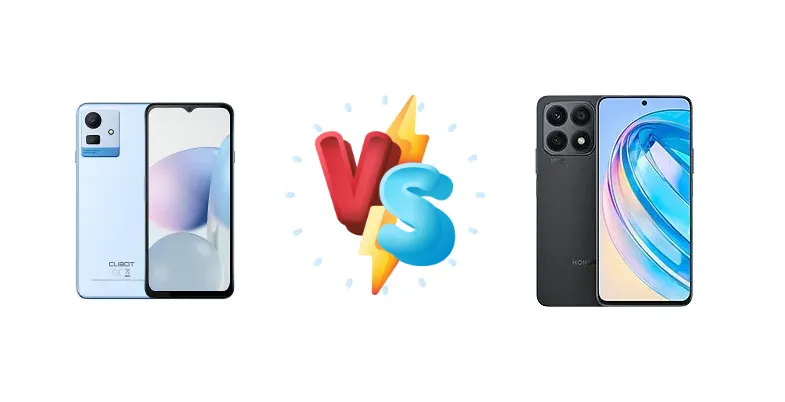
The sub-$200 smartphone market is fiercely competitive. The Cubot Note 50 and Honor X8a both aim to deliver a solid experience without breaking the bank, but they take different approaches. The Note 50 focuses on a streamlined experience with a Unisoc chipset, while the X8a leverages MediaTek’s Helio G88 and faster charging. This comparison dives deep into the specifics to determine which device offers the best value.
🏆 Quick Verdict
For the average user prioritizing responsiveness and faster charging, the Honor X8a is the better choice. Its Helio G88 chipset, clocked higher at 2.0 GHz versus the Note 50’s 1.6 GHz, provides a noticeable performance edge, and the 22.5W charging significantly reduces downtime. However, the Note 50 remains a viable option for those on a tighter budget.
| Network |
|---|
| 2G bands | GSM 850 / 900 / 1800 / 1900 | GSM 850 / 900 / 1800 / 1900 |
| 3G bands | HSDPA 850 / 900 / 1700(AWS) / 1900 / 2100 | HSDPA 850 / 900 / 2100 |
| 4G bands | 1, 2, 3, 4, 5, 7, 8, 12, 17, 20, 28, 41 | LTE |
| Speed | HSPA, LTE | HSPA, LTE |
| Technology | GSM / HSPA / LTE | GSM / HSPA / LTE |
| | - | Virtual proximity sensing |
| Launch |
|---|
| Announced | 2023, July | 2023, February 08 |
| Status | Available. Released 2023, August 07 | Available. Released 2023, February 11 |
| Body |
|---|
| Build | Glass front, plastic frame, plastic back | Glass front, plastic frame, plastic back |
| Dimensions | 165.8 x 75.8 x 10.1 mm (6.53 x 2.98 x 0.40 in) | 162.9 x 74.5 x 7.5 mm (6.41 x 2.93 x 0.30 in) |
| SIM | Nano-SIM + Nano-SIM | Nano-SIM + Nano-SIM |
| Weight | 233 g (8.22 oz) | 179 g (6.31 oz) |
| Display |
|---|
| Resolution | 720 x 1612 pixels, 20:9 ratio (~269 ppi density) | 1080 x 2388 pixels (~391 ppi density) |
| Size | 6.56 inches, 103.4 cm2 (~82.3% screen-to-body ratio) | 6.7 inches, 108.7 cm2 (~89.6% screen-to-body ratio) |
| Type | IPS LCD, 90Hz | IPS LCD, 90Hz |
| Platform |
|---|
| CPU | Octa-core (2x1.6 GHz Cortex-A75 & 6x1.6 GHz Cortex-A55) | Octa-core (2x2.0 GHz Cortex-A75 & 6x1.8 GHz Cortex-A55) |
| Chipset | Unisoc T606 (12 nm) | Mediatek MT6769H Helio G88 (12 nm) |
| GPU | Mali-G57 MP1 | Mali-G52 MC2 |
| OS | Android 13 | Android 12, Magic UI 6.1 |
| Memory |
|---|
| Card slot | microSDXC (uses shared SIM slot) | No |
| Internal | 256GB 8GB RAM | 128GB 4GB RAM, 128GB 6GB RAM, 128GB 8GB RAM, 128GB 12GB RAM, 256GB 4GB RAM, 256GB 8GB RAM |
| Main Camera |
|---|
| Dual | 50 MP, (wide), PDAF
2 MP (macro) | - |
| Features | LED flash | LED flash, panorama, HDR |
| Single | - | 16 MP, f/2.5 |
| Triple | - | 100 MP, f/1.9, (wide), AF
5 MP, f/2.2, (ultrawide)
2 MP (macro) |
| Video | 1080p@30fps | 1080p@30fps |
| Selfie camera |
|---|
| Single | 8 MP | 16 MP, f/2.5 |
| Video | Yes | 1080p@30fps |
| Sound |
|---|
| 3.5mm jack | - | No |
| 35mm jack | No | No |
| Loudspeaker | Yes | Yes |
| Comms |
|---|
| Bluetooth | 5.0, A2DP, LE | 5.1, A2DP, LE |
| NFC | Yes | Yes (CRT-LX1 only) |
| Positioning | GPS, GLONASS, GALILEO, BDS | GPS, GLONASS, GALILEO, BDS |
| Radio | No | No |
| USB | USB Type-C, OTG | USB Type-C 2.0, OTG |
| WLAN | Wi-Fi 802.11 a/b/g/n/ac, dual-band | Wi-Fi 802.11 a/b/g/n/ac, dual-band, Wi-Fi Direct |
| Features |
|---|
| Sensors | Fingerprint (side-mounted), accelerometer, gyro, proximity, compass | Fingerprint (side-mounted), accelerometer, compass |
| Battery |
|---|
| Charging | - | 22.5W wired, 50% in 30 min |
| Type | 5200 mAh | Li-Po 4500 mAh |
| Misc |
|---|
| Colors | Black, Purple, Green, Blue | Cyan Lake, Titanium Silver, Midnight Black |
| Models | - | CRT-LX1, CRT-LX2, CRT-LX3 |
| Price | About 130 EUR | About 170 EUR |
Cubot Note 50
- Likely the more affordable option.
- Functional for basic smartphone tasks.
- Unisoc T606 is power efficient.
- Slower processor compared to the Helio G88.
- Slower charging speeds.
- May struggle with demanding applications.
Honor X8a
- Faster processor for smoother performance.
- 22.5W fast charging for reduced downtime.
- Better gaming capabilities.
- Generally more expensive than the Cubot Note 50.
- Helio G88 can run warmer under load.
- May not offer significantly better camera performance.
Display Comparison
Neither device boasts a standout display. Both utilize LCD panels, and detailed specifications like resolution and peak brightness are absent from the provided data. However, the focus should be on the processing power needed to drive the display, which we'll cover in the performance section. Bezels are likely comparable given the price point, and color accuracy will likely be standard for this segment.
Camera Comparison
Without detailed camera specifications beyond the chipsets, a direct comparison is difficult. Both phones likely feature a multi-camera setup, but image quality will heavily depend on sensor size and image processing algorithms. The absence of information regarding sensor resolution or aperture makes it impossible to determine a clear winner. It's safe to assume both will perform adequately in good lighting conditions, but struggle in low-light scenarios. The presence of a 2MP macro camera on either device is unlikely to significantly impact overall image quality.
Performance
The core difference lies in the chipsets. The Honor X8a’s MediaTek Helio G88 (12nm) features a CPU clocked up to 2.0 GHz, utilizing two Cortex-A75 cores and six Cortex-A55 cores. This is a step up from the Cubot Note 50’s Unisoc T606 (12nm), which tops out at 1.6 GHz with the same core configuration. While both are 12nm processes, the higher clock speed of the G88 translates to faster application loading and smoother multitasking. The G88’s GPU is also more capable, offering a better gaming experience, though neither phone is a gaming powerhouse. The Note 50 will likely exhibit more noticeable slowdowns under sustained load.
Battery Life
Battery capacity is not specified for either device. However, the Honor X8a’s 22.5W wired charging is a significant advantage. The ability to reach 50% charge in 30 minutes drastically reduces downtime compared to a standard, slower charging solution. While the Cubot Note 50’s battery life may be comparable, the slower charging speed will be a noticeable drawback for users who frequently use their phones throughout the day.
Buying Guide
Buy the Cubot Note 50 if you need a functional, no-frills smartphone for basic tasks like calling, texting, and light social media use, and are prioritizing the absolute lowest price. Buy the Honor X8a if you prefer a smoother user experience, enjoy occasional gaming, and value the convenience of faster charging – even if it means spending a bit more.
Frequently Asked Questions
❓ Will the Helio G88 in the Honor X8a overheat during prolonged gaming sessions?
The Helio G88 is known to generate more heat than some other chips in this class. While it's unlikely to cause critical issues, you may experience some thermal throttling during extended gaming, leading to a slight performance decrease. The Cubot Note 50's Unisoc T606 will likely run cooler, but at the cost of overall performance.
❓ Is the performance difference between the Unisoc T606 and Helio G88 noticeable in everyday tasks like browsing and social media?
Yes, the difference is noticeable. The Helio G88’s higher clock speed and more powerful GPU will result in snappier app launches, smoother scrolling, and a more responsive overall experience. While the Unisoc T606 is adequate for basic tasks, the Helio G88 provides a more fluid and enjoyable user experience.
❓ Does the Honor X8a support any form of fast charging protocol beyond the stated 22.5W?
While the specification only lists 22.5W wired charging, Honor often implements proprietary fast charging technologies. It's likely the X8a utilizes a specific protocol for optimal charging speeds with a compatible charger, but this isn't explicitly stated in the provided data.