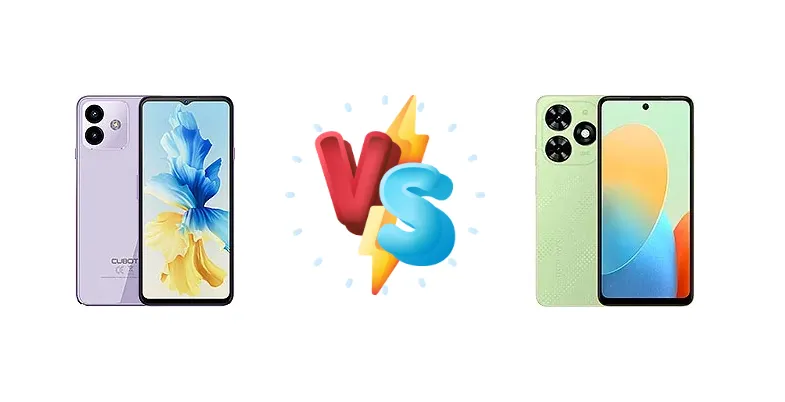
The ultra-budget smartphone market is fiercely competitive, and the Cubot Note 40 and Tecno Spark Go 2024 both aim for the bottom line. Strikingly, both devices share the exact same Unisoc T606 chipset, creating a head-to-head battle where differences likely lie in software optimization, build quality, and subtle feature variations. This comparison dissects these nuances to determine which phone delivers the most value.
🏆 Quick Verdict
For the average user prioritizing pure affordability, the Tecno Spark Go 2024 likely edges out the Cubot Note 40 due to Tecno's established brand recognition and potentially more refined software experience. However, the Cubot Note 40 remains a viable option if priced significantly lower.
| Network |
|---|
| 2G bands | GSM 850 / 900 / 1800 / 1900 | GSM 850 / 900 / 1800 / 1900 |
| 3G bands | HSDPA 850 / 900 / 1700(AWS) / 1900 / 2100 | HSDPA 900 / 2100 |
| 4G bands | 1, 2, 3, 4, 5, 7, 8, 12, 17, 20, 28, 41 | LTE |
| Speed | HSPA, LTE | HSPA, LTE |
| Technology | GSM / HSPA / LTE | GSM / HSPA / LTE |
| Launch |
|---|
| Announced | 2023, October 16 | 2023, November 21 |
| Status | Available. Released 2023, October 16 | Available. Released 2023, December 07 |
| Body |
|---|
| Build | - | Glass front, plastic back, plastic frame |
| Dimensions | 165.8 x 75.8 x 10.1 mm (6.53 x 2.98 x 0.40 in) | 163.7 x 75.6 x 8.6 mm (6.44 x 2.98 x 0.34 in) |
| SIM | Nano-SIM + Nano-SIM | Nano-SIM + Nano-SIM |
| Weight | 222 g (7.83 oz) | - |
| Display |
|---|
| Resolution | 720 x 1612 pixels, 20:9 ratio (~269 ppi density) | 720 x 1612 pixels, 20:9 ratio (~267 ppi density) |
| Size | 6.56 inches, 103.4 cm2 (~82.3% screen-to-body ratio) | 6.6 inches, 104.6 cm2 (~84.6% screen-to-body ratio) |
| Type | IPS LCD, 90Hz | IPS LCD, 90Hz |
| Platform |
|---|
| CPU | Octa-core (2x1.6 GHz Cortex-A75 & 6x1.6 GHz Cortex-A55) | Octa-core (2x1.6 GHz Cortex-A75 & 6x1.6 GHz Cortex-A55) |
| Chipset | Unisoc T606 (12 nm) | Unisoc T606 (12 nm) |
| GPU | Mali-G57 MP1 | Mali-G57 MP1 |
| OS | Android 13 | Android 13 (Go edition), HIOS 13 |
| Memory |
|---|
| Card slot | microSDXC (uses shared SIM slot) | microSDXC |
| Internal | 256GB 6GB RAM | 64GB 2GB RAM, 64GB 3GB RAM, 64GB 4GB RAM, 128GB 4GB RAM |
| Main Camera |
|---|
| Dual | 50 MP, (wide)
2 MP (macro) | - |
| Features | LED flash | Dual-LED flash, HDR |
| Single | - | 13 MP, f/1.9, (wide), 1.12µm, AF
Auxiliary lens |
| Video | Yes | 1080p@30fps |
| Selfie camera |
|---|
| Features | - | Dual-LED flash |
| Single | 8 MP | 8 MP |
| Video | Yes | Yes |
| Sound |
|---|
| 35mm jack | Unspecified | Yes |
| Loudspeaker | Yes | Yes, with dual speakers |
| Comms |
|---|
| Bluetooth | 5.0, A2DP | Yes |
| NFC | No | No |
| Positioning | GPS, GLONASS, GALILEO, BDS | GPS |
| Radio | Unspecified | FM radio |
| USB | USB Type-C 2.0, OTG | USB Type-C, OTG |
| WLAN | Wi-Fi 802.11 a/b/g/n/ac, dual-band | Yes |
| Features |
|---|
| Sensors | Accelerometer, proximity, compass | Fingerprint (side-mounted), accelerometer |
| Battery |
|---|
| Charging | 10W wired | 10W wired |
| Type | 5200 mAh | 5000 mAh |
| Misc |
|---|
| Colors | Black, Purple, Green, Blue | Mystery White, Alpenglow Gold, Magic Skin, Gravity Black |
| Models | - | BG6 |
| Price | About 90 EUR | About 90 EUR |
Cubot Note 40
- Potentially lower price point
- Unisoc T606 provides adequate performance for basic tasks
- Functional Android experience
- Likely less refined software experience
- Potentially lower build quality
- Limited brand recognition
Tecno Spark Go 2024
- Established brand with wider support
- Potentially better software optimization
- Slightly more polished user experience
- May be slightly more expensive
- Still limited by the Unisoc T606 chipset
- 10W charging is slow
Display Comparison
Both the Cubot Note 40 and Tecno Spark Go 2024 utilize the Unisoc T606, which doesn't inherently dictate display quality. Without specific display specs (resolution, panel type, brightness), it's reasonable to assume both employ similar LCD panels targeting the entry-level market. Expect 720p+ resolution and moderate brightness levels. The user experience will likely be similar, with neither device offering exceptional viewing angles or color accuracy. Bezels are likely to be substantial on both, maximizing screen real estate within a budget.
Camera Comparison
Camera performance is likely to be a weak point on both devices. Without detailed sensor information, it's safe to assume both rely on basic camera modules. The presence of a 2MP macro camera on either device is largely a marketing tactic, offering limited practical benefit due to the low resolution. Image quality will be acceptable in well-lit conditions, but expect significant noise and a lack of detail in low light. Image processing algorithms will play a crucial role, and Tecno's experience in this area might give it a slight edge.
Performance
The core of both devices is the Unisoc T606 (12 nm) chipset, featuring an octa-core CPU configuration with 2x1.6 GHz Cortex-A75 and 6x1.6 GHz Cortex-A55 cores. This means performance will be virtually identical in CPU-bound tasks like web browsing and social media. The 12nm process node suggests moderate thermal efficiency; sustained heavy workloads may lead to some throttling, but for typical daily use, both phones should handle basic tasks adequately. RAM capacity, which is not specified, will be a key differentiator, with more RAM leading to better multitasking.
Battery Life
Both the Cubot Note 40 and Tecno Spark Go 2024 support 10W wired charging, indicating a similar charging experience. While battery capacity isn't specified, typical budget phones in this segment range from 4000mAh to 5000mAh. With 10W charging, a full 0-100% charge will likely take over 3 hours. Battery life will depend heavily on usage patterns, but both phones should comfortably last a full day with moderate use, prioritizing power-saving features.
Buying Guide
Buy the Cubot Note 40 if you need a functional smartphone at the absolute lowest possible price and are comfortable with a potentially less polished software experience. Buy the Tecno Spark Go 2024 if you prefer a brand with a wider support network and anticipate a smoother, more consistent user interface, even within the budget segment.
Frequently Asked Questions
❓ Will the Unisoc T606 struggle with popular games like PUBG Mobile?
The Unisoc T606 is an entry-level chipset. While it can run PUBG Mobile, expect to play at low graphics settings and potentially experience frame drops, especially during intense action. It's not designed for demanding gaming.
❓ Is the 10W charging speed acceptable for daily use?
10W charging is slow by modern standards. It's sufficient for overnight charging, but topping up the battery quickly will be challenging. Plan to charge the phone for several hours to reach a full charge.
❓ How much storage do these phones typically offer, and is it expandable?
Budget phones like these usually start with 32GB or 64GB of internal storage. MicroSD card support is common, allowing you to expand storage capacity, but check the specifications to confirm the maximum supported size.
❓ What Android version do these phones ship with, and will they receive updates?
These phones likely ship with Android 13 (Go Edition) or Android 14 (Go Edition). Software update support is often limited on ultra-budget devices, so don't expect frequent or long-term updates.