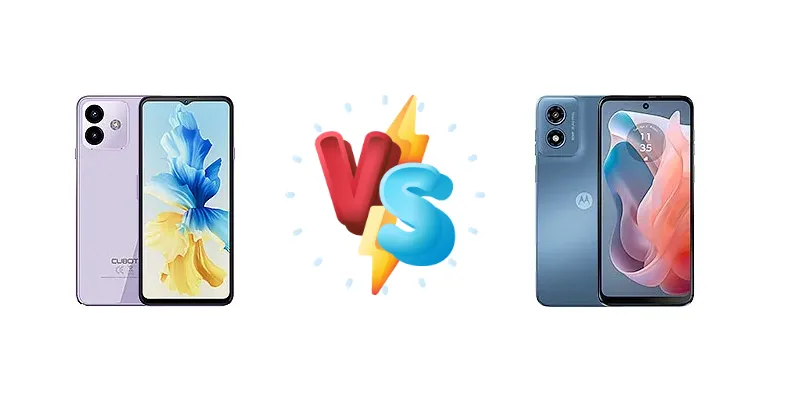
The sub-$150 smartphone market is fiercely competitive. The Cubot Note 40 and Motorola Moto G Play (2024) both aim to deliver essential smartphone functionality at an accessible price. However, they take different approaches, with the Cubot relying on a Unisoc chipset and the Motorola opting for Qualcomm's Snapdragon. This comparison dissects the key differences to help you choose the right device.
🏆 Quick Verdict
For most users, the Motorola Moto G Play (2024) is the better choice. Its Snapdragon 680, built on a more efficient 6nm process, provides a noticeable performance advantage over the Cubot Note 40’s Unisoc T606, translating to smoother multitasking and app loading. While the Cubot offers a slightly lower price point, the Motorola’s superior chipset justifies the small premium.
| Network |
|---|
| 2G bands | GSM 850 / 900 / 1800 / 1900 | GSM 850 / 900 / 1800 / 1900 |
| 3G bands | HSDPA 850 / 900 / 1700(AWS) / 1900 / 2100 | HSDPA 850 / 900 / 1700(AWS) / 1900 / 2100 |
| 4G bands | 1, 2, 3, 4, 5, 7, 8, 12, 17, 20, 28, 41 | 1, 2, 3, 4, 5, 7, 8, 12, 13, 17, 25, 26, 28, 38, 41, 66, 71 - USA |
| Speed | HSPA, LTE | HSPA, LTE |
| Technology | GSM / HSPA / LTE | GSM / HSPA / LTE |
| Launch |
|---|
| Announced | 2023, October 16 | 2024, January 16 |
| Status | Available. Released 2023, October 16 | Available. Released 2024, January 26 |
| Body |
|---|
| Build | - | Glass front, plastic frame, plastic back |
| Dimensions | 165.8 x 75.8 x 10.1 mm (6.53 x 2.98 x 0.40 in) | 163.8 x 75 x 8.3 mm (6.45 x 2.95 x 0.33 in) |
| SIM | Nano-SIM + Nano-SIM | Nano-SIM |
| Weight | 222 g (7.83 oz) | 185 g (6.53 oz) |
| Display |
|---|
| Protection | - | Corning Gorilla Glass 3 |
| Resolution | 720 x 1612 pixels, 20:9 ratio (~269 ppi density) | 720 x 1600 pixels, 20:9 ratio (~270 ppi density) |
| Size | 6.56 inches, 103.4 cm2 (~82.3% screen-to-body ratio) | 6.5 inches, 102.0 cm2 (~83.0% screen-to-body ratio) |
| Type | IPS LCD, 90Hz | IPS LCD, 90Hz, 500 nits (typ) |
| Platform |
|---|
| CPU | Octa-core (2x1.6 GHz Cortex-A75 & 6x1.6 GHz Cortex-A55) | Octa-core (4x2.4 GHz Kryo 265 Gold & 4x1.9 GHz Kryo 265 Silver) |
| Chipset | Unisoc T606 (12 nm) | Qualcomm SM6225 Snapdragon 680 4G (6 nm) |
| GPU | Mali-G57 MP1 | Adreno 610 |
| OS | Android 13 | Android 13, upgradable to Android 14 |
| Memory |
|---|
| Card slot | microSDXC (uses shared SIM slot) | microSDXC (dedicated slot) |
| Internal | 256GB 6GB RAM | 64GB 4GB RAM, 128GB 4GB RAM |
| Main Camera |
|---|
| Dual | 50 MP, (wide)
2 MP (macro) | - |
| Features | LED flash | LED flash, HDR, panorama |
| Single | - | 50 MP, f/1.8, (wide), 0.64µm, PDAF |
| Video | Yes | 1080p@30fps |
| Selfie camera |
|---|
| Features | - | HDR |
| Single | 8 MP | 8 MP, f/2.0, (wide), 1.12µm |
| Video | Yes | 1080p@30fps |
| Sound |
|---|
| 35mm jack | Unspecified | Yes |
| Loudspeaker | Yes | Yes, with stereo speakers |
| Comms |
|---|
| Bluetooth | 5.0, A2DP | 5.1, A2DP, LE |
| NFC | No | No |
| Positioning | GPS, GLONASS, GALILEO, BDS | GPS, GALILEO, GLONASS |
| Radio | Unspecified | No |
| USB | USB Type-C 2.0, OTG | USB Type-C 2.0 |
| WLAN | Wi-Fi 802.11 a/b/g/n/ac, dual-band | Wi-Fi 802.11 a/b/g/n/ac, dual-band |
| Features |
|---|
| Sensors | Accelerometer, proximity, compass | Fingerprint (side-mounted), accelerometer, proximity, compass, barometer |
| Battery |
|---|
| Charging | 10W wired | 15W wired |
| Type | 5200 mAh | 5000 mAh |
| Misc |
|---|
| Colors | Black, Purple, Green, Blue | Sapphire Blue |
| Models | - | XT2413-1, XT2413 |
| Price | About 90 EUR | $ 55.00 |
Cubot Note 40
- Potentially lower price point
- Functional for basic smartphone tasks
- Acceptable for light usage
- Less powerful Unisoc T606 chipset
- Slower 10W charging
- Likely less efficient power consumption
Motorola Moto G Play (2024)
- More powerful Snapdragon 680 chipset
- Faster 15W charging
- Better power efficiency for longer battery life
- Slightly higher price
- Still a budget-level display
- Camera performance is adequate, not exceptional
Display Comparison
Neither device boasts a standout display. Specifications are unavailable for the Cubot Note 40’s panel, but given its price point, it likely utilizes a standard LCD. The Moto G Play (2024) also uses an LCD. The key difference lies in processing power, not display quality. Expect similar viewing angles and color reproduction on both, with neither offering features like high refresh rates or HDR support. Bezels are likely to be substantial on both devices, reflecting their budget nature.
Camera Comparison
Camera performance is likely to be similar on both devices, leaning towards basic functionality. Details on sensor sizes and apertures are unavailable, but both will likely feature a primary camera paired with lower-resolution auxiliary lenses. The Motorola’s image signal processor (ISP) within the Snapdragon 680 will likely offer slightly better image processing capabilities, potentially resulting in more detailed photos in good lighting conditions. However, don't expect flagship-level image quality from either device. Focusing on the primary sensor is key, as auxiliary 2MP macro or depth sensors typically add little value.
Performance
The Motorola Moto G Play (2024) holds a significant advantage in performance. Its Qualcomm Snapdragon 680 (6nm) features a more modern architecture and higher clock speeds (2.4 GHz vs 1.6 GHz) compared to the Cubot Note 40’s Unisoc T606 (12nm). The 6nm process node of the Snapdragon 680 is crucial; it allows for greater transistor density and improved thermal efficiency, meaning sustained performance is less likely to be throttled under load. The Snapdragon’s Kryo Gold cores will outperform the Cortex-A75 cores in the Unisoc chip in CPU-intensive tasks. While both phones have 4GB of RAM (assumed based on market segment), the superior chipset will make a more substantial difference in real-world responsiveness.
Battery Life
The Motorola Moto G Play (2024) features 15W wired charging, a step up from the Cubot Note 40’s 10W charging. While neither offers incredibly fast charging, the 15W rate will translate to quicker top-ups. Battery capacity is not specified for either device, but given the market segment, both likely fall in the 4000-5000 mAh range. The Snapdragon 680’s superior power efficiency will likely result in slightly better battery life on the Motorola, even with a similar capacity, as it consumes less power during everyday tasks.
Buying Guide
Buy the Cubot Note 40 if your primary need is a basic smartphone for calls, texts, and light social media use, and you are prioritizing the absolute lowest price. Buy the Motorola Moto G Play (2024) if you value a more responsive user experience, occasional gaming, and a chipset known for better power efficiency, even if it means spending a bit more.
Frequently Asked Questions
❓ Will the Snapdragon 680 in the Moto G Play (2024) handle popular games like PUBG Mobile?
The Snapdragon 680 can run PUBG Mobile, but expect to play at lower graphics settings (Medium or Low) to maintain a stable frame rate. It's not a gaming powerhouse, but it's significantly more capable than the Unisoc T606 in the Cubot Note 40 for gaming.
❓ Is the difference in charging speed (10W vs 15W) noticeable in everyday use?
Yes, the 15W charging on the Moto G Play (2024) will noticeably reduce charging times. While neither phone offers rapid charging, the Motorola will get you from 0% to 100% approximately 30-60 minutes faster than the Cubot Note 40.
❓ How does the Unisoc T606 perform with multitasking compared to the Snapdragon 680?
The Snapdragon 680 excels at multitasking due to its more efficient architecture and higher clock speeds. The Unisoc T606 may exhibit lag or slowdown when running multiple apps simultaneously, especially more demanding ones. The Motorola will provide a smoother, more responsive experience.
❓ Are software updates likely to be consistent on both devices?
Motorola generally provides more consistent software updates, including security patches, than smaller brands like Cubot. While neither phone will receive updates for an extended period, the Moto G Play (2024) is more likely to receive timely security updates.