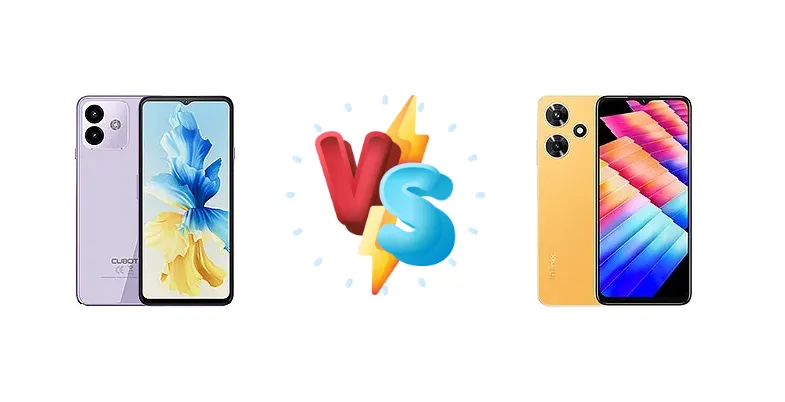
The sub-$150 smartphone market is fiercely competitive. Both the Cubot Note 40 and the Infinix Hot 30i aim to deliver essential smartphone functionality at an accessible price point. While both devices share the same Unisoc T606 chipset, key differences in charging speed and potentially other areas create a compelling comparison for budget-conscious buyers.
🏆 Quick Verdict
For the average user prioritizing faster charging and potentially slightly improved power delivery, the Infinix Hot 30i is the better choice. Its 18W charging significantly reduces downtime compared to the Cubot Note 40’s 10W charging, a crucial advantage for those heavily reliant on their smartphones throughout the day.
| Network |
|---|
| 2G bands | GSM 850 / 900 / 1800 / 1900 | GSM 850 / 900 / 1800 / 1900 |
| 3G bands | HSDPA 850 / 900 / 1700(AWS) / 1900 / 2100 | HSDPA 850 / 900 / 1700(AWS) / 1900 / 2100 |
| 4G bands | 1, 2, 3, 4, 5, 7, 8, 12, 17, 20, 28, 41 | 1, 2, 3, 4, 5, 7, 8, 20, 28, 38, 40, 41 |
| Speed | HSPA, LTE | HSPA, LTE |
| Technology | GSM / HSPA / LTE | GSM / HSPA / LTE |
| Launch |
|---|
| Announced | 2023, October 16 | 2023, March 31 |
| Status | Available. Released 2023, October 16 | Available. Released 2023, March 31 |
| Body |
|---|
| Build | - | Glass front, plastic frame, plastic back |
| Dimensions | 165.8 x 75.8 x 10.1 mm (6.53 x 2.98 x 0.40 in) | 164 x 75.8 x 8.4 mm (6.46 x 2.98 x 0.33 in) |
| SIM | Nano-SIM + Nano-SIM | Nano-SIM + Nano-SIM |
| Weight | 222 g (7.83 oz) | 191 g (6.74 oz) |
| Display |
|---|
| Resolution | 720 x 1612 pixels, 20:9 ratio (~269 ppi density) | 720 x 1612 pixels, 20:9 ratio (~269 ppi density) |
| Size | 6.56 inches, 103.4 cm2 (~82.3% screen-to-body ratio) | 6.56 inches, 103.4 cm2 (~83.2% screen-to-body ratio) |
| Type | IPS LCD, 90Hz | IPS LCD, 90Hz, 500 nits (peak) |
| Platform |
|---|
| CPU | Octa-core (2x1.6 GHz Cortex-A75 & 6x1.6 GHz Cortex-A55) | Octa-core (2x1.6 GHz Cortex-A75 & 6x1.6 GHz Cortex-A55) |
| Chipset | Unisoc T606 (12 nm) | Unisoc T606 (12 nm) |
| GPU | Mali-G57 MP1 | Mali-G57 MP1 |
| OS | Android 13 | Android 12, XOS 10.6 |
| Memory |
|---|
| Card slot | microSDXC (uses shared SIM slot) | microSDXC (dedicated slot) |
| Internal | 256GB 6GB RAM | 64GB 4GB RAM, 128GB 4GB RAM, 128GB 8GB RAM |
| | - | UFS 2.2 |
| Main Camera |
|---|
| Dual | 50 MP, (wide)
2 MP (macro) | 13 MP, f/1.9, (wide), AF
0.08 MP, (depth) |
| Features | LED flash | Dual-LED flash, HDR, panorama |
| Single | - | 13 MP, f/1.9, (wide), 1/3.07", AF
Auxiliary lens |
| Video | Yes | 1080p@30fps |
| Selfie camera |
|---|
| Features | - | Dual-LED flash |
| Single | 8 MP | 8 MP, f/2.0, (wide), 1/3.94" |
| Video | Yes | 1080p@30fps |
| Sound |
|---|
| 3.5mm jack | - | Yes |
| 35mm jack | Unspecified | Yes |
| Loudspeaker | Yes | Yes |
| Comms |
|---|
| Bluetooth | 5.0, A2DP | Yes |
| NFC | No | Yes (Hot 30i NFC only) |
| Positioning | GPS, GLONASS, GALILEO, BDS | GPS |
| Radio | Unspecified | FM radio |
| USB | USB Type-C 2.0, OTG | USB Type-C 2.0, OTG |
| WLAN | Wi-Fi 802.11 a/b/g/n/ac, dual-band | Wi-Fi 802.11 a/b/g/n/ac, dual-band |
| Features |
|---|
| Sensors | Accelerometer, proximity, compass | Fingerprint (side-mounted), accelerometer, proximity, compass |
| Battery |
|---|
| Charging | 10W wired | 18W wired |
| Type | 5200 mAh | 5000 mAh |
| Misc |
|---|
| Colors | Black, Purple, Green, Blue | Mirror Black, Glacier Blue, Diamond White, Marigold |
| Models | - | X669, X669D |
| Price | About 90 EUR | - |
Cubot Note 40
- Potentially lower initial purchase price.
- Identical CPU performance to the Infinix Hot 30i.
- Functional for basic smartphone tasks.
- Significantly slower 10W charging.
- Likely limited camera performance.
- May have a less refined software experience.
Infinix Hot 30i
- Faster 18W charging for quicker top-ups.
- Identical CPU performance to the Cubot Note 40.
- Potentially better power delivery due to charging efficiency.
- May be slightly more expensive than the Cubot Note 40.
- Likely similar camera performance to the Cubot Note 40.
- Still limited by the Unisoc T606 chipset.
Display Comparison
Both the Cubot Note 40 and Infinix Hot 30i likely feature LCD panels, common in this price bracket. Without specific display specs like resolution or peak brightness, it’s difficult to differentiate. However, the quality of the panel itself (color accuracy, viewing angles) will likely be similar given the shared target market. Expect standard 60Hz refresh rates on both devices, prioritizing battery life over smooth scrolling.
Camera Comparison
Without detailed camera specifications, it’s safe to assume both phones will feature a multi-camera setup with a primary sensor and potentially auxiliary lenses (depth, macro). Given the price point, image quality will likely be adequate for social media sharing in good lighting conditions, but struggle in low-light scenarios. The absence of Optical Image Stabilization (OIS) on either device suggests reliance on software processing for stabilization, which may introduce artifacts. The usefulness of any 2MP macro lens is questionable, offering limited detail and often poor image quality.
Performance
Both devices are powered by the Unisoc T606 (12 nm) chipset, featuring an octa-core CPU configuration with 2x1.6 GHz Cortex-A75 and 6x1.6 GHz Cortex-A55 cores. This means CPU performance will be virtually identical between the two. The real-world impact will be similar for everyday tasks like browsing, social media, and light app usage. Thermal management will also likely be comparable, as the chipset and power draw are the same. The GPU performance will also be the same, limiting gaming to less demanding titles at lower settings.
Battery Life
While battery capacity isn't specified, the key differentiator here is charging speed. The Infinix Hot 30i’s 18W wired charging is a significant advantage over the Cubot Note 40’s 10W charging. This translates to a substantially faster 0-100% charge time for the Infinix, potentially cutting charging time by 40-60%. Even with a similar battery capacity, the faster charging will provide more usable uptime throughout the day for the average user.
Buying Guide
Buy the Cubot Note 40 if you prioritize a potentially lower initial cost and are comfortable with slower charging speeds. It’s a suitable option for users who primarily use their phone for basic tasks like calls, texts, and light social media. Buy the Infinix Hot 30i if you value quicker top-ups and anticipate more frequent use, especially if you stream videos or play mobile games, as the faster charging will minimize interruptions.
Frequently Asked Questions
❓ Will the Unisoc T606 in either phone struggle with demanding games like PUBG Mobile?
Yes, the Unisoc T606 is an entry-level chipset. While it can run PUBG Mobile, you'll likely need to play at the lowest graphics settings and potentially accept lower frame rates for a smooth experience. Expect some stuttering during intense moments.
❓ How long will it realistically take to fully charge the Cubot Note 40 with its 10W charger?
Given the 10W charging speed, a full charge from 0% to 100% on the Cubot Note 40 will likely take between 3 to 4 hours, depending on battery capacity. This is considerably slower than the Infinix Hot 30i.
❓ Is the software experience significantly different between Cubot and Infinix?
Both Cubot and Infinix utilize customized versions of Android. Infinix's XOS is generally considered more polished and feature-rich, while Cubot's software may be more basic. Expect some pre-installed bloatware on both devices, though the amount can vary.
❓ Can I use a faster charger with the Cubot Note 40 to speed up charging?
While you can physically connect a faster charger to the Cubot Note 40, the phone itself will only draw power at its maximum supported rate of 10W. Using a higher wattage charger won't result in faster charging times.