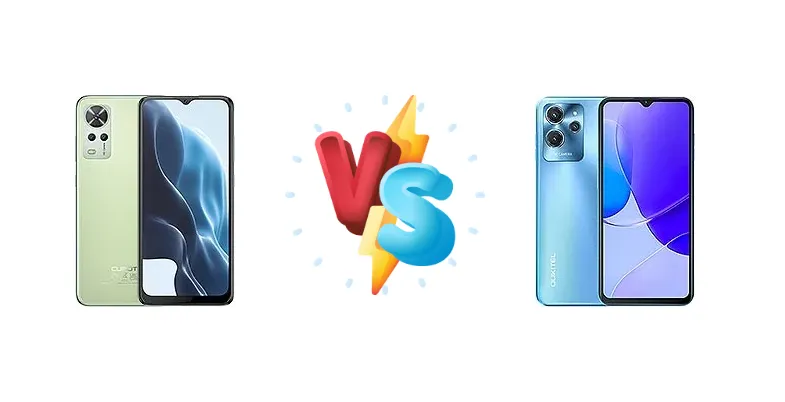
The Cubot Note 30 and Oukitel C32 represent the fiercely competitive sub-$150 smartphone market. Both aim to deliver essential functionality at an accessible price, but they take different approaches under the hood. This comparison focuses on the core performance differences stemming from their respective chipsets – the Mediatek Helio P35 in the Cubot Note 30 and the Unisoc T606 in the Oukitel C32 – and how those translate to real-world user experience.
🏆 Quick Verdict
For the average user prioritizing responsiveness in everyday tasks, the Oukitel C32 edges out the Cubot Note 30. The Unisoc T606’s Cortex-A75 cores provide a noticeable performance boost over the Helio P35’s all-A53 configuration, resulting in smoother app launches and multitasking. However, the difference isn't massive, and the Note 30 remains a viable option for basic use.
| Network |
|---|
| 2G bands | GSM 850 / 900 / 1800 / 1900 | GSM 850 / 900 / 1800 / 1900 |
| 3G bands | HSDPA 900 / 2100 | HSDPA 850 / 900 / 2100 |
| 4G bands | 1, 3, 5, 7, 8, 19, 20, 40 | LTE |
| Speed | HSPA, LTE | HSPA, LTE |
| Technology | GSM / HSPA / LTE | GSM / HSPA / LTE |
| Launch |
|---|
| Announced | 2022 | 2023, January |
| Status | Available. Released 2022 | Available. Released 2023, January |
| Body |
|---|
| Dimensions | 165 x 75.7 x 9 mm (6.50 x 2.98 x 0.35 in) | 9.2 mm thickness |
| SIM | Nano-SIM + Nano-SIM | Nano-SIM + Nano-SIM |
| Weight | 195 g (6.88 oz) | 198 g (6.98 oz) |
| Display |
|---|
| Resolution | 720 x 1600 pixels, 20:9 ratio (~269 ppi density) | 720 x 1600 pixels, 20:9 ratio (~269 ppi density) |
| Size | 6.52 inches, 102.6 cm2 (~82.2% screen-to-body ratio) | 6.52 inches, 102.6 cm2 |
| Type | IPS LCD | IPS LCD, 440 nits |
| Platform |
|---|
| CPU | Octa-core (4x2.35 GHz Cortex-A53 & 4x1.8 GHz Cortex-A53) | Octa-core (2x1.6 GHz Cortex-A75 & 6x1.6 GHz Cortex-A55) |
| Chipset | Mediatek MT6765 Helio P35 (12 nm) | Unisoc T606 (12 nm) |
| GPU | PowerVR GE8320 | Mali-G57 MP1 |
| OS | Android 12 | Android 12 |
| Memory |
|---|
| Card slot | microSDXC (uses shared SIM slot) | microSDXC (uses shared SIM slot) |
| Internal | 64GB 4GB RAM | 128GB 8GB RAM |
| Main Camera |
|---|
| Dual | 20 MP, (wide)
2 MP (macro) | - |
| Features | LED flash | LED flash, panorama |
| Triple | - | 20 MP, f/1.8, (wide), AF
Other unspecified cameras |
| Video | Yes | 1080p@30fps |
| Selfie camera |
|---|
| Single | 8 MP | 5 MP, f/2.2 |
| Video | Yes | Yes |
| Sound |
|---|
| 35mm jack | Unspecified | Yes |
| Loudspeaker | Yes | Yes |
| Comms |
|---|
| Bluetooth | 5.0, A2DP | Yes |
| NFC | No | No |
| Positioning | GPS, GLONASS, GALILEO, BDS | GPS, GLONASS, GALILEO, BDS |
| Radio | Unspecified | Unspecified |
| USB | USB Type-C | USB Type-C 2.0 |
| WLAN | Wi-Fi 802.11 a/b/g/n, dual-band | Yes |
| Features |
|---|
| Sensors | Accelerometer, proximity | Fingerprint (side-mounted); unspecified sensors |
| Battery |
|---|
| Type | 4000 mAh, removable | Li-Po 5150 mAh |
| Misc |
|---|
| Colors | Black, Green | Blue, Purple, Black |
| Price | - | About 150 EUR |
Cubot Note 30
- Potentially lower price point.
- Reliable for basic smartphone functions.
- Mediatek chipset is well-established.
- Older chipset architecture.
- Slower performance compared to the Oukitel C32.
- May struggle with demanding apps.
Oukitel C32
- More responsive performance due to Cortex-A75 cores.
- Improved multitasking capabilities.
- Potentially better power efficiency.
- May be slightly more expensive.
- Unisoc chipset is less widely known.
- Camera performance likely similar to Cubot Note 30.
Display Comparison
Neither device boasts a standout display. Given the price bracket, we can assume both utilize IPS LCD panels. Without specific brightness or color gamut data, it’s difficult to declare a clear winner. However, the focus here is on processing power, so display differences are less critical. Expect standard 720p+ resolutions on both, adequate for the screen sizes typically found in this segment.
Camera Comparison
Without detailed camera specs beyond the presence of sensors, a meaningful comparison is impossible. It’s safe to assume both phones feature basic camera setups geared towards casual photography. The inclusion of a 2MP macro lens on either device is largely a marketing tactic, offering limited practical benefit due to the low resolution and lack of optical image stabilization (OIS). Image processing will likely be similar, prioritizing basic scene recognition and software enhancements.
Performance
The core difference lies in the chipsets. The Cubot Note 30’s Mediatek Helio P35 (MT6765) uses an older architecture – eight Cortex-A53 cores, split into 4x2.35 GHz and 4x1.8 GHz. This is a homogenous core setup, meaning all cores are equal in capability. The Oukitel C32’s Unisoc T606 employs a big.LITTLE architecture with 2x1.6 GHz Cortex-A75 cores and 6x1.6 GHz Cortex-A55 cores. The A75 cores are significantly more powerful than the A53, providing a substantial uplift in single-core performance, which directly impacts app launch speeds and UI responsiveness. While both are 12nm chips, the architectural advantage favors the T606. The T606 will handle multitasking and moderately demanding apps more gracefully.
Battery Life
Battery capacity isn’t specified, but both phones likely house batteries in the 4000-5000 mAh range, typical for this price point. Charging wattage is also unknown. The Unisoc T606’s improved efficiency *could* translate to slightly longer battery life in real-world usage, but the difference will likely be marginal. Without knowing the charging speeds, it’s impossible to determine which phone offers a faster 0-100% charge time.
Buying Guide
Buy the Cubot Note 30 if you need a reliably basic smartphone for calls, texts, and light social media use, and are prioritizing a potentially lower price point. Buy the Oukitel C32 if you prefer a slightly more responsive experience for everyday tasks like browsing, navigating apps, and occasional light gaming, and are willing to spend a little more for that added performance.
Frequently Asked Questions
❓ Will the Oukitel C32 handle popular social media apps like TikTok and Instagram smoothly?
The Unisoc T606’s Cortex-A75 cores provide a noticeable performance boost over the Helio P35, making the Oukitel C32 better equipped to handle the demands of social media apps like TikTok and Instagram. Expect smoother scrolling and faster loading times compared to the Cubot Note 30, though performance will still be limited by the amount of RAM.
❓ Is the difference in performance between the Helio P35 and Unisoc T606 noticeable for everyday tasks like browsing and email?
Yes, the difference is noticeable. The Unisoc T606’s more powerful cores result in quicker app launches and a more responsive user interface. While both phones can handle basic browsing and email, the Oukitel C32 will feel snappier and less prone to lag during these tasks.
❓ Can either of these phones handle mobile gaming beyond very casual titles?
Neither phone is ideal for serious mobile gaming. Both chipsets are entry-level and will struggle with graphically demanding games. You might be able to play less intensive games at low settings, but expect frame rate drops and potential overheating. The Oukitel C32 will offer a slightly better experience due to its more powerful processor.