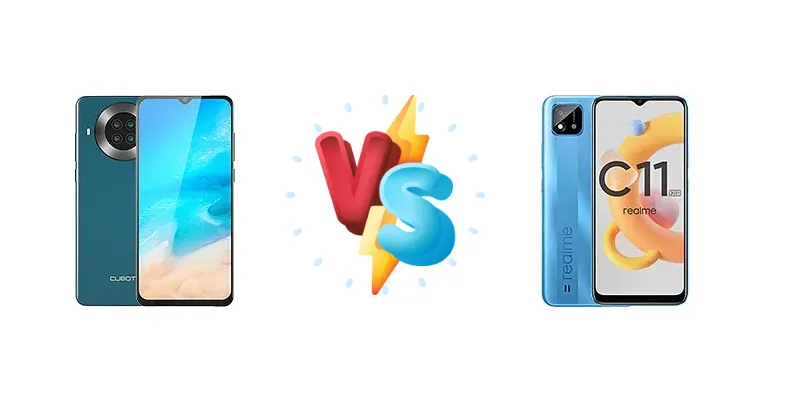
The sub-$150 smartphone market is fiercely competitive. Both the Cubot Note 20 and the Realme C11 (2021) aim to deliver essential smartphone functionality at an incredibly affordable price. However, they take different approaches to achieving this, primarily in their chipset choices. This comparison will dissect those differences and determine which device offers the best value for your money.
🏆 Quick Verdict
For the average user prioritizing responsiveness and multitasking, the Realme C11 (2021) is the better choice. Its Unisoc SC9863A octa-core processor provides a noticeable performance advantage over the Cubot Note 20’s quad-core Mediatek Helio A20, despite the older Unisoc chip's larger manufacturing process.
| Network |
|---|
| 2G bands | GSM 850 / 900 / 1800 / 1900 | GSM 850 / 900 / 1800 / 1900 |
| 3G bands | HSDPA 900 / 2100 | HSDPA 850 / 900 / 1900 / 2100 |
| 4G bands | 1, 3, 7, 8, 19, 20 | 1, 3, 5, 8, 38, 40, 41 |
| Speed | HSPA, LTE | HSPA, LTE |
| Technology | GSM / HSPA / LTE | GSM / HSPA / LTE |
| Launch |
|---|
| Announced | 2020. Released 2020 | 2021, June 28 |
| Status | Discontinued | Available. Released 2021, June 28 |
| Body |
|---|
| Build | - | Glass front, plastic frame, plastic back |
| Dimensions | 162.8 x 75.4 x 9.1 mm (6.41 x 2.97 x 0.36 in) | 165.2 x 76.4 x 8.9 mm (6.50 x 3.01 x 0.35 in) |
| SIM | Nano-SIM + Nano-SIM | Nano-SIM + Nano-SIM |
| Weight | 200 g (7.05 oz) | 190 g (6.70 oz) |
| | - | Splash resistant design |
| Display |
|---|
| Resolution | 720 x 1600 pixels, 20:9 ratio (~270 ppi density) | 720 x 1600 pixels, 20:9 ratio (~269 ppi density) |
| Size | 6.5 inches, 102.0 cm2 (~83.1% screen-to-body ratio) | 6.52 inches, 102.6 cm2 (~81.3% screen-to-body ratio) |
| Type | IPS LCD | IPS LCD, 400 nits (typ) |
| Platform |
|---|
| CPU | Quad-core 1.8 GHz Cortex-A53 | Octa-core (4x1.6 GHz Cortex-A55 & 4x1.2 GHz Cortex-A55) |
| Chipset | Mediatek MT6761D Helio A20 (12 nm) | Unisoc SC9863A (28 nm) |
| GPU | PowerVR GE8320 | IMG8322 |
| OS | Android 10 | Android 11, Realme Go UI |
| Memory |
|---|
| Card slot | microSDXC (dedicated slot) | microSDXC (dedicated slot) |
| Internal | 64GB 3GB RAM | 32GB 2GB RAM, 64GB 4GB RAM |
| | - | eMMC 5.1 |
| Main Camera |
|---|
| Features | LED flash | LED flash, HDR, panorama |
| Quad | 12 MP, (wide), 1/2.9", AF
20 MP, (depth), 1/2.78"
Auxiliary lenses | - |
| Single | - | 8 MP, f/2.0, (wide), AF |
| Video | Yes | 1080p@30fps |
| Selfie camera |
|---|
| Features | - | HDR, panorama |
| Single | 8 MP | 5 MP, f/2.2, (wide) |
| Video | Yes | 1080p@30fps |
| Sound |
|---|
| 3.5mm jack | - | Yes |
| 35mm jack | Yes | Yes |
| Loudspeaker | Yes | Yes |
| Comms |
|---|
| Bluetooth | 4.2, A2DP | 4.2, A2DP |
| NFC | Yes | No |
| Positioning | GPS | GPS, GLONASS, GALILEO, BDS |
| Radio | Unspecified | Unspecified |
| USB | microUSB | microUSB 2.0, OTG |
| WLAN | Wi-Fi 802.11 a/b/g/n | Wi-Fi 802.11 b/g/n |
| Features |
|---|
| Sensors | Accelerometer, proximity | Accelerometer, gyro, proximity, compass |
| Battery |
|---|
| Charging | - | 10W wired
Reverse wired |
| Type | 4200 mAh, removable | 5000 mAh |
| Misc |
|---|
| Colors | Black, Blue, Green | Cool Blue, Cool Grey |
| Models | - | RMX3231 |
| Price | - | About 80 EUR |
Cubot Note 20
- Potentially better power efficiency due to 12nm process
- Lower price point (likely)
- Simple and straightforward user experience
- Significantly weaker performance due to quad-core processor
- Lacks reverse charging capability
- May struggle with multitasking
Realme C11 (2021)
- Octa-core processor for smoother performance
- Reverse wired charging for added convenience
- Potentially better image processing
- Less power-efficient 28nm process
- May have slightly shorter battery life under heavy load
- Potentially higher price
Display Comparison
Neither device boasts a standout display. Both are likely to feature LCD panels, typical for this price bracket. Specifics like resolution and brightness are not provided, but we can infer they are similar – likely 720p+ resolution. The Realme C11 (2021) doesn’t benefit from any advanced display tech like high refresh rates or LTPO. The larger manufacturing process of the Unisoc chip suggests less focus on power efficiency, potentially impacting display brightness optimization.
Camera Comparison
Details on camera sensors are scarce. Both devices likely feature basic camera setups geared towards casual photography. Without specific megapixel counts or aperture information, it’s difficult to make a definitive judgment. However, the Realme brand generally invests slightly more in image processing algorithms, potentially leading to more pleasing results, even with similar hardware. The presence of a 2MP macro lens on either device is largely a marketing gimmick and shouldn’t be a deciding factor.
Performance
This is where the most significant difference lies. The Cubot Note 20’s Mediatek MT6761D Helio A20 is a quad-core processor built on a more efficient 12nm process. However, the Realme C11 (2021) utilizes the Unisoc SC9863A, an octa-core processor, albeit on a less efficient 28nm node. The octa-core configuration, with its four Cortex-A55 cores clocked at 1.6GHz and another four at 1.2GHz, provides a substantial advantage in multitasking and handling more demanding applications. While the 28nm process is less efficient, the sheer number of cores compensates for this, offering a smoother user experience. The Helio A20 will struggle with more than a few apps open simultaneously.
Battery Life
Battery capacity isn’t specified for either device, but both likely fall in the 4000-5000mAh range, common for this segment. The Realme C11 (2021) includes 10W wired charging and, crucially, reverse wired charging. This allows it to act as a power bank for other devices, a feature absent on the Cubot Note 20. The Unisoc chip’s less efficient process may lead to slightly faster battery drain under heavy load, but the reverse charging capability adds significant utility.
Buying Guide
Buy the Cubot Note 20 if you need a basic smartphone for extremely light tasks like calls, texts, and occasional social media browsing, and are on the absolute tightest budget. Buy the Realme C11 (2021) if you prefer a more responsive experience for everyday use, including smoother app switching, slightly better gaming performance, and the convenience of reverse wired charging.
Frequently Asked Questions
❓ Will the Realme C11 (2021) struggle with graphically intensive games like PUBG Mobile?
While the Unisoc SC9863A isn't a gaming powerhouse, it will offer a more playable experience in PUBG Mobile than the Cubot Note 20’s Helio A20. Expect to play on lower graphics settings and potentially experience some frame drops during intense action. The Cubot Note 20 will likely be limited to the lowest settings and may still struggle.
❓ How much of a real-world difference will the extra cores in the Realme C11 (2021) make for everyday tasks?
The difference will be noticeable in app switching, web browsing, and opening multiple applications. The Helio A20 in the Cubot Note 20 will feel sluggish when multitasking, while the Realme C11 (2021) will handle these tasks much more smoothly. This translates to a more responsive and less frustrating user experience.
❓ Is the 28nm process of the Unisoc SC9863A a major concern for battery life?
While the 28nm process is less efficient than the 12nm process of the Helio A20, the octa-core architecture and software optimizations in the Realme C11 (2021) help mitigate this. You might see slightly faster battery drain under heavy gaming or video playback, but for typical usage, the difference will likely be minimal.