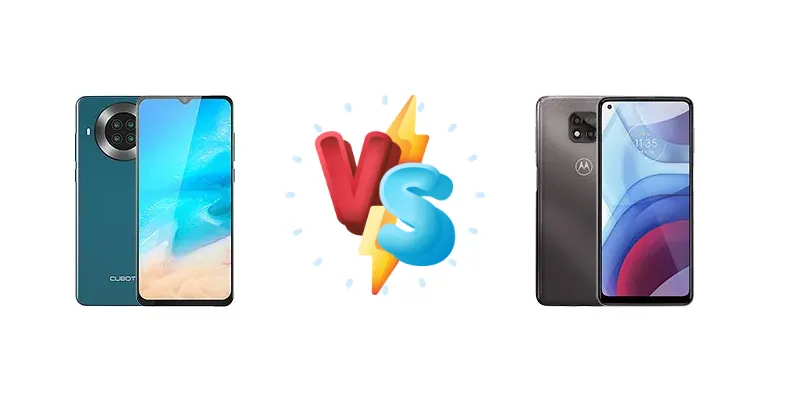
The sub-$200 smartphone market is fiercely competitive. The Cubot Note 20 and Motorola Moto G Power (2021) both aim to deliver essential smartphone functionality at an accessible price. However, they take drastically different approaches to achieving this, particularly in their core processing power. This comparison dissects those differences, helping you determine which device best suits your needs.
🏆 Quick Verdict
For the average user prioritizing responsiveness and a smoother overall experience, the Motorola Moto G Power (2021) is the clear winner. Its Snapdragon 662 chipset, with its octa-core configuration and 11nm process, provides a significant performance advantage over the Cubot Note 20’s Helio A20, despite the Moto G Power’s slower 15W charging.
| Network |
|---|
| 2G bands | GSM 850 / 900 / 1800 / 1900 | GSM 850 / 900 / 1800 / 1900 |
| 3G bands | HSDPA 900 / 2100 | HSDPA 850 / 900 / 1700(AWS) / 1900 / 2100 |
| 4G bands | 1, 3, 7, 8, 19, 20 | 1, 2, 3, 4, 5, 7, 8, 12, 13, 14, 17, 25, 26, 29, 30, 38, 41, 66, 71 |
| Speed | HSPA, LTE | HSPA, LTE |
| Technology | GSM / HSPA / LTE | GSM / CDMA / HSPA / EVDO / LTE |
| | - | CDMA2000 1xEV-DO |
| Launch |
|---|
| Announced | 2020. Released 2020 | 2021, January 08 |
| Status | Discontinued | Available. Released 2021, January 14 |
| Body |
|---|
| Build | - | Glass front, plastic back, plastic frame |
| Dimensions | 162.8 x 75.4 x 9.1 mm (6.41 x 2.97 x 0.36 in) | 165.3 x 75.9 x 9.5 mm (6.51 x 2.99 x 0.37 in) |
| SIM | Nano-SIM + Nano-SIM | Nano-SIM |
| Weight | 200 g (7.05 oz) | 206.5 g (7.30 oz) |
| | - | Water-repellent coating |
| Display |
|---|
| Resolution | 720 x 1600 pixels, 20:9 ratio (~270 ppi density) | 720 x 1600 pixels, 20:9 ratio (~266 ppi density) |
| Size | 6.5 inches, 102.0 cm2 (~83.1% screen-to-body ratio) | 6.6 inches, 105.2 cm2 (~83.8% screen-to-body ratio) |
| Type | IPS LCD | IPS LCD |
| Platform |
|---|
| CPU | Quad-core 1.8 GHz Cortex-A53 | Octa-core (4x2.0 GHz Kryo 260 Gold & 4x1.8 GHz Kryo 260 Silver) |
| Chipset | Mediatek MT6761D Helio A20 (12 nm) | Qualcomm SM6115 Snapdragon 662 (11 nm) |
| GPU | PowerVR GE8320 | Adreno 610 |
| OS | Android 10 | Android 10 |
| Memory |
|---|
| Card slot | microSDXC (dedicated slot) | microSDXC (dedicated slot) |
| Internal | 64GB 3GB RAM | 32GB 3GB RAM, 64GB 4GB RAM |
| | - | eMMC 5.1 |
| Main Camera |
|---|
| Features | LED flash | LED flash, HDR, panorama |
| Quad | 12 MP, (wide), 1/2.9", AF
20 MP, (depth), 1/2.78"
Auxiliary lenses | - |
| Triple | - | 48 MP, f/1.7, (wide), 1/2.0", 0.8µm, PDAF
2 MP (macro)
Auxiliary lens |
| Video | Yes | 1080p@30/60fps, gyro-EIS |
| Selfie camera |
|---|
| Features | - | HDR |
| Single | 8 MP | 8 MP, f/2.0, 1.12µm |
| Video | Yes | 1080p@30fps, gyro-EIS |
| Sound |
|---|
| 3.5mm jack | - | Yes |
| 35mm jack | Yes | Yes |
| Loudspeaker | Yes | Yes |
| Comms |
|---|
| Bluetooth | 4.2, A2DP | 5.0, A2DP, LE |
| NFC | Yes | No |
| Positioning | GPS | GPS, GLONASS, GALILEO |
| Radio | Unspecified | FM radio |
| USB | microUSB | USB Type-C 2.0 |
| WLAN | Wi-Fi 802.11 a/b/g/n | Wi-Fi 802.11 a/b/g/n/ac, dual-band, Wi-Fi Direct |
| Features |
|---|
| Sensors | Accelerometer, proximity | Fingerprint (side-mounted), accelerometer, gyro, proximity, compass, barometer |
| Battery |
|---|
| Charging | - | 15W wired |
| Type | 4200 mAh, removable | Li-Po 5000 mAh |
| Misc |
|---|
| Colors | Black, Blue, Green | Flash Gray, Polar Silver |
| Price | - | About 60 EUR |
Cubot Note 20
- Lowest possible price point
- Functional for basic communication
- Potentially larger storage options (depending on configuration)
- Significantly slower performance
- Less efficient processor
- Likely inferior camera quality
Motorola Moto G Power (2021)
- Much faster and more responsive performance
- More efficient processor for better battery life
- Likely superior camera image processing
- Higher price than Cubot Note 20
- Slower charging than some competitors
- May not have expandable storage
Display Comparison
Neither device boasts a standout display. While specific display specs (resolution, panel type) are missing for the Cubot Note 20, it’s reasonable to assume a basic LCD panel given its price bracket. The Moto G Power (2021) also utilizes an LCD, but the focus here is on the chipset’s impact on UI smoothness. A faster processor translates to quicker screen transitions and less lag when scrolling, a benefit the Moto G Power delivers.
Camera Comparison
Without detailed camera specifications for either device, a direct comparison is difficult. However, given the market segment, it’s likely both phones feature modest camera setups. The Moto G Power (2021) likely benefits from Qualcomm’s image signal processor (ISP), which generally provides better image processing and noise reduction compared to MediaTek’s offerings in this price range. The presence of a larger main sensor (likely on the Moto G Power) would further enhance image quality, particularly in low-light conditions. The inclusion of a 2MP macro lens on either device is largely a marketing gimmick and shouldn't be a deciding factor.
Performance
The performance gap is the defining characteristic of this comparison. The Motorola Moto G Power (2021) features the Qualcomm Snapdragon 662, an octa-core processor built on an 11nm process. This contrasts sharply with the Cubot Note 20’s MediaTek Helio A20, a quad-core chip fabricated on a larger 12nm node. The Snapdragon 662’s eight cores (4x2.0 GHz Kryo 260 Gold & 4x1.8 GHz Kryo 260 Silver) allow for more efficient multitasking and handling of complex applications. The 11nm process also contributes to better power efficiency and potentially less thermal throttling under sustained load. The Helio A20, while adequate for basic tasks, will struggle with anything beyond simple app switching and light web browsing.
Battery Life
The Motorola Moto G Power (2021) includes 15W wired charging, a feature absent from readily available information regarding the Cubot Note 20. While the Moto G Power’s battery capacity isn’t specified in the provided data, Motorola’s ‘Power’ line is known for prioritizing battery life. The Snapdragon 662’s 11nm process also contributes to better power efficiency, potentially offsetting any capacity difference. The 15W charging, while not fast by modern standards, will provide a noticeable top-up speed advantage over a potentially slower, unconfirmed charging solution on the Cubot Note 20.
Buying Guide
Buy the Cubot Note 20 if you need a basic smartphone for extremely light tasks – calls, texts, and occasional social media – and are on the absolute tightest budget. Its primary appeal is its low price point. Buy the Motorola Moto G Power (2021) if you value a more responsive user experience, better multitasking capabilities, and a chipset capable of handling more demanding applications, even if it means spending a bit more.
Frequently Asked Questions
❓ Will the Cubot Note 20 struggle with popular apps like Facebook or WhatsApp?
The Helio A20 chipset in the Cubot Note 20 is a low-end processor. While it can run basic apps like Facebook and WhatsApp, you may experience noticeable lag, slow loading times, and difficulty multitasking. The experience won't be as smooth or responsive as on the Moto G Power.
❓ Is the Snapdragon 662 in the Moto G Power (2021) capable of playing mobile games?
The Snapdragon 662 can handle many popular mobile games, but not at the highest settings. Expect to play titles like PUBG Mobile or Call of Duty Mobile at medium settings with reasonable frame rates. Demanding games may require lower graphics settings to maintain smooth gameplay. The Cubot Note 20’s Helio A20 would struggle significantly with these titles.
❓ Does the Motorola Moto G Power (2021) support software updates?
Motorola’s software update support is generally limited on their budget devices. While the Moto G Power (2021) will likely receive at least one major Android update, long-term support is not guaranteed. The Cubot Note 20’s update schedule is even less predictable.