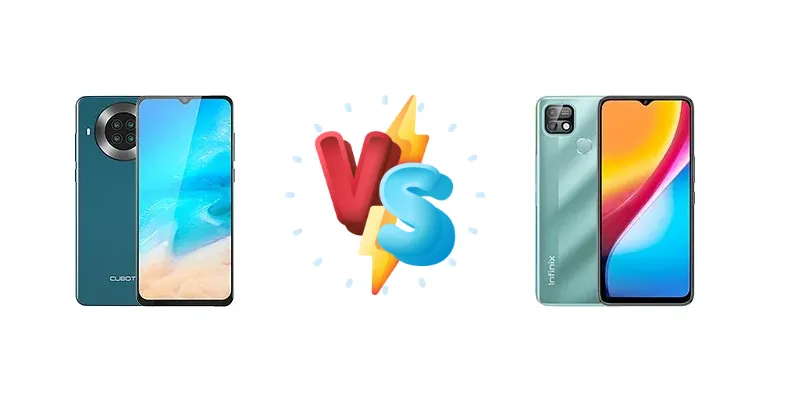
The Cubot Note 20 and Infinix Smart 5 Pro represent the extreme end of the budget smartphone market. Both aim to deliver essential smartphone functionality at the lowest possible price point, but they take different approaches to achieving this. This comparison dissects their core components to determine which device offers the best experience for users prioritizing affordability.
🏆 Quick Verdict
For the average user needing a basic smartphone for calls, messaging, and light social media, the Infinix Smart 5 Pro edges out the Cubot Note 20. Its octa-core processor, despite the older 28nm process, provides a noticeable performance advantage over the quad-core Helio A20, making everyday tasks smoother.
| Network |
|---|
| 2G bands | GSM 850 / 900 / 1800 / 1900 | GSM 850 / 900 / 1800 / 1900 |
| 3G bands | HSDPA 900 / 2100 | HSDPA 850 / 900 / 2100 |
| 4G bands | 1, 3, 7, 8, 19, 20 | 1, 3, 5, 8, 38, 40, 41 |
| Speed | HSPA, LTE | HSPA 21.1/5.76 Mbps, LTE Cat4 150/50 Mbps |
| Technology | GSM / HSPA / LTE | GSM / HSPA / LTE |
| | - | 1, 2, 3, 4, 5, 7, 8, 20, 28, 38, 41, 40, 66 |
| Launch |
|---|
| Announced | 2020. Released 2020 | 2021, November 17 |
| Status | Discontinued | Available. Released 2021, November 17 |
| Body |
|---|
| Build | - | Glass front, plastic back, plastic frame |
| Dimensions | 162.8 x 75.4 x 9.1 mm (6.41 x 2.97 x 0.36 in) | 164.4 x 75.6 x 9.5 mm (6.47 x 2.98 x 0.37 in) |
| SIM | Nano-SIM + Nano-SIM | Nano-SIM + Nano-SIM |
| Weight | 200 g (7.05 oz) | - |
| Display |
|---|
| Resolution | 720 x 1600 pixels, 20:9 ratio (~270 ppi density) | 720 x 1600 pixels, 20:9 ratio (~269 ppi density) |
| Size | 6.5 inches, 102.0 cm2 (~83.1% screen-to-body ratio) | 6.52 inches, 102.6 cm2 (~82.6% screen-to-body ratio) |
| Type | IPS LCD | IPS LCD, 500 nits (peak) |
| Platform |
|---|
| CPU | Quad-core 1.8 GHz Cortex-A53 | Octa-core (4x1.6 GHz Cortex-A55 & 4x1.2 GHz Cortex-A55) |
| Chipset | Mediatek MT6761D Helio A20 (12 nm) | Unisoc SC9863A (28 nm) |
| GPU | PowerVR GE8320 | IMG8322 |
| OS | Android 10 | Android 11 (Go edition), XOS 7.6 |
| Memory |
|---|
| Card slot | microSDXC (dedicated slot) | microSDXC (dedicated slot) |
| Internal | 64GB 3GB RAM | 32GB 2GB RAM |
| | - | eMMC 5.1 |
| Main Camera |
|---|
| Dual | - | 13 MP, f/1.8, AF
Auxiliary lens |
| Features | LED flash | Quad-LED flash |
| Quad | 12 MP, (wide), 1/2.9", AF
20 MP, (depth), 1/2.78"
Auxiliary lenses | - |
| Single | - | 8 MP |
| Video | Yes | 1440p@30fps |
| Selfie camera |
|---|
| Features | - | Dual-LED flash |
| Single | 8 MP | 8 MP |
| Video | Yes | 1080p@30fps |
| Sound |
|---|
| 3.5mm jack | - | Yes |
| 35mm jack | Yes | Yes |
| Loudspeaker | Yes | Yes |
| Comms |
|---|
| Bluetooth | 4.2, A2DP | 4.2, A2DP |
| NFC | Yes | No |
| Positioning | GPS | GPS |
| Radio | Unspecified | FM radio |
| USB | microUSB | microUSB 2.0 |
| WLAN | Wi-Fi 802.11 a/b/g/n | Wi-Fi 802.11 b/g/n |
| Features |
|---|
| Sensors | Accelerometer, proximity | Fingerprint (rear-mounted), accelerometer, proximity |
| Battery |
|---|
| Charging | - | 10W wired |
| Type | 4200 mAh, removable | 6000 mAh |
| Misc |
|---|
| Colors | Black, Blue, Green | Morandi Green, Heart of Ocean |
| Price | - | About 70 EUR |
Cubot Note 20
- More modern 12nm chipset fabrication.
- Potentially lower power consumption (though offset by fewer cores).
- May offer software updates for a longer period.
- Quad-core processor limits multitasking performance.
- Older Cortex-A53 cores are less efficient per clock cycle.
- Likely slower overall performance compared to the Infinix.
Infinix Smart 5 Pro
- Octa-core processor provides smoother multitasking.
- More modern Cortex-A55 cores offer better efficiency.
- More responsive user experience for everyday tasks.
- Older 28nm manufacturing process is less efficient.
- Slower 10W charging.
- Unisoc chipsets may have limited software support.
Display Comparison
Neither device boasts a standout display. Details regarding panel type (IPS, TFT) and resolution are missing, but both are likely to be 720p or lower. The focus here is on functionality, not fidelity. Bezels are expected to be substantial on both, maximizing screen real estate within a budget-friendly form factor. Color accuracy and brightness are likely to be average at best, suitable for indoor use but potentially washed out in direct sunlight.
Camera Comparison
Camera performance is expected to be basic on both devices. Details regarding sensor sizes and apertures are unavailable, but both likely feature a primary camera paired with low-resolution auxiliary sensors (often 2MP for macro or depth). Image quality will be acceptable in good lighting conditions, but struggles in low light. The focus should be on capturing memories, not professional-grade photography. The image processing capabilities of both chipsets are likely limited, resulting in images with limited dynamic range and detail.
Performance
The core difference lies in the chipsets. The Cubot Note 20 utilizes the Mediatek MT6761D Helio A20, a quad-core processor built on a more efficient 12nm process. However, the Infinix Smart 5 Pro counters with the Unisoc SC9863A, an octa-core chip, albeit fabricated on an older 28nm node. While the 28nm process is less efficient, the eight cores (4x1.6 GHz Cortex-A55 & 4x1.2 GHz Cortex-A55) provide a significant advantage in multi-threaded tasks. This translates to smoother app switching and a more responsive experience when running multiple applications simultaneously. The Cortex-A55 cores in the Infinix are also more modern than the A53 cores in the Cubot, offering incremental performance gains per clock cycle.
Battery Life
Battery capacity details are missing for the Cubot Note 20, but the Infinix Smart 5 Pro supports 10W wired charging. Given the lower processing demands of these devices, battery life should be adequate for a full day of light use on both. However, the 10W charging on the Infinix will result in a longer 0-100% charge time compared to potentially faster charging solutions available on some Cubot models (depending on the specific variant).
Buying Guide
Buy the Cubot Note 20 if you prioritize a newer chipset architecture, even if it's less powerful, and are comfortable with potentially slower performance in multi-tasking scenarios. Buy the Infinix Smart 5 Pro if you prefer a more responsive user experience for everyday tasks and don't mind the older manufacturing process and slower charging.
Frequently Asked Questions
❓ Will the Infinix Smart 5 Pro struggle with popular apps like WhatsApp and Facebook?
The octa-core Unisoc SC9863A processor in the Infinix Smart 5 Pro should handle apps like WhatsApp and Facebook without significant issues. While not a powerhouse, the eight cores provide enough processing power for these commonly used applications. However, running multiple demanding apps simultaneously may lead to slowdowns.
❓ Is the 28nm process of the Unisoc SC9863A a major concern for battery life?
The 28nm process is less efficient than the 12nm process used in the Cubot Note 20's Helio A20. This means the Infinix Smart 5 Pro *may* consume slightly more power under similar workloads. However, the difference is unlikely to be dramatic, and the overall battery life should still be sufficient for a day of light use. The impact will be more noticeable during intensive tasks.
❓ Can I play basic games like Candy Crush on the Cubot Note 20?
Yes, the Cubot Note 20 should be capable of running casual games like Candy Crush without significant problems. However, more demanding games may experience lag or reduced frame rates due to the quad-core processor and limited GPU capabilities.
❓ Does the Infinix Smart 5 Pro support fast charging?
No, the Infinix Smart 5 Pro only supports 10W wired charging. This is a relatively slow charging speed compared to modern smartphones, so expect a longer charging time from 0% to 100%.