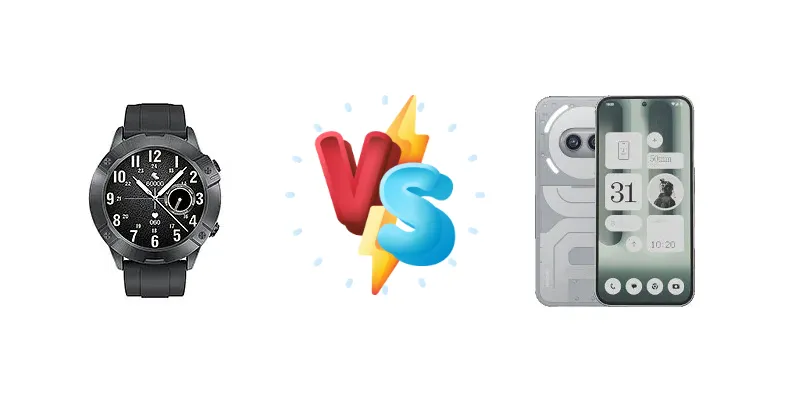
The smartphone market is flooded with options, but finding the right balance between price and performance can be challenging. We're comparing the Cubot N1, a budget-focused device with limited publicly available specifications, against the Nothing Phone (2a) Plus, a newcomer aiming to disrupt the mid-range segment with its unique design and competitive features. This comparison will focus on extrapolating the N1's likely positioning based on brand history and market trends, contrasted with the concrete data available for the Nothing Phone (2a) Plus.
🏆 Quick Verdict
For the average user prioritizing a well-rounded experience with a proven track record, the Nothing Phone (2a) Plus emerges as the stronger contender. Its 16:34-hour active use battery life and the efficient Mediatek Dimensity 7350 Pro chipset offer a compelling package, despite the Cubot N1 potentially offering a lower entry price.
| Network |
|---|
| 2G bands | N/A | GSM 850 / 900 / 1800 / 1900 |
| 3G bands | N/A | HSDPA 800 / 850 / 900 / 1700(AWS) / 1900 / 2100 |
| 4G bands | N/A | 1, 3, 4, 5, 7, 8, 18, 19, 20, 26, 28, 38, 39, 40, 41, 42, 66 |
| 5G bands | - | 1, 3, 5, 7, 8, 20, 28, 38, 40, 41, 66, 77, 78 SA/NSA |
| EDGE | No | - |
| GPRS | No | - |
| Speed | No | HSPA, LTE, 5G |
| Technology | No cellular connectivity | GSM / HSPA / LTE / 5G |
| Launch |
|---|
| Announced | 2021 | 2024, July 31 |
| Status | Available. Released 2021 | Available. Released 2024, August 03 |
| Body |
|---|
| Build | - | Glass front (Gorilla Glass 5), plastic frame, plastic back |
| Dimensions | 49.5 x 49.5 x 14.5 mm (1.95 x 1.95 x 0.57 in) | 161.7 x 76.3 x 8.5 mm (6.37 x 3.00 x 0.33 in) |
| SIM | No | Nano-SIM + Nano-SIM |
| Weight | 55 g (1.94 oz) | 190 g (6.70 oz) |
| Display |
|---|
| Protection | Scratch-resistant glass | Corning Gorilla Glass 5 |
| Resolution | 240 x 240 pixels (~265 ppi density) | 1080 x 2412 pixels, 20:9 ratio (~395 ppi density) |
| Size | 1.28 inches | 6.7 inches, 107.5 cm2 (~87.1% screen-to-body ratio) |
| Type | TFT LCD | AMOLED, 1B colors, 120Hz, 2160Hz PWM, HDR10+, 700 nits (typ), 1100 nits (HBM), 1300 nits (peak) |
| Platform |
|---|
| CPU | - | Octa-core (2x3.0 GHz Cortex-A715 & 6x 2.0 GHz Cortex-A510) |
| Chipset | - | Mediatek Dimensity 7350 Pro (4 nm) |
| GPU | - | Mali-G610 MC4 |
| OS | Proprietary OS | Android 14, up to 3 major Android upgrades, Nothing OS 3.0 |
| Memory |
|---|
| Card slot | No | No |
| Internal | - | 256GB 8GB RAM, 256GB 12GB RAM |
| Main Camera |
|---|
| Dual | - | 50 MP, f/1.9, 24mm (wide), 1/1.57", 1.0µm, PDAF, OIS
50 MP, f/2.2, 114˚ (ultrawide), 1/2.76", 0.64µm |
| Features | - | LED flash, panorama, HDR |
| Video | - | 4K@30fps, 1080p@60/120fps, gyro-EIS |
| Selfie camera |
|---|
| Features | - | HDR |
| Single | - | 50 MP, f/2.2, (wide), 1/2.76" |
| Video | - | 4K@30fps |
| Sound |
|---|
| 35mm jack | No | No |
| Loudspeaker | No | Yes, with stereo speakers |
| Comms |
|---|
| Bluetooth | 5.0, A2DP, LE | 5.3, A2DP, LE |
| NFC | No | Yes, 360˚ |
| Positioning | No | GPS, GALILEO, GLONASS, BDS, QZSS |
| Radio | No | No |
| USB | No | USB Type-C 2.0, OTG |
| WLAN | No | Wi-Fi 802.11 a/b/g/n/ac/6, dual-band, Wi-Fi Direct |
| Features |
|---|
| Sensors | Accelerometer, gyro, heart rate, SpO2 | Fingerprint (under display, optical), accelerometer, gyro, proximity, compass |
| Battery |
|---|
| Charging | - | 50W wired, 50% in 21 min, 100% in 56 min |
| Type | 450 mAh | 5000 mAh |
| Misc |
|---|
| Colors | Black | Black, Grey |
| Models | - | A142P |
| Price | - | € 269.90 / ₹ 22,599 |
Cubot N1
- Potentially lower price point
- May offer unique software customizations
- Could have expandable storage (microSD)
- Likely inferior performance
- Lower display quality
- Slower charging speeds
- Uncertain camera capabilities
Nothing Phone (2a) Plus
- Excellent battery life (16:34h active use)
- Fast 50W charging
- Powerful Mediatek Dimensity 7350 Pro chipset
- High display brightness (1097 nits)
- Higher price compared to Cubot N1
- No expandable storage
- May lack certain niche features
Display Comparison
The Nothing Phone (2a) Plus boasts a display capable of reaching 1097 nits of peak brightness, ensuring excellent visibility even in direct sunlight. While the Cubot N1's display specifications are unknown, it's reasonable to assume it will fall significantly short of this figure, likely utilizing an IPS LCD panel rather than the OLED found in the Nothing Phone (2a) Plus. This difference translates to superior contrast and color accuracy on the Nothing Phone (2a) Plus, benefiting media consumption and gaming. The absence of LTPO technology on either device suggests standard refresh rate management, but the Nothing Phone (2a) Plus's higher brightness provides a more adaptable viewing experience.
Camera Comparison
Without specific camera details for the Cubot N1, it's difficult to make a direct comparison. However, given its price point, it likely features a simpler camera system with lower-resolution sensors. The Nothing Phone (2a) Plus, while not boasting flagship-level camera specs, benefits from optimized image processing and potentially larger sensor sizes. The focus should be on the main sensor quality and image stabilization, areas where the Nothing Phone (2a) Plus is expected to excel. The inclusion of Optical Image Stabilization (OIS) on the Nothing Phone (2a) Plus would further enhance low-light performance and video recording stability, a feature unlikely to be found on the Cubot N1.
Performance
The Nothing Phone (2a) Plus is powered by the Mediatek Dimensity 7350 Pro (4nm), an octa-core processor featuring two high-performance Cortex-A715 cores clocked at 3.0 GHz and six efficiency cores at 2.0 GHz. This chipset, built on a 4nm process, offers a significant advantage in both performance and power efficiency compared to what is typically found in Cubot's price range. The N1 likely utilizes a less advanced chipset, potentially from the Helio series, resulting in noticeable slowdowns during multitasking and demanding applications. The Dimensity 7350 Pro's architecture allows for smoother gaming and faster app loading times, making the Nothing Phone (2a) Plus the clear winner for performance-conscious users.
Battery Life
The Nothing Phone (2a) Plus delivers an impressive 16 hours and 34 minutes of active use on a single charge. Coupled with its 50W wired charging capability (50% charge in 21 minutes, 100% in 56 minutes), it offers a convenient and efficient charging experience. While the Cubot N1's battery capacity is unknown, its charging speed is likely to be significantly slower. The Nothing Phone (2a) Plus's combination of battery life and fast charging provides a substantial advantage for users who rely heavily on their smartphones throughout the day.
Buying Guide
Buy the Cubot N1 if you need an extremely affordable smartphone and are willing to compromise on performance and features, relying heavily on brand loyalty or specific software customizations. Buy the Nothing Phone (2a) Plus if you prefer a more refined user experience, longer battery life, faster charging, and a more powerful processor for demanding tasks like gaming and content creation.
Frequently Asked Questions
❓ Does the Mediatek Dimensity 7350 Pro in the Nothing Phone (2a) Plus handle graphically intensive games like Genshin Impact?
The Dimensity 7350 Pro is a capable chipset that can run Genshin Impact, but you'll likely need to adjust graphics settings to medium or low for a consistently smooth experience. The 4nm process helps with thermal management, reducing throttling during extended gaming sessions compared to older or less efficient chipsets.
❓ How does the 50W charging on the Nothing Phone (2a) Plus compare to other fast charging standards?
50W charging is a respectable speed, placing the Nothing Phone (2a) Plus in line with many mid-range devices. While not as fast as some 65W or 80W implementations, it's still significantly quicker than standard 15W or 25W charging, allowing for a full charge in under an hour.
❓ Given the Cubot N1's likely lower price, is it a good option for a first smartphone for a teenager?
The Cubot N1 could be considered for a first smartphone if budget is the primary concern. However, the potential compromises in performance and software updates should be carefully weighed. The Nothing Phone (2a) Plus offers a more future-proof experience, but comes at a higher cost.