
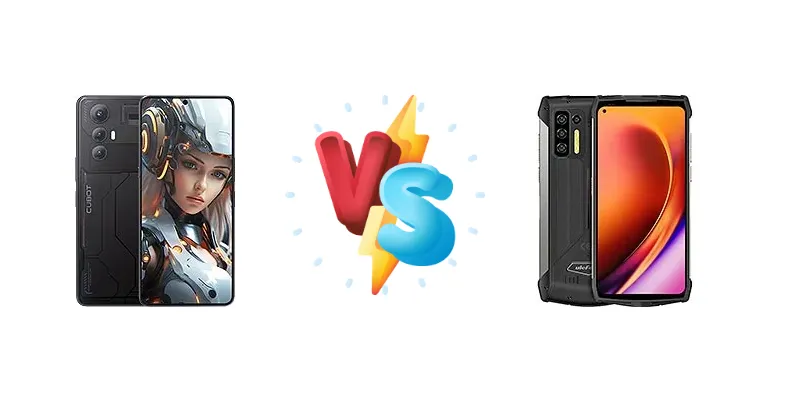
Cubot Max 5 vs Ulefone Power Armor 13: A Detailed Comparison of Performance and Ruggedness
| Phones Images | |||||
|---|---|---|---|---|---|
|
🏆 Quick Verdict
For users prioritizing performance and responsiveness, the Cubot Max 5 is the clear winner thanks to its significantly more powerful Dimensity 8200 chipset. However, if you require a phone that can withstand harsh conditions and offers wireless charging, the Ulefone Power Armor 13 is the more practical choice.
| PHONES | ||
|---|---|---|
| Phone Names | Cubot Max 5 | Ulefone Power Armor 13 |
| Network | ||
|---|---|---|
| 2G bands | GSM 850 / 900 / 1800 / 1900 | GSM 850 / 900 / 1800 / 1900 |
| 3G bands | HSDPA 800 / 850 / 900 / 1700(AWS) / 1900 / 2100 | HSDPA 850 / 900 / 1700(AWS) / 1900 / 2100 |
| 4G bands | 1, 2, 3, 4, 5, 7, 8, 12, 13, 17, 18, 19, 20, 25, 26, 28, 34, 38, 39, 40, 41, 66, 71 | 1, 2, 3, 4, 5, 7, 8, 12, 13, 17, 18, 19, 20, 25, 26, 28, 38, 40, 66 |
| 5G bands | 1, 2, 3, 5, 7, 8, 20, 25, 28, 38, 40, 41, 66, 77, 78 SA/NSA | - |
| Speed | HSPA, LTE, 5G | HSPA 42.2/11.5 Mbps, LTE Cat12 600/150 Mbps |
| Technology | GSM / HSPA / LTE / 5G | GSM / HSPA / LTE |
| Launch | ||
|---|---|---|
| Announced | 2024, July 03 | 2021, July 22 |
| Status | Available. Released 2024, July 22 | Available. Released 2021, July 26 |
| Body | ||
|---|---|---|
| Dimensions | 173.9 x 78.9 x 9.2 mm (6.85 x 3.11 x 0.36 in) | 183.7 x 85.4 x 20.8 mm (7.23 x 3.36 x 0.82 in) |
| SIM | Nano-SIM + Nano-SIM | Nano-SIM + Nano-SIM |
| Weight | 223 g (7.87 oz) | 492 g (1.08 lb) |
| - | IP68 dust/water resistant (up to 1.5m for 30 min) Drop-to-concrete resistance from up to 1.2m MIL-STD-810G compliant | |
| Display | ||
|---|---|---|
| Protection | Mohs level 6 | Corning Gorilla Glass 3 |
| Resolution | 1080 x 2460 pixels (~387 ppi density) | 1080 x 2400 pixels, 20:9 ratio (~386 ppi density) |
| Size | 6.95 inches, 114.7 cm2 (~83.6% screen-to-body ratio) | 6.81 inches, 112.0 cm2 (~71.4% screen-to-body ratio) |
| Type | IPS LCD, 144Hz | IPS LCD |
| Platform | ||
|---|---|---|
| CPU | Octa-core (1x3.1 GHz Cortex-A78 & 3x3.0 GHz Cortex-A78 & 4x2.0 GHz Cortex-A55) | Octa-core (2x2.05 GHz Cortex-A76 & 6x2.0 GHz Cortex-A55) |
| Chipset | Mediatek Dimensity 8200 (4 nm) | Mediatek MT6785V/CD Helio G95 (12 nm) |
| GPU | Mali-G610 MC6 | Mali-G76 MC4 |
| OS | Android 14 | Android 11 |
| Memory | ||
|---|---|---|
| Card slot | No | microSDXC (uses shared SIM slot) |
| Internal | 256GB 12GB RAM | 256GB 8GB RAM |
| Main Camera | ||
|---|---|---|
| Dual | 100 MP, (wide), PDAF 5 MP (macro) | - |
| Features | LED flash, HDR, panorama | Quad-LED flash, HDR, panorama |
| Penta | - | 48 MP, f/1.8, 26mm (wide), 1/2.0", 0.8µm, PDAF 8 MP, f/2.2, (ultrawide) 2 MP (macro) Auxiliary lens |
| Video | 4K@30fps, 1080p@30fps | 4K@30fps, 1080p@30fps |
| Selfie camera | ||
|---|---|---|
| Features | - | HDR, panorama |
| Single | 32 MP, AF | 16 MP, f/2.2 |
| Video | 1080p@30fps | 1080p@30fps |
| Sound | ||
|---|---|---|
| 3.5mm jack | - | Yes |
| 35mm jack | No | Yes |
| Loudspeaker | Yes | Yes |
| Comms | ||
|---|---|---|
| Bluetooth | 5.3, A2DP, LE | 5.0, A2DP, LE |
| NFC | Yes | Yes |
| Positioning | GPS (L1+L5), GLONASS, GALILEO, BDS | GPS, GLONASS, GALILEO, BDS |
| Radio | Unspecified | FM radio, RDS, recording |
| USB | USB Type-C, OTG, DisplayPort | - |
| WLAN | Wi-Fi 802.11 a/b/g/n/ac/6, dual-band | Wi-Fi 802.11 a/b/g/n/ac, dual-band |
| Features | ||
|---|---|---|
| Sensors | Fingerprint (side-mounted), accelerometer, gyro, proximity, compass | Fingerprint (side-mounted), accelerometer, gyro, proximity, compass, baroceptor, coulombmeter |
| - | Infrared distance measure (error range: 1~20m, ±10mm; 20~40m, ±25mm) | |
| Battery | ||
|---|---|---|
| Charging | 33W wired | 33W wired 15W wireless 5W reverse wireless |
| Type | 5100 mAh | Li-Po 13200 mAh |
| Misc | ||
|---|---|---|
| Colors | Tech Black, Pearl White | Black |
| Price | € 299.95 / $ 219.99 | About 300 EUR |
| Tests | ||
|---|---|---|
| Battery life | - | Endurance rating 296h |
| Camera | - | Photo / Video |
| Display | - | Contrast ratio: 1306:1 (nominal) |
| Loudspeaker | - | -28.3 LUFS (Average) |
| Performance | - | AnTuTu: 294194 (v8), 351678 (v9) GeekBench: 1610 (v5.1) GFXBench: 18fps (ES 3.1 onscreen) |
| EU LABEL | ||
|---|---|---|
| Battery | 29:38h endurance, 900 cycles | - |
| Energy | Class E | - |
| Free fall | Class B (180 falls) | - |
| Repairability | Class B | - |
Cubot Max 5
- Significantly faster processor for gaming and multitasking
- More power-efficient chipset (4nm)
- Likely superior display quality (assuming higher refresh rate)
- Lacks ruggedized design
- No wireless charging
Ulefone Power Armor 13
- Ruggedized design for durability
- Wireless and reverse wireless charging
- Potentially longer battery life due to efficient chipset
- Significantly slower processor
- Less responsive user experience
Display Comparison
The Ulefone Power Armor 13 features a display with a 1306:1 contrast ratio and a measured peak brightness of 401 nits. While adequate for outdoor visibility, this is a fairly standard specification. The Cubot Max 5’s display specifications are not provided, but given its focus on overall performance, it’s likely to prioritize refresh rate and color accuracy over peak brightness. The Armor 13’s contrast ratio suggests a decent viewing experience, but the Max 5 may offer a more vibrant and fluid visual experience if it incorporates a higher refresh rate panel.
Camera Comparison
Both devices list 'Photo / Video' capabilities, but lack specific details. Without sensor size, aperture, or image processing details, a direct comparison is difficult. However, given the Armor 13’s rugged focus, its camera is likely optimized for capturing usable images in challenging conditions, prioritizing reliability over cutting-edge image quality. The Max 5, with its higher overall specifications, may offer more advanced camera features and potentially better image quality in ideal lighting conditions, but this remains speculative without further data.
Performance
The performance gap between these two devices is substantial. The Cubot Max 5 is equipped with the Mediatek Dimensity 8200 (4nm), an octa-core processor featuring a 1x3.1 GHz Cortex-A78, 3x3.0 GHz Cortex-A78, and 4x2.0 GHz Cortex-A55 cores. This is a flagship-level chipset. In contrast, the Ulefone Power Armor 13 utilizes the Mediatek Helio G95 (12nm) with an octa-core configuration of 2x2.05 GHz Cortex-A76 and 6x2.0 GHz Cortex-A55 cores. The Dimensity 8200’s 4nm process node provides significantly improved power efficiency and thermal performance compared to the G95’s 12nm node, translating to less throttling during sustained workloads and superior overall responsiveness. Gamers and demanding users will overwhelmingly benefit from the Max 5’s superior processing power.
Battery Life
Both phones claim an endurance rating of approximately 29 hours, with the Ulefone Power Armor 13 also listing a 296h endurance rating (likely an older, less accurate measurement). The Max 5 supports 33W wired charging, while the Armor 13 adds 15W wireless charging and 5W reverse wireless charging. While the battery capacity isn’t specified for either device, the Armor 13’s wireless charging capabilities offer added convenience. The Max 5’s faster wired charging may offset any potential battery capacity difference, allowing for quicker top-ups.
Buying Guide
Buy the Cubot Max 5 if you're a power user who demands smooth multitasking, enjoys mobile gaming, and values a responsive user experience. Buy the Ulefone Power Armor 13 if you work in a demanding environment, frequently spend time outdoors, or simply need a phone that can survive drops and impacts, and appreciate the convenience of wireless charging.