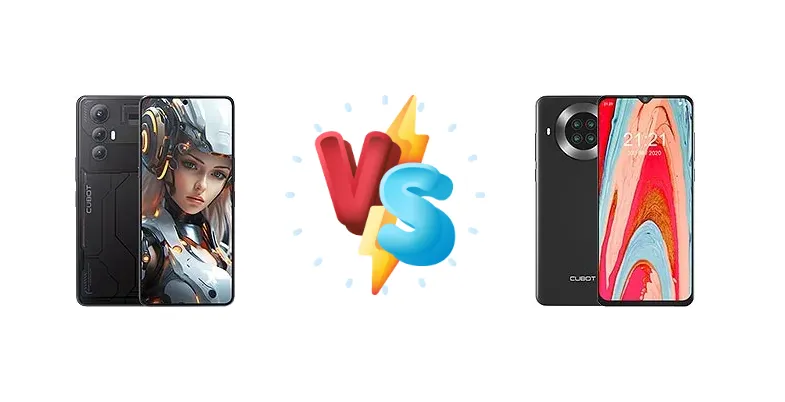
Cubot offers two distinct approaches to the smartphone market with the Max 5 and Note 20 Pro. The Max 5 aims for a strong performance profile with a modern chipset, while the Note 20 Pro focuses on affordability. This comparison dissects the core differences to determine which device best suits your needs and budget.
🏆 Quick Verdict
For the average user prioritizing performance and longevity, the Cubot Max 5 is the clear winner. Its Dimensity 8200 chipset delivers significantly faster processing speeds and superior graphics capabilities compared to the Note 20 Pro’s Helio P60. While the Note 20 Pro offers a budget-friendly entry point, the Max 5 provides a substantially improved user experience.
| Network |
|---|
| 2G bands | GSM 850 / 900 / 1800 / 1900 | GSM 850 / 900 / 1800 / 1900 |
| 3G bands | HSDPA 800 / 850 / 900 / 1700(AWS) / 1900 / 2100 | HSDPA 900 / 2100 |
| 4G bands | 1, 2, 3, 4, 5, 7, 8, 12, 13, 17, 18, 19, 20, 25, 26, 28, 34, 38, 39, 40, 41, 66, 71 | 1, 3, 7, 8, 19, 20 |
| 5G bands | 1, 2, 3, 5, 7, 8, 20, 25, 28, 38, 40, 41, 66, 77, 78 SA/NSA | - |
| Speed | HSPA, LTE, 5G | HSPA, LTE |
| Technology | GSM / HSPA / LTE / 5G | GSM / HSPA / LTE |
| Launch |
|---|
| Announced | 2024, July 03 | 2020. Released 2020 |
| Status | Available. Released 2024, July 22 | Discontinued |
| Body |
|---|
| Dimensions | 173.9 x 78.9 x 9.2 mm (6.85 x 3.11 x 0.36 in) | 162.8 x 75.4 x 9.1 mm (6.41 x 2.97 x 0.36 in) |
| SIM | Nano-SIM + Nano-SIM | Nano-SIM + Nano-SIM |
| Weight | 223 g (7.87 oz) | 200 g (7.05 oz) |
| Display |
|---|
| Protection | Mohs level 6 | - |
| Resolution | 1080 x 2460 pixels (~387 ppi density) | 720 x 1600 pixels, 20:9 ratio (~270 ppi density) |
| Size | 6.95 inches, 114.7 cm2 (~83.6% screen-to-body ratio) | 6.5 inches, 102.0 cm2 (~83.1% screen-to-body ratio) |
| Type | IPS LCD, 144Hz | IPS LCD |
| Platform |
|---|
| CPU | Octa-core (1x3.1 GHz Cortex-A78 & 3x3.0 GHz Cortex-A78 & 4x2.0 GHz Cortex-A55) | Octa-core (4x2.0 GHz Cortex-A73 & 4x2.0 GHz Cortex-A53) |
| Chipset | Mediatek Dimensity 8200 (4 nm) | Mediatek MT6771 Helio P60 (12 nm) |
| GPU | Mali-G610 MC6 | Mali-G72 MP3 |
| OS | Android 14 | Android 10 |
| Memory |
|---|
| Card slot | No | microSDXC (dedicated slot) |
| Internal | 256GB 12GB RAM | 128GB 8GB RAM |
| Main Camera |
|---|
| Dual | 100 MP, (wide), PDAF
5 MP (macro) | - |
| Features | LED flash, HDR, panorama | LED flash |
| Quad | - | 12 MP, (wide), 1/2.9", AF
20 MP, (depth), 1/2.78"
Auxiliary lenses |
| Video | 4K@30fps, 1080p@30fps | Yes |
| Selfie camera |
|---|
| Single | 32 MP, AF | 8 MP |
| Video | 1080p@30fps | Yes |
| Sound |
|---|
| 35mm jack | No | Yes |
| Loudspeaker | Yes | Yes |
| Comms |
|---|
| Bluetooth | 5.3, A2DP, LE | 4.2, A2DP |
| NFC | Yes | Yes |
| Positioning | GPS (L1+L5), GLONASS, GALILEO, BDS | GPS |
| Radio | Unspecified | Unspecified |
| USB | USB Type-C, OTG, DisplayPort | microUSB, OTG |
| WLAN | Wi-Fi 802.11 a/b/g/n/ac/6, dual-band | Wi-Fi 802.11 a/b/g/n |
| Features |
|---|
| Sensors | Fingerprint (side-mounted), accelerometer, gyro, proximity, compass | Accelerometer, gyro, proximity, compass |
| Battery |
|---|
| Charging | 33W wired | - |
| Type | 5100 mAh | 4200 mAh, removable |
| Misc |
|---|
| Colors | Tech Black, Pearl White | Black, Blue, Green |
| Price | € 299.95 / $ 219.99 | - |
| EU LABEL |
|---|
| Battery | 29:38h endurance, 900 cycles | - |
| Energy | Class E | - |
| Free fall | Class B (180 falls) | - |
| Repairability | Class B | - |
Cubot Max 5
- Exceptional performance with Dimensity 8200
- Long battery life (29:38h endurance)
- Potential for future software updates
- May be more expensive than the Note 20 Pro
- 33W charging isn't the fastest available
Cubot Note 20 Pro
- Highly affordable price point
- Suitable for basic smartphone tasks
- Acceptable for light users
- Outdated Helio P60 chipset
- Limited performance for demanding apps
- Shorter battery life expected
Display Comparison
Display specifications are not provided, so a direct comparison is limited. However, given the Max 5’s focus on performance, it likely features a higher-quality panel with a faster refresh rate. The Note 20 Pro, targeting a lower price point, likely utilizes a more basic LCD panel. Expect the Max 5 to offer better color accuracy and viewing angles, though this is speculative without further data.
Camera Comparison
Camera details are limited. However, the chipset difference heavily influences image processing capabilities. The Dimensity 8200’s integrated ISP (Image Signal Processor) in the Max 5 will deliver superior image quality, faster processing, and better low-light performance compared to the Helio P60 in the Note 20 Pro. While both phones may have similar megapixel counts, the Max 5 will produce more detailed and vibrant photos. Without sensor size information, it's difficult to assess dynamic range, but the processing advantage favors the Max 5.
Performance
The performance disparity is the most significant difference. The Cubot Max 5’s Mediatek Dimensity 8200 (4nm) is a flagship-level chipset featuring an octa-core configuration with a high-clocked Cortex-A78 prime core (3.1 GHz). This contrasts sharply with the Note 20 Pro’s Helio P60 (12nm), an older, less powerful chipset with Cortex-A73 cores (2.0 GHz). The 4nm fabrication process of the Dimensity 8200 offers significantly improved power efficiency and thermal management, translating to sustained performance during intensive tasks. The Max 5 will handle demanding games and applications with ease, while the Note 20 Pro will struggle with anything beyond basic usage.
Battery Life
The Cubot Max 5 boasts an impressive 29:38h endurance and a 900-cycle battery lifespan, indicating a large capacity and optimized power management. While the Note 20 Pro’s battery capacity is unknown, the less efficient Helio P60 chipset will likely result in significantly shorter battery life. The Max 5’s 33W wired charging is a reasonable speed, allowing for a relatively quick recharge, but the longer battery life minimizes the need for frequent charging. The Note 20 Pro will likely require more frequent top-ups.
Buying Guide
Buy the Cubot Max 5 if you need a phone capable of handling demanding tasks like gaming, video editing, or multitasking without slowdowns. Its superior chipset and potential for longer software support make it a future-proof investment. Buy the Cubot Note 20 Pro if you prioritize extreme affordability and basic smartphone functionality – web browsing, social media, and light communication – and are willing to compromise on performance and long-term usability.
Frequently Asked Questions
❓ Will the Cubot Max 5 handle graphically intensive games like Genshin Impact or Call of Duty Mobile?
Yes, the Dimensity 8200 chipset in the Cubot Max 5 is more than capable of running demanding games like Genshin Impact and Call of Duty Mobile at high settings. The 4nm process and powerful GPU will provide a smooth and enjoyable gaming experience with minimal throttling.
❓ Is the Helio P60 in the Cubot Note 20 Pro sufficient for everyday tasks like browsing and social media?
The Helio P60 is adequate for basic tasks like web browsing, social media, and messaging. However, it will struggle with multitasking or running resource-intensive applications. Expect some lag and slowdowns when switching between apps or loading complex web pages.
❓ How long will the Cubot Max 5's battery last with moderate usage (calls, texts, social media)?
With moderate usage, the Cubot Max 5's battery should easily last a full day, potentially even two days. The 29:38h endurance rating suggests excellent power efficiency, allowing for extended use without needing to recharge.
❓ Does the Cubot Note 20 Pro support software updates beyond the initial Android version?
Given the age of the Helio P60 chipset and the Note 20 Pro's budget positioning, long-term software support is unlikely. Expect limited updates, primarily security patches, and potentially no major Android version upgrades.