
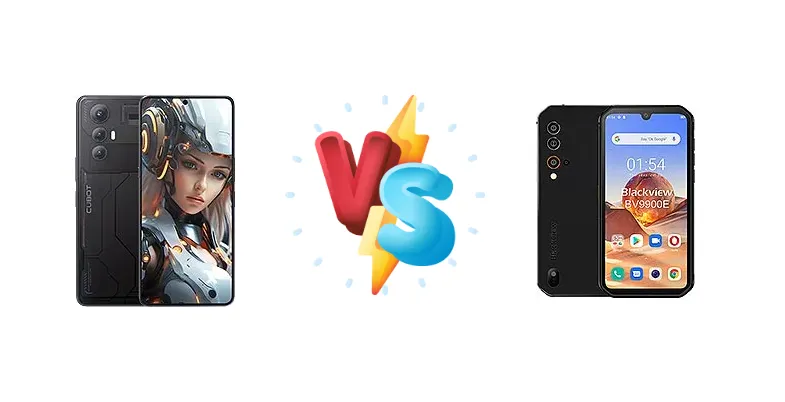
Cubot Max 5 vs. Blackview BV9900E: A Deep Dive into Performance and Ruggedness
| Phones Images | |||||
|---|---|---|---|---|---|
|
🏆 Quick Verdict
For the average user prioritizing speed and future-proofing, the Cubot Max 5 is the clear winner. Its Dimensity 8200 chipset offers a substantial performance leap over the Blackview BV9900E’s Helio P90. However, the BV9900E remains a compelling option for those needing wireless charging and a more ruggedized build.
| PHONES | ||
|---|---|---|
| Phone Names | Cubot Max 5 | Blackview BV9900E |
| Network | ||
|---|---|---|
| 2G bands | GSM 850 / 900 / 1800 / 1900 | GSM 850 / 900 / 1800 / 1900 |
| 3G bands | HSDPA 800 / 850 / 900 / 1700(AWS) / 1900 / 2100 | HSDPA 800 / 850 / 900 / 1700(AWS) / 1900 / 2100 |
| 4G bands | 1, 2, 3, 4, 5, 7, 8, 12, 13, 17, 18, 19, 20, 25, 26, 28, 34, 38, 39, 40, 41, 66, 71 | 1, 2, 3, 4, 5, 7, 8, 12, 13, 17, 18, 19, 20, 25, 26, 28, 34, 38, 39, 40, 41, 66 |
| 5G bands | 1, 2, 3, 5, 7, 8, 20, 25, 28, 38, 40, 41, 66, 77, 78 SA/NSA | - |
| Speed | HSPA, LTE, 5G | HSPA, LTE |
| Technology | GSM / HSPA / LTE / 5G | GSM / CDMA / HSPA / CDMA2000 / LTE |
| Launch | ||
|---|---|---|
| Announced | 2024, July 03 | 2020, September 10. Released 2020, September |
| Status | Available. Released 2024, July 22 | Discontinued |
| Body | ||
|---|---|---|
| Dimensions | 173.9 x 78.9 x 9.2 mm (6.85 x 3.11 x 0.36 in) | 156.5 x 78.3 x 14.2 mm (6.16 x 3.08 x 0.56 in) |
| SIM | Nano-SIM + Nano-SIM | Nano-SIM + Nano-SIM |
| Weight | 223 g (7.87 oz) | 273 g (9.63 oz) |
| Display | ||
|---|---|---|
| Protection | Mohs level 6 | Corning Gorilla Glass 5 |
| Resolution | 1080 x 2460 pixels (~387 ppi density) | 1080 x 2280 pixels, 19:9 ratio (~432 ppi density) |
| Size | 6.95 inches, 114.7 cm2 (~83.6% screen-to-body ratio) | 5.84 inches, 85.1 cm2 (~69.5% screen-to-body ratio) |
| Type | IPS LCD, 144Hz | IPS LCD |
| Platform | ||
|---|---|---|
| CPU | Octa-core (1x3.1 GHz Cortex-A78 & 3x3.0 GHz Cortex-A78 & 4x2.0 GHz Cortex-A55) | Octa-core (2x2.2 GHz Cortex-A75 & 6x2.0 GHz Cortex-A55) |
| Chipset | Mediatek Dimensity 8200 (4 nm) | Mediatek MT6779V/CE Helio P90 (12 nm) |
| GPU | Mali-G610 MC6 | PowerVR GM9446 |
| OS | Android 14 | Android 10 |
| Memory | ||
|---|---|---|
| Card slot | No | microSDXC |
| Internal | 256GB 12GB RAM | 128GB 6GB RAM |
| Main Camera | ||
|---|---|---|
| Dual | 100 MP, (wide), PDAF 5 MP (macro) | - |
| Features | LED flash, HDR, panorama | LED flash, HDR, panorama |
| Quad | - | 48 MP, f/1.8, (wide), PDAF 16 MP, 120˚ (ultrawide) 2 MP (macro) Auxiliary lens |
| Video | 4K@30fps, 1080p@30fps | 4K@30fps, 1080p@60fps |
| Selfie camera | ||
|---|---|---|
| Single | 32 MP, AF | 16 MP, f/2.0, (wide) |
| Video | 1080p@30fps | 1080p@30fps |
| Sound | ||
|---|---|---|
| 35mm jack | No | No |
| Loudspeaker | Yes | Yes |
| Comms | ||
|---|---|---|
| Bluetooth | 5.3, A2DP, LE | 5.0, A2DP, LE |
| NFC | Yes | Yes |
| Positioning | GPS (L1+L5), GLONASS, GALILEO, BDS | GPS, GLONASS, GALILEO, BDS |
| Radio | Unspecified | FM radio |
| USB | USB Type-C, OTG, DisplayPort | USB Type-C 2.0, OTG |
| WLAN | Wi-Fi 802.11 a/b/g/n/ac/6, dual-band | Wi-Fi 802.11 a/b/g/n/ac |
| Features | ||
|---|---|---|
| Sensors | Fingerprint (side-mounted), accelerometer, gyro, proximity, compass | Fingerprint (side-mounted), accelerometer, gyro, proximity, compass, barometer |
| Battery | ||
|---|---|---|
| Charging | 33W wired | 15W wired 18W wireless |
| Type | 5100 mAh | 4380 mAh |
| Misc | ||
|---|---|---|
| Colors | Tech Black, Pearl White | Black, Silver |
| Price | € 299.95 / $ 219.99 | About 260 EUR |
| EU LABEL | ||
|---|---|---|
| Battery | 29:38h endurance, 900 cycles | - |
| Energy | Class E | - |
| Free fall | Class B (180 falls) | - |
| Repairability | Class B | - |
Cubot Max 5
- Significantly faster processor (Dimensity 8200)
- Superior power efficiency (4nm process)
- Longer battery endurance (29:38h)
- Lacks wireless charging
- Potentially less durable build quality
Blackview BV9900E
- Wireless charging support (18W)
- Ruggedized design for enhanced durability
- Established brand reputation in rugged phones
- Significantly slower processor (Helio P90)
- Less efficient chipset (12nm process)
- Slower wired charging (15W)
Display Comparison
Display specifications are not provided, but given the price points, both devices likely feature LCD panels. The focus here is on internal performance. The lack of information on refresh rates or resolution makes a direct comparison impossible, but the Max 5’s processing power could potentially drive higher frame rates in games if paired with a capable display.
Camera Comparison
Camera details are absent, but we can infer that the Blackview BV9900E, being a rugged phone, might prioritize a more durable camera module. However, the Dimensity 8200 in the Cubot Max 5 includes a more powerful ISP (Image Signal Processor) capable of handling more complex image processing algorithms, potentially resulting in better image quality even with similar sensors. Without specific sensor information, it’s difficult to make a definitive judgment.
Performance
The performance gap is the most significant differentiator. The Cubot Max 5’s Mediatek Dimensity 8200 (4nm) is a generational leap ahead of the Blackview BV9900E’s Helio P90 (12nm). The Dimensity 8200’s octa-core configuration – 1x3.1 GHz Cortex-A78, 3x3.0 GHz Cortex-A78, and 4x2.0 GHz Cortex-A55 – provides significantly more processing power and efficiency than the Helio P90’s 2x2.2 GHz Cortex-A75 & 6x2.0 GHz Cortex-A55. The 4nm process node of the Dimensity 8200 translates to lower heat generation and sustained performance under load, crucial for gaming and demanding applications. The Helio P90, while capable, will struggle with newer, more resource-intensive titles.
Battery Life
The Cubot Max 5 boasts an impressive 29:38h endurance and a claimed 900 battery cycles, suggesting a focus on longevity. The Blackview BV9900E offers 15W wired and 18W wireless charging, a convenience the Max 5 lacks. While the Max 5’s endurance is excellent, the 33W wired charging will likely provide faster top-ups than the BV9900E’s 15W wired option. The inclusion of wireless charging on the BV9900E is a significant advantage for users who prefer cable-free charging.
Buying Guide
Buy the Cubot Max 5 if you need a phone for demanding tasks like gaming, video editing, or running multiple apps simultaneously. Its superior processing power and efficient 4nm chipset will provide a smoother, more responsive experience. Buy the Blackview BV9900E if you prioritize durability, wireless charging convenience, and a more established track record in the rugged phone space, even if it means sacrificing raw performance.