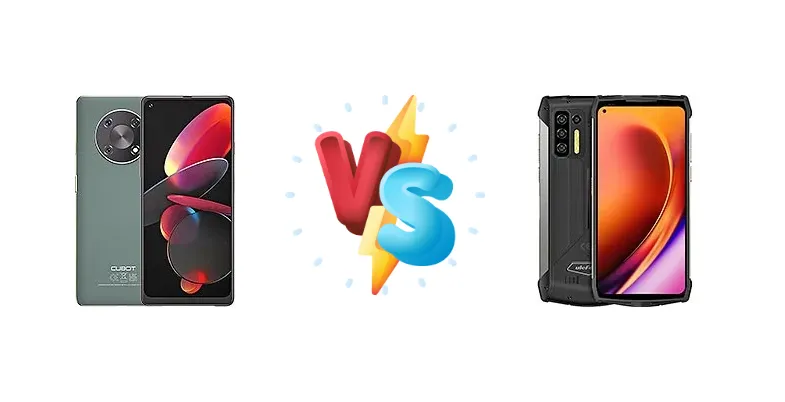
The smartphone market offers a spectrum of choices, from ultra-durable devices designed for harsh environments to budget-friendly options prioritizing affordability. This comparison pits the Ulefone Power Armor 13, a rugged phone built to withstand the elements, against the Cubot Max 3, a more conventional smartphone focused on delivering essential features at a competitive price point. We'll dissect their core specifications to determine which device best suits your needs.
🏆 Quick Verdict
For users prioritizing durability and fast charging, the Ulefone Power Armor 13 is the clear winner. Its Helio G95 chipset and 33W charging significantly outperform the Cubot Max 3's Helio P22. However, the Cubot Max 3 remains a viable option for those on a tight budget who don't require a ruggedized build.
| Network |
|---|
| 2G bands | GSM 850 / 900 / 1800 / 1900 | GSM 850 / 900 / 1800 / 1900 |
| 3G bands | HSDPA 900 / 2100 | HSDPA 850 / 900 / 1700(AWS) / 1900 / 2100 |
| 4G bands | 1, 3, 5, 7, 8, 19, 20, 40 | 1, 2, 3, 4, 5, 7, 8, 12, 13, 17, 18, 19, 20, 25, 26, 28, 38, 40, 66 |
| Speed | HSPA, LTE | HSPA 42.2/11.5 Mbps, LTE Cat12 600/150 Mbps |
| Technology | GSM / HSPA / LTE | GSM / HSPA / LTE |
| Launch |
|---|
| Announced | 2021 | 2021, July 22 |
| Status | Available. Released 2021 | Available. Released 2021, July 26 |
| Body |
|---|
| Dimensions | 173 x 77 x 9.4 mm (6.81 x 3.03 x 0.37 in) | 183.7 x 85.4 x 20.8 mm (7.23 x 3.36 x 0.82 in) |
| SIM | Nano-SIM + Nano-SIM | Nano-SIM + Nano-SIM |
| Weight | - | 492 g (1.08 lb) |
| | - | IP68 dust/water resistant (up to 1.5m for 30 min)
Drop-to-concrete resistance from up to 1.2m
MIL-STD-810G compliant |
| Display |
|---|
| Protection | - | Corning Gorilla Glass 3 |
| Resolution | 720 x 1640 pixels (~258 ppi density) | 1080 x 2400 pixels, 20:9 ratio (~386 ppi density) |
| Size | 6.95 inches, 114.7 cm2 (~86.1% screen-to-body ratio) | 6.81 inches, 112.0 cm2 (~71.4% screen-to-body ratio) |
| Type | IPS LCD | IPS LCD |
| Platform |
|---|
| CPU | Octa-core (4x2.0 GHz Cortex-A53 & 4x1.5 GHz Cortex-A53) | Octa-core (2x2.05 GHz Cortex-A76 & 6x2.0 GHz Cortex-A55) |
| Chipset | Mediatek MT6762 Helio P22 (12 nm) | Mediatek MT6785V/CD Helio G95 (12 nm) |
| GPU | PowerVR GE8320 | Mali-G76 MC4 |
| OS | Android 11 | Android 11 |
| Memory |
|---|
| Card slot | microSDXC (dedicated slot) | microSDXC (uses shared SIM slot) |
| Internal | 64GB 4GB RAM | 256GB 8GB RAM |
| Main Camera |
|---|
| Features | LED flash | Quad-LED flash, HDR, panorama |
| Penta | - | 48 MP, f/1.8, 26mm (wide), 1/2.0", 0.8µm, PDAF
8 MP, f/2.2, (ultrawide)
2 MP (macro)
Auxiliary lens |
| Triple | 48 MP, (wide), PDAF
5 MP (macro)
Auxiliary lens | - |
| Video | Yes | 4K@30fps, 1080p@30fps |
| Selfie camera |
|---|
| Features | - | HDR, panorama |
| Single | 16 MP | 16 MP, f/2.2 |
| Video | Yes | 1080p@30fps |
| Sound |
|---|
| 3.5mm jack | - | Yes |
| 35mm jack | Unspecified | Yes |
| Loudspeaker | Yes | Yes |
| Comms |
|---|
| Bluetooth | 5.0, A2DP | 5.0, A2DP, LE |
| NFC | Yes | Yes |
| Positioning | GPS, GLONASS, BDS | GPS, GLONASS, GALILEO, BDS |
| Radio | Unspecified | FM radio, RDS, recording |
| USB | USB Type-C, OTG | - |
| WLAN | Wi-Fi 802.11 a/b/g/n, dual-band | Wi-Fi 802.11 a/b/g/n/ac, dual-band |
| Features |
|---|
| Sensors | Fingerprint (side-mounted), accelerometer, gyro, proximity, compass | Fingerprint (side-mounted), accelerometer, gyro, proximity, compass, baroceptor, coulombmeter |
| | - | Infrared distance measure (error range: 1~20m, ±10mm; 20~40m, ±25mm) |
| Battery |
|---|
| Charging | - | 33W wired
15W wireless
5W reverse wireless |
| Type | 5000 mAh, removable | Li-Po 13200 mAh |
| Misc |
|---|
| Colors | Black, Green | Black |
| Price | - | About 300 EUR |
| Tests |
|---|
| Battery life | - |
Endurance rating 296h
|
| Camera | - |
Photo / Video |
| Display | - |
Contrast ratio: 1306:1 (nominal) |
| Loudspeaker | - |
-28.3 LUFS (Average)
|
| Performance | - |
AnTuTu: 294194 (v8), 351678 (v9)
GeekBench: 1610 (v5.1)
GFXBench: 18fps (ES 3.1 onscreen) |
Cubot Max 3
- More affordable price point
- Potentially lighter weight due to less ruggedized design
- Acceptable battery life for basic usage
- Significantly weaker processor performance
- Slower charging speeds (likely)
- Lacks ruggedized features for durability
Ulefone Power Armor 13
- Ruggedized design for enhanced durability
- Faster processor for smoother performance
- 33W fast charging and wireless charging capabilities
- Higher price compared to the Cubot Max 3
- Potentially bulkier and heavier due to ruggedized build
- Camera specifications are not detailed
Display Comparison
Both devices share a contrast ratio of 1306:1, suggesting similar visual depth. However, the Ulefone Power Armor 13 boasts a measured peak brightness of 401 nits, which will provide better visibility in direct sunlight compared to the Cubot Max 3, whose brightness is not specified. The lack of information regarding the Cubot Max 3’s panel technology makes it difficult to assess its color accuracy or viewing angles relative to the Ulefone.
Camera Comparison
Both phones list 'Photo / Video' capabilities, but lack specific details regarding sensor size, aperture, or image processing. This makes a direct comparison challenging. However, the Ulefone Power Armor 13, being a more recent and generally higher-tier device, likely benefits from more advanced image processing algorithms. The absence of details on both devices suggests a focus on basic photography rather than high-end imaging features. It's safe to assume neither will compete with flagship camera phones.
Performance
The Ulefone Power Armor 13’s Mediatek Helio G95 chipset represents a significant leap in performance over the Cubot Max 3’s Helio P22. The G95 features a dual-core Cortex-A76 configuration alongside six Cortex-A55 cores, offering substantially improved multi-core performance compared to the P22’s quad-core Cortex-A53 setup. This translates to smoother multitasking, faster app loading times, and a more responsive user experience, particularly for demanding applications. The G95’s architecture is also more efficient, potentially leading to better thermal management during prolonged use.
Battery Life
Both devices share an endurance rating of 296 hours, indicating comparable battery life under similar usage conditions. However, the Ulefone Power Armor 13 distinguishes itself with significantly faster charging capabilities: 33W wired, 15W wireless, and even 5W reverse wireless charging. The Cubot Max 3’s charging speed is not specified, implying a slower charging rate. The Ulefone’s wireless charging adds a layer of convenience, while the reverse wireless charging can be used to top up accessories like earbuds.
Buying Guide
Buy the Cubot Max 3 if you need a functional smartphone for everyday tasks and prioritize affordability above all else. It's ideal for users who don't work in demanding environments or require extensive gaming capabilities. Buy the Ulefone Power Armor 13 if you work outdoors, in construction, or simply need a phone that can survive drops, dust, and water exposure. The faster processor and charging are also beneficial for power users.
Frequently Asked Questions
❓ Is the Ulefone Power Armor 13's Helio G95 chipset capable of handling demanding games like PUBG or Call of Duty?
The Helio G95 is a capable mid-range chipset that can handle PUBG and Call of Duty at medium settings. While it won't deliver the same performance as flagship processors, it provides a significantly smoother gaming experience compared to the Cubot Max 3's Helio P22, which may struggle with these titles even at lower settings.
❓ How effective is the Ulefone Power Armor 13's ruggedization against drops and water damage?
The Ulefone Power Armor 13 is built to meet MIL-STD-810H standards, meaning it's been tested against a range of environmental factors including drops, shocks, dust, and water immersion. While not indestructible, it offers significantly greater protection than a standard smartphone, making it ideal for users working in challenging conditions. Specific IP rating details should be verified for precise water resistance levels.
❓ Does the Cubot Max 3 support fast charging, and if so, what is the charging time from 0% to 100%?
The Cubot Max 3's charging specifications are not publicly available. Given its budget-oriented positioning, it likely supports standard 5W or 10W charging, resulting in a significantly longer charging time (potentially 3-5 hours) compared to the Ulefone Power Armor 13's 33W fast charging (approximately 1.5-2 hours).