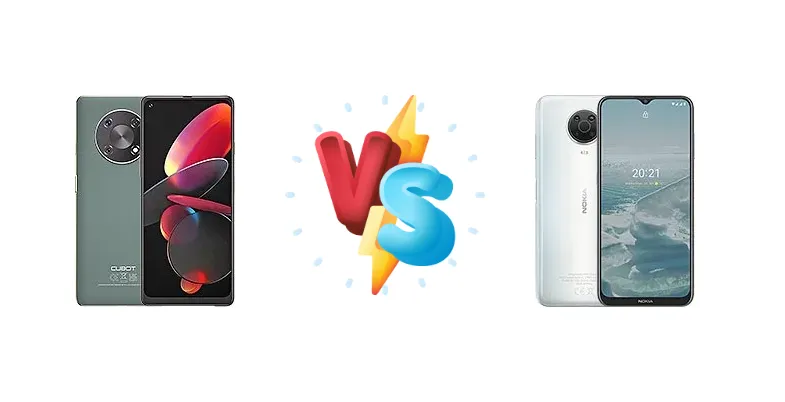
The Cubot Max 3 and Nokia G20 represent the fiercely competitive sub-$150 Android smartphone market. Both aim to deliver essential functionality at an accessible price, but they take different approaches to achieving this. The Cubot Max 3 relies on the older, but still capable, Helio P22, while the Nokia G20 opts for the slightly newer Helio G35. This comparison dives deep into the nuances of these chipsets and overall device features to determine which phone offers the best experience.
🏆 Quick Verdict
For the average user prioritizing slightly smoother performance and a more responsive experience, the Nokia G20 is the better choice. Its Helio G35 chipset, with higher clock speeds, provides a noticeable edge in everyday tasks and light gaming. However, the Cubot Max 3 remains a viable option for those on a very tight budget.
| Network |
|---|
| 2G bands | GSM 850 / 900 / 1800 / 1900 | GSM 850 / 900 / 1800 / 1900 |
| 3G bands | HSDPA 900 / 2100 | HSDPA 850 / 900 / 1900 / 2100 - International |
| 4G bands | 1, 3, 5, 7, 8, 19, 20, 40 | 1, 3, 5, 7, 8, 20, 28, 38, 40, 41 - International |
| Speed | HSPA, LTE | HSPA 42.2/5.76 Mbps, LTE Cat4 150/50 Mbps |
| Technology | GSM / HSPA / LTE | GSM / HSPA / LTE |
| | - | 1, 2, 3, 4, 5, 7, 8, 12, 17, 28, 66 - LATAM |
| Launch |
|---|
| Announced | 2021 | 2021, April 08 |
| Status | Available. Released 2021 | Available. Released 2021, May 17 |
| Body |
|---|
| Dimensions | 173 x 77 x 9.4 mm (6.81 x 3.03 x 0.37 in) | 164.9 x 76 x 9.2 mm (6.49 x 2.99 x 0.36 in) |
| SIM | Nano-SIM + Nano-SIM | · Nano-SIM· Nano-SIM + Nano-SIM |
| Weight | - | 197 g (6.95 oz) |
| | - | Splash protection |
| Display |
|---|
| Resolution | 720 x 1640 pixels (~258 ppi density) | 720 x 1600 pixels, 20:9 ratio (~269 ppi density) |
| Size | 6.95 inches, 114.7 cm2 (~86.1% screen-to-body ratio) | 6.52 inches, 102.6 cm2 (~81.9% screen-to-body ratio) |
| Type | IPS LCD | IPS LCD |
| Platform |
|---|
| CPU | Octa-core (4x2.0 GHz Cortex-A53 & 4x1.5 GHz Cortex-A53) | Octa-core (4x2.3 GHz Cortex-A53 & 4x1.8 GHz Cortex-A53) |
| Chipset | Mediatek MT6762 Helio P22 (12 nm) | Mediatek MT6765G Helio G35 (12 nm) |
| GPU | PowerVR GE8320 | PowerVR GE8320 |
| OS | Android 11 | Android 11, upgradable to Android 13 |
| Memory |
|---|
| Card slot | microSDXC (dedicated slot) | microSDXC (dedicated slot) |
| Internal | 64GB 4GB RAM | 64GB 4GB RAM, 128GB 4GB RAM |
| Main Camera |
|---|
| Features | LED flash | LED flash, HDR, panorama |
| Quad | - | 48 MP, f/1.8, (wide), PDAF
5 MP, (ultrawide)
2 MP (macro)
Auxiliary lens |
| Single | - | 8 MP, (wide) |
| Triple | 48 MP, (wide), PDAF
5 MP (macro)
Auxiliary lens | - |
| Video | Yes | 1080p@30fps |
| Selfie camera |
|---|
| Single | 16 MP | 8 MP, (wide) |
| Video | Yes | 1080p@30fps |
| Sound |
|---|
| 3.5mm jack | - | Yes |
| 35mm jack | Unspecified | Yes |
| Loudspeaker | Yes | Yes |
| Comms |
|---|
| Bluetooth | 5.0, A2DP | 5.0, A2DP, LE |
| NFC | Yes | Yes (market/region dependent) |
| Positioning | GPS, GLONASS, BDS | GPS, GLONASS, BDS |
| Radio | Unspecified | FM radio |
| USB | USB Type-C, OTG | USB Type-C 2.0, OTG |
| WLAN | Wi-Fi 802.11 a/b/g/n, dual-band | Wi-Fi 802.11 b/g/n |
| Features |
|---|
| Sensors | Fingerprint (side-mounted), accelerometer, gyro, proximity, compass | Fingerprint (side-mounted), accelerometer, gyro, proximity |
| Battery |
|---|
| Charging | - | 10W wired |
| Type | 5000 mAh, removable | Li-Po 5050 mAh |
| Misc |
|---|
| Colors | Black, Green | Glacier, Night |
| Models | - | TA-1336, TA-1343, TA-1347, TA-1372, TA-1365 |
| Price | - | About 90 EUR |
| SAR | - | 1.01 W/kg (head) 1.02 W/kg (body) |
| SAR EU | - | 0.49 W/kg (head) 1.13 W/kg (body) |
Cubot Max 3
- Potentially lower price point
- Functional for basic smartphone tasks
- May offer larger storage options (depending on configuration)
- Slower processor compared to the Nokia G20
- Likely slower charging speeds
- Less refined software experience
Nokia G20
- Faster processor (Helio G35)
- 10W wired charging
- Nokia's software support and updates
- May be slightly more expensive
- Still limited gaming performance
- Camera quality is likely average
Display Comparison
Neither device boasts a standout display. Both utilize panels likely based on IPS LCD technology, given their price point. Detailed specs like resolution and brightness are missing, but we can infer they are similar – likely 720p+ resolution. The focus here isn't on visual fidelity, but on basic usability. Bezels are expected to be noticeable on both, contributing to a larger overall footprint. Color accuracy will likely be standard for this segment, prioritizing power efficiency over color calibration.
Camera Comparison
Camera performance is likely to be similar, with both phones relying on budget sensors and image processing. Without specific sensor details, it’s difficult to make a definitive judgment. However, the Nokia G20’s image processing algorithms, benefiting from Nokia’s software optimization, may yield slightly more pleasing results in good lighting conditions. The inclusion of a 2MP macro camera on both devices is largely a marketing tactic, offering limited practical benefit due to the low resolution and lack of optical image stabilization (OIS).
Performance
The core difference lies in the chipsets. The Nokia G20’s Mediatek Helio G35 (12nm) features a CPU clocked up to 2.3 GHz, a clear advantage over the Cubot Max 3’s Helio P22 (12nm) which peaks at 2.0 GHz. While both use Cortex-A53 cores, the higher clock speed of the G35 translates to faster processing of individual tasks. The G35’s 1.8 GHz cores also outperform the P22’s 1.5 GHz cores in multi-threaded workloads. This means the Nokia G20 will feel snappier when switching between apps and handling multiple tasks simultaneously. The GPU on the G35 will also provide a slightly better gaming experience, though neither phone is designed for demanding titles.
Battery Life
Battery capacity is not specified for the Cubot Max 3, but given its focus on affordability, it's likely comparable to the Nokia G20's. The Nokia G20’s 10W wired charging is a significant advantage over what is likely a slower charging solution on the Cubot Max 3. While 10W isn’t fast by modern standards, it provides a more convenient and reliable charging experience, reducing the time spent tethered to a power outlet. The efficiency of the Helio G35 may also contribute to slightly better battery life on the Nokia G20, despite potentially similar battery capacities.
Buying Guide
Buy the Cubot Max 3 if you need a functional smartphone for basic tasks like calls, messaging, and light social media, and your budget is extremely limited. It's a no-frills device focused on affordability. Buy the Nokia G20 if you prefer a more responsive user experience, slightly better performance for casual gaming, and the added benefit of Nokia's software support and 10W charging for a more convenient experience.
Frequently Asked Questions
❓ Will the Nokia G20 handle popular social media apps like Facebook and Instagram smoothly?
Yes, the Mediatek Helio G35 in the Nokia G20 is sufficiently powerful to run social media apps like Facebook and Instagram without significant lag. The higher clock speeds compared to the Cubot Max 3’s Helio P22 will contribute to a more responsive experience when scrolling through feeds and loading content.
❓ Is the Nokia G20 a good choice for playing mobile games like PUBG or Call of Duty?
The Nokia G20 is suitable for *casual* mobile gaming, but it's not designed for demanding titles like PUBG or Call of Duty at high settings. You'll likely need to lower the graphics settings to achieve playable frame rates. The Helio G35 offers a slight improvement over the Helio P22 in the Cubot Max 3, but neither phone is a gaming powerhouse.
❓ How long will it take to fully charge the Nokia G20 with the 10W charger?
With the 10W charger, expect the Nokia G20 to take approximately 3-4 hours to fully charge from 0% to 100%. While not fast charging, it's a reasonable charging time for a budget device and provides a convenient overnight charging solution.
❓ Does the Cubot Max 3 receive regular software updates?
Software update support for the Cubot Max 3 is likely limited. Cubot, as a smaller manufacturer, typically doesn't provide the same level of long-term software support as Nokia. This means you may not receive security patches or Android version updates as frequently, or at all.