
Cubot KingKong X vs. Doogee S97 Pro: A Deep Dive into Rugged Smartphone Performance
| Phones Images | |||||
|---|---|---|---|---|---|
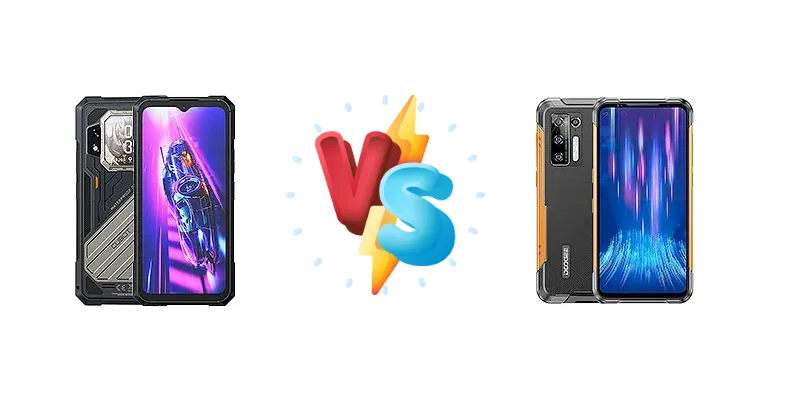
|
🏆 Quick Verdict
For most users, the Cubot KingKong X emerges as the stronger choice. Its Dimensity 7050 chipset delivers significantly better CPU performance and efficiency, translating to smoother multitasking and potentially longer battery life despite similar charging speeds. The S97 Pro offers wireless charging, but the performance gap is too substantial to ignore.
| PHONES | ||
|---|---|---|
| Phone Names | Cubot KingKong X | Doogee S97 Pro |
| Network | ||
|---|---|---|
| 2G bands | GSM 850 / 900 / 1800 / 1900 | GSM 850 / 900 / 1800 / 1900 |
| 3G bands | HSDPA 800 / 850 / 900 / 1700(AWS) / 1900 / 2100 | HSDPA 800 / 850 / 900 / 1700(AWS) / 1900 / 2100 |
| 4G bands | 1, 2, 3, 4, 5, 7, 8, 12, 17, 18, 19, 20, 25, 26, 28, 34, 38, 39, 40, 41, 66 | 1, 2, 3, 4, 5, 7, 8, 12, 13, 17, 18, 19, 20, 25, 26, 28, 38, 40, 66 |
| Speed | HSPA, LTE | HSPA, LTE |
| Technology | GSM / HSPA / LTE | GSM / HSPA / LTE |
| Launch | ||
|---|---|---|
| Announced | 2024, June 28 | 2021, April |
| Status | Available. Released 2024, July 23 | Available. Released 2021, April |
| Body | ||
|---|---|---|
| Dimensions | 170.9 x 82.2 x 18.7 mm (6.73 x 3.24 x 0.74 in) | 170.2 x 83.6 x 16.2 mm (6.70 x 3.29 x 0.64 in) |
| SIM | Nano-SIM + Nano-SIM | Nano-SIM + Nano-SIM |
| Weight | 388 g (13.69 oz) | - |
| Display | ||
|---|---|---|
| Protection | Mohs level 6 | Corning Gorilla Glass |
| Resolution | 1080 x 2408 pixels, 20:9 ratio (~401 ppi density) | 720 x 1560 pixels, 19.5:9 ratio (~269 ppi density) |
| Size | 6.58 inches, 104.3 cm2 (~74.2% screen-to-body ratio) | 6.39 inches, 100.2 cm2 (~70.4% screen-to-body ratio) |
| Type | IPS LCD, 120Hz | IPS LCD |
| Platform | ||
|---|---|---|
| CPU | Octa-core (2x2.6 GHz Cortex-A78 & 6x2.0 GHz Cortex-A55) | Octa-core (2x2.0 GHz Cortex-A76 & 6x2.0 GHz Cortex-A55) |
| Chipset | Mediatek Dimensity 7050 (6 nm) | Mediatek MT6785V/CD Helio G95 (12 nm) |
| GPU | Mali-G68 MC4 | Mali-G76 MC4 |
| OS | Android 14 | Android 11 |
| Memory | ||
|---|---|---|
| Card slot | microSDXC (uses shared SIM slot) | microSDXC (uses shared SIM slot) |
| Internal | 256GB 16GB RAM, 512GB 16GB RAM | 128GB 8GB RAM |
| Main Camera | ||
|---|---|---|
| Dual | 100 MP, (wide), PDAF 5 MP (macro) | - |
| Features | LED flash, HDR | Quad-LED flash, HDR, panorama |
| Triple | - | 48 MP, f/1.8, (wide), PDAF 8 MP, f/2.2, 130˚, (ultrawide) 2 MP (macro) Auxiliary lens |
| Video | 4K@30fps, 1080p@30fps | 1080p |
| Selfie camera | ||
|---|---|---|
| Single | 32 MP | 16 MP, f/2.0, (wide) |
| Video | Yes | 1080p |
| Sound | ||
|---|---|---|
| 35mm jack | Unspecified | Unspecified |
| Loudspeaker | Yes | Yes |
| Comms | ||
|---|---|---|
| Bluetooth | 5.1, A2DP, LE | 5.0, A2DP, LE |
| NFC | Yes | Yes |
| Positioning | GPS, GLONASS, GALILEO, BDS | GPS, GLONASS, BDS, GALILEO |
| Radio | Unspecified | FM radio |
| USB | USB Type-C, OTG | USB Type-C 2.0, OTG |
| WLAN | Wi-Fi 802.11 a/b/g/n/ac/6, dual-band | Wi-Fi 802.11 a/b/g/n/ac, dual-band |
| Features | ||
|---|---|---|
| Sensors | Fingerprint (side-mounted), accelerometer, gyro, proximity, compass | Fingerprint (side-mounted), accelerometer, gyro, proximity, compass, laser rangefinder |
| Battery | ||
|---|---|---|
| Charging | 33W wired, PD | 33W wired 10W wireless |
| Type | 10200 mAh | 8500 mAh |
| Misc | ||
|---|---|---|
| Colors | Black | Black, Orange, Red |
| Price | About 280 EUR | About 300 EUR |
| EU LABEL | ||
|---|---|---|
| Battery | 15:41h endurance, 1400 cycles | - |
| Energy | Class G | - |
| Free fall | Class A (270 falls) | - |
| Repairability | Class C | - |
Cubot KingKong X
- Significantly faster processor with the Dimensity 7050
- More efficient 6nm chipset for better battery life
- Longer battery lifespan with 1400 charge cycles
- Lacks wireless charging
- Display specifications are unknown
Doogee S97 Pro
- Convenience of 10W wireless charging
- Potentially lower price point (depending on retailer)
- Suitable for basic smartphone tasks
- Older and less powerful Helio G95 chipset
- Less efficient 12nm process
- Likely to throttle under heavy load
Display Comparison
Neither device's display specifications are provided, so a direct comparison is limited. However, given the target market, both likely utilize durable, scratch-resistant panels. The absence of LTPO technology suggests neither will offer adaptive refresh rates for power saving. Bezels are likely similar, prioritizing robustness over minimizing screen borders. Color accuracy is likely tuned for outdoor visibility rather than professional color grading.
Camera Comparison
Without detailed camera specs, a precise comparison is difficult. However, the chipset difference indirectly impacts camera performance. The Dimensity 7050’s more powerful ISP (Image Signal Processor) will likely enable faster image processing and potentially better low-light performance. The absence of information regarding sensor size and OIS makes it impossible to determine which phone captures superior images. We can assume both will feature a standard array of lenses, but the KingKong X’s superior processing power gives it an edge in computational photography.
Performance
The core difference lies in the chipsets. The Cubot KingKong X’s Mediatek Dimensity 7050 (6nm) boasts a significant architectural advantage over the Doogee S97 Pro’s Helio G95 (12nm). The Dimensity 7050’s Cortex-A78 cores, clocked at 2.6 GHz, are substantially faster than the G95’s 2.0 GHz Cortex-A76 cores. The 6nm process node also contributes to improved thermal efficiency, meaning the KingKong X is less likely to throttle under sustained load. This translates to a smoother experience for demanding tasks like video editing or graphically intensive games. The G95 is still capable, but the Dimensity 7050 represents a clear generational leap in performance.
Battery Life
The Cubot KingKong X claims 15:41h of endurance and 1400 charge cycles, indicating a focus on long-term battery health and usability. Both phones support 33W wired charging, suggesting similar 0-100% charge times. The Doogee S97 Pro adds 10W wireless charging, a convenience feature for users who prefer cable-free charging. However, the KingKong X’s superior chipset efficiency may offset the wireless charging advantage, potentially delivering longer real-world battery life despite similar battery capacities (which are not specified).
Buying Guide
Buy the Cubot KingKong X if you prioritize raw processing power for demanding apps, gaming, or frequent multitasking, and value a more modern chipset architecture. Buy the Doogee S97 Pro if wireless charging is a must-have feature and you primarily use your phone for basic tasks like calls, messaging, and light social media, and are less concerned with peak performance.