
Cubot KingKong X Pro vs. Ulefone Armor 12 5G: A Deep Dive into Rugged Performance
| Phones Images | |||||
|---|---|---|---|---|---|
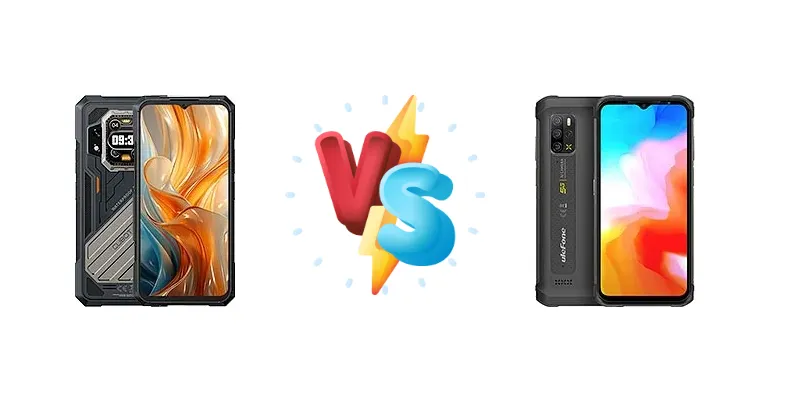
|
🏆 Quick Verdict
For users prioritizing raw performance and extended battery life, the Cubot KingKong X Pro is the clear winner. Its Dimensity 8200 chipset and impressive 88:59h endurance significantly outperform the Ulefone Armor 12 5G. However, the Armor 12 5G offers wireless charging and a lower price point, making it a viable option for less demanding users.
| PHONES | ||
|---|---|---|
| Phone Names | Cubot KingKong X Pro | Ulefone Armor 12 5G |
| Network | ||
|---|---|---|
| 2G bands | GSM 850 / 900 / 1800 / 1900 | GSM 850 / 900 / 1800 / 1900 |
| 3G bands | HSDPA 800 / 850 / 900 / 1700(AWS) / 1900 / 2100 | HSDPA 850 / 900 / 1700(AWS) / 1900 / 2100 |
| 4G bands | 1, 2, 3, 4, 5, 7, 8, 12, 13, 17, 18, 19, 20, 25, 26, 28, 34, 38, 39, 40, 41, 66, 71 | 1, 2, 3, 4, 5, 7, 8, 12, 13, 17, 18, 19, 20, 25, 26, 28, 34, 38, 39, 40, 41, 66 |
| 5G bands | 1, 2, 3, 5, 7, 8, 20, 25, 28, 38, 40, 41, 66, 77, 78 SA/NSA | 1, 3, 28, 38, 41, 77, 78 SA/NSA |
| Speed | HSPA, LTE, 5G | HSPA, LTE, 5G |
| Technology | GSM / HSPA / LTE / 5G | GSM / CDMA / HSPA / EVDO / LTE / 5G |
| - | CDMA2000 1xEV-DO | |
| Launch | ||
|---|---|---|
| Announced | 2024, November 01 | 2021, August 14 |
| Status | Available. Released 2024, November | Available. Released 2021, August 23 |
| Body | ||
|---|---|---|
| Build | - | Front glass, aluminum back with rubber, aluminum frame |
| Dimensions | 175.9 x 83.3 x 18.4 mm (6.93 x 3.28 x 0.72 in) | 175.9 x 82.5 x 14.3 mm (6.93 x 3.25 x 0.56 in) |
| SIM | Nano-SIM + Nano-SIM | Nano-SIM + Nano-SIM |
| Weight | 392 g (13.83 oz) | 296 g (10.44 oz) |
| - | IP68 dust/water resistant (up to 1.5m for 30 min) Drop-to-concrete resistance from up to 1.2m MIL-STD-810G compliant | |
| Display | ||
|---|---|---|
| Protection | Mohs level 7 | - |
| Resolution | 1080 x 2400 pixels, 20:9 ratio (~392 ppi density) | 720 x 1560 pixels, 19.5:9 ratio (~264 ppi density) |
| Size | 6.72 inches, 109.0 cm2 (~74.4% screen-to-body ratio) | 6.52 inches, 104.4 cm2 (~71.9% screen-to-body ratio) |
| Type | IPS LCD, 144Hz | IPS LCD |
| Platform | ||
|---|---|---|
| CPU | Octa-core (1x3.1 GHz Cortex-A78 & 3x3.0 GHz Cortex-A78 & 4x2.0 GHz Cortex-A55) | Octa-core (2x2.2 GHz Cortex-A76 & 6x2.0 GHz Cortex-A55) |
| Chipset | Mediatek Dimensity 8200 (4 nm) | Mediatek Dimensity 700 (7 nm) |
| GPU | Mali-G610 MC6 | Mali-G57 MC2 |
| OS | Android 14 | Android 11 |
| Memory | ||
|---|---|---|
| Card slot | microSDXC (uses shared SIM slot) | microSDXC |
| Internal | 256GB 12GB RAM, 256GB 24GB RAM | 128GB 8GB RAM |
| Main Camera | ||
|---|---|---|
| Dual | 100 MP, (wide), PDAF 5 MP (macro), AF | - |
| Features | LED flash | Dual-LED flash, HDR, panorama |
| Quad | - | 48 MP, f/1.8, 26mm (wide), 1/2.0", 0.8µm, PDAF 8 MP, f/2.2, (ultrawide) 2 MP (macro) Auxiliary lens |
| Single | - | 16 MP, f/2.2 |
| Video | Yes | 1440p@30fps |
| Selfie camera | ||
|---|---|---|
| Features | - | HDR, panorama |
| Single | 32 MP | 16 MP, f/2.2 |
| Video | Yes | 1080p@30fps |
| Sound | ||
|---|---|---|
| 3.5mm jack | - | No |
| 35mm jack | No | No |
| Loudspeaker | Yes | Yes, with dual speakers |
| Comms | ||
|---|---|---|
| Bluetooth | 5.3, A2DP, LE | 5.1, A2DP, LE |
| NFC | Yes | Yes |
| Positioning | GPS (L1+L5), GALILEO, GLONASS, BDS | GPS, GLONASS, GALILEO, BDS |
| Radio | Unspecified | Wireless FM radio, RDS |
| USB | USB Type-C, OTG | USB Type-C 2.0, OTG |
| WLAN | Wi-Fi 802.11 a/b/g/n/ac/6, dual-band | Wi-Fi 802.11 a/b/g/n/ac, Wi-Fi Direct |
| Features | ||
|---|---|---|
| Sensors | Fingerprint (side-mounted), accelerometer, gyro, proximity, compass | Fingerprint (side-mounted), accelerometer, gyro, proximity, compass, coulombmeter |
| Battery | ||
|---|---|---|
| Charging | 33W wired | 18W wired 15W wireless |
| Type | 10200 mAh | Li-Po 5180 mAh |
| Misc | ||
|---|---|---|
| Colors | Black | Black/Orange, Gray/Black |
| Price | € 349.95 | About 370 EUR |
| EU LABEL | ||
|---|---|---|
| Battery | 88:59h endurance, 1400 cycles | - |
| Energy | Class C | - |
| Free fall | Class A (270 falls) | - |
| Repairability | Class C | - |
Cubot KingKong X Pro
- Significantly faster processor (Dimensity 8200)
- Exceptional battery life (88:59h endurance)
- Potentially superior camera performance
- Longer battery lifespan (1400 cycles)
- Slower charging speed (33W)
- Likely higher price point
Ulefone Armor 12 5G
- Wireless charging support
- More affordable price
- Acceptable performance for basic tasks
- 5G connectivity
- Significantly slower processor (Dimensity 700)
- Shorter battery life
- Potentially lower camera quality
Display Comparison
While both phones are built for rugged use, display details are absent in the provided data. However, given the KingKong X Pro's higher price point, we can infer a potentially brighter panel and possibly a higher refresh rate. The Armor 12 5G likely focuses on durability and visibility in direct sunlight, potentially sacrificing peak brightness for power efficiency. Bezels are likely substantial on both to contribute to drop protection.
Camera Comparison
Camera specifications are not provided, but the chipset difference suggests a significant advantage for the KingKong X Pro. The Dimensity 8200 includes a more powerful ISP (Image Signal Processor) capable of handling higher resolution sensors and more complex image processing algorithms. This likely results in better dynamic range, noise reduction, and overall image quality. The Armor 12 5G’s camera will likely be sufficient for casual snapshots, but won’t compete with the KingKong X Pro in challenging lighting conditions. We anticipate both phones will include a basic macro camera, but its utility will be limited.
Performance
The performance gap between these two devices is substantial. The Cubot KingKong X Pro’s Mediatek Dimensity 8200 (4nm) is a significant leap ahead of the Ulefone Armor 12 5G’s Dimensity 700 (7nm). The 8200 features a tri-cluster configuration with a high-clocked Cortex-A78 core at 3.1 GHz, alongside additional A78 cores, and efficiency cores, offering superior multi-core and single-core performance. The 7nm process of the Dimensity 700, while efficient, can't match the 4nm node's density and power efficiency. This translates to faster app loading, smoother multitasking, and a better gaming experience on the KingKong X Pro. The Armor 12 5G will handle everyday tasks adequately, but will struggle with graphically intensive applications.
Battery Life
The Cubot KingKong X Pro boasts an impressive 88:59h endurance, indicating exceptional battery life. While the capacity isn't specified, this figure suggests a large battery combined with the efficiency of the Dimensity 8200. The 33W wired charging is respectable, but slower than some competitors. The Ulefone Armor 12 5G offers both 18W wired and 15W wireless charging. While wireless charging adds convenience, the slower charging speeds and potentially lower battery capacity (not specified) mean it will likely require more frequent charging compared to the KingKong X Pro. The KingKong X Pro's 1400 charge cycles also suggest a longer lifespan for the battery itself.
Buying Guide
Buy the Cubot KingKong X Pro if you need a rugged phone capable of handling demanding tasks like gaming, video editing, or running multiple apps simultaneously, and if long battery life is paramount. Buy the Ulefone Armor 12 5G if you prioritize affordability, wireless charging convenience, and primarily use your phone for basic communication, navigation, and occasional photography. It's a solid choice for those who need a durable device without breaking the bank.