
Cubot KingKong Star vs. Blackview BV9200: A Rugged Smartphone Showdown
| Phones Images | |||||
|---|---|---|---|---|---|
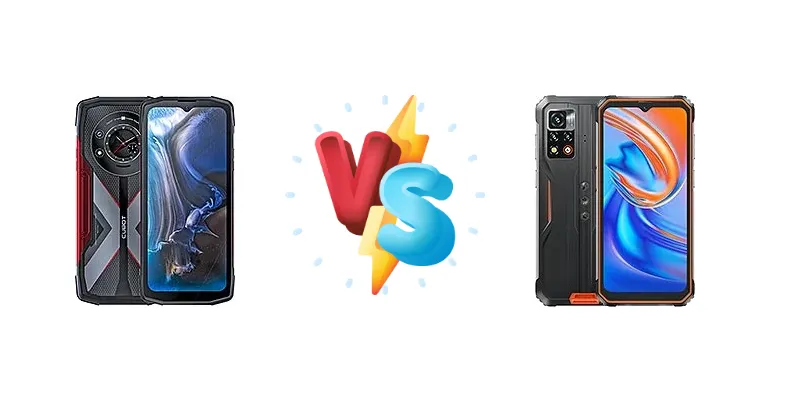
|
🏆 Quick Verdict
For most users, the Blackview BV9200 emerges as the stronger choice. Its 66W wired and 30W wireless charging capabilities, coupled with a brighter, higher-contrast display, offer a more refined user experience. While the KingKong Star’s Dimensity 700 is more modern, the G96 in the BV9200 provides comparable real-world performance in most scenarios.
| PHONES | ||
|---|---|---|
| Phone Names | Cubot KingKong Star | Blackview BV9200 |
| Network | ||
|---|---|---|
| 2G bands | GSM 850 / 900 / 1800 / 1900 | GSM 850 / 900 / 1800 / 1900 |
| 3G bands | HSDPA 800 / 850 / 900 / 1700(AWS) / 1900 / 2100 | HSDPA 850 / 900 / 1700(AWS) / 1900 / 2100 |
| 4G bands | 1, 2, 3, 4, 5, 7, 8, 12, 13, 17, 18, 19, 20, 25, 26, 28, 34, 38, 39, 40, 41, 66, 71 | 1, 2, 3, 4, 5, 7, 8, 12, 13, 17, 18, 19, 20, 25, 26, 28, 34, 38, 39, 40, 41, 66 |
| 5G bands | 1, 2, 3, 5, 7, 8, 20, 25, 28, 38, 41, 66, 77, 78 SA/NSA | - |
| Speed | HSPA, LTE, 5G | HSPA, LTE |
| Technology | GSM / HSPA / LTE / 5G | GSM / CDMA / HSPA / LTE |
| - | CDMA 800 / 1900 | |
| Launch | ||
|---|---|---|
| Announced | 2023, July 19 | 2022, December 28 |
| Status | Available. Released 2023, August 07 | Available. Released 2023, January 09 |
| Body | ||
|---|---|---|
| Dimensions | 180.2 x 80.8 x 17.8 mm (7.09 x 3.18 x 0.70 in) | 174.5 x 81.8 x 13.6 mm (6.87 x 3.22 x 0.54 in) |
| SIM | Nano-SIM + Nano-SIM | Nano-SIM + Nano-SIM |
| Weight | 395 g (13.93 oz) | 310 g (10.93 oz) |
| - | IP68/IP69K dust/water resistant (up to 1.5m for 30 min) Drop-to-concrete resistance from up to 1.8m MIL-STD-810H compliant | |
| Display | ||
|---|---|---|
| Protection | - | Corning Gorilla Glass 5 |
| Resolution | 1080 x 2460 pixels (~396 ppi density) | 1080 x 2408 pixels, 20:9 ratio (~400 ppi density) |
| Size | 6.78 inches, 109.2 cm2 (~75.0% screen-to-body ratio) | 6.6 inches, 104.9 cm2 (~73.5% screen-to-body ratio) |
| Type | IPS LCD, 90Hz | IPS LCD, 120Hz |
| Platform | ||
|---|---|---|
| CPU | Octa-core (2x2.2 GHz Cortex-A76 & 6x2.0 GHz Cortex-A55) | Octa-core (2x2.05 GHz Cortex-A76 & 6x2.0 GHz Cortex-A55) |
| Chipset | Mediatek Dimensity 700 (7 nm) | Mediatek MT6781 Helio G96 (12 nm) |
| GPU | Mali-G57 MC2 | Mali-G52 MC2 |
| OS | Android 13 | Android 12, Doke-OS 3.1 |
| Memory | ||
|---|---|---|
| Card slot | microSDXC (dedicated slot) | microSDXC (dedicated slot) |
| Internal | 256GB 12GB RAM | 256GB 8GB RAM |
| - | UFS 2.1 | |
| Main Camera | ||
|---|---|---|
| Features | LED flash | LED flash, HDR, panorama |
| Single | - | 16 MP, (wide), 1/3", 1.0µm |
| Triple | 100 MP, (wide), PDAF 24 MP, (night vision camera), 2 IR emitters 5 MP (macro) | 50 MP, f/1.8, (wide), 1/2.76", 0.64µm, PDAF 8 MP, f/1.8, 120˚, (ultrawide), AF Auxiliary lens |
| Video | Yes | 1440p@30fps, 1080p@30fps |
| Selfie camera | ||
|---|---|---|
| Single | 32 MP | 16 MP, f/2.0, (wide), 1/3", 1.0µm |
| Video | Yes | 1080p |
| Sound | ||
|---|---|---|
| 3.5mm jack | - | No |
| 35mm jack | Unspecified | No |
| Loudspeaker | Yes | Yes, with dual speakers |
| Comms | ||
|---|---|---|
| Bluetooth | 5.1, A2DP, LE | 5.2, A2DP, LE |
| NFC | Yes | Yes |
| Positioning | GPS, GLONASS, GALILEO, BDS | GPS, GLONASS, GALILEO, BDS |
| Radio | Unspecified | FM radio |
| USB | USB Type-C, OTG | USB Type-C, OTG |
| WLAN | Wi-Fi 802.11 a/b/g/n/ac, dual-band | Wi-Fi 802.11 a/b/g/n/ac, dual-band |
| Features | ||
|---|---|---|
| Sensors | Fingerprint (side-mounted), accelerometer, gyro, proximity, compass | Fingerprint (side-mounted), accelerometer, gyro, proximity, compass, barometer |
| Battery | ||
|---|---|---|
| Charging | 33W wired | 66W wired 30W wireless |
| Type | 10600 mAh | 5000 mAh |
| Misc | ||
|---|---|---|
| Colors | Black, Black/Red | Black, Orange, Green |
| Price | About 280 EUR | About 200 EUR |
Cubot KingKong Star
- More modern Dimensity 700 chipset
- Potentially better long-term software support
- More efficient processor architecture
- Slower 33W charging
- Likely inferior display quality
- Missing display specifications
Blackview BV9200
- 66W wired and 30W wireless charging
- Brighter and higher contrast display (481 nits, 1423:1)
- Faster CPU clock speeds
- Less efficient 12nm Helio G96 chipset
- Potentially shorter software support lifespan
- Larger manufacturing process
Display Comparison
The Blackview BV9200 boasts a significantly more refined display experience. Its measured 481 nits of peak brightness surpasses what we’d expect in this price bracket, ensuring excellent visibility outdoors. The 1423:1 contrast ratio further enhances image quality, providing deeper blacks and more vibrant colors. The Cubot KingKong Star’s display specifications are not provided, suggesting a more basic panel. This likely translates to lower brightness and contrast, potentially impacting usability in direct sunlight. The BV9200’s display is a clear advantage for media consumption and general use.
Camera Comparison
Without detailed camera specifications for either device, a direct comparison is challenging. However, the rugged phone market generally prioritizes durability over camera prowess. We can assume both phones feature a multi-camera setup, but image quality will likely depend more on software processing than sensor size. The absence of information regarding OIS or large sensors suggests neither phone will excel in low-light photography. Users should temper expectations regarding camera performance and focus on the rugged features as the primary selling point.
Performance
Both phones utilize octa-core MediaTek processors, but differ significantly in architecture and manufacturing process. The Cubot KingKong Star’s Dimensity 700, built on a 7nm node, offers a more efficient design compared to the Blackview BV9200’s Helio G96 (12nm). However, the G96 features slightly higher clocked Cortex-A76 cores (2.05 GHz vs 2.2 GHz on the Dimensity 700). In practice, this difference is unlikely to be noticeable in everyday tasks. The Dimensity 700’s superior efficiency *could* translate to slightly better battery life under sustained load, but the G96’s larger cache might offer a marginal advantage in some gaming scenarios. Both phones are likely to handle common tasks and moderate gaming without issue.
Battery Life
The Blackview BV9200 takes a decisive lead in battery and charging capabilities. While the battery capacity isn’t specified, the inclusion of 66W wired charging and 30W wireless charging is a significant advantage. This allows for incredibly fast top-ups, minimizing downtime. The Cubot KingKong Star’s 33W wired charging is respectable, but considerably slower. The convenience of wireless charging on the BV9200 is a major benefit for users who prefer cable-free solutions. The faster charging speeds of the BV9200 effectively mitigate any potential capacity difference.
Buying Guide
Buy the Cubot KingKong Star if you prioritize future-proofing and potentially better long-term software support due to the newer Dimensity 700 chipset. This phone is ideal for users who frequently update their devices and anticipate needing the extra processing power for emerging applications. Buy the Blackview BV9200 if you value fast charging, a more visually appealing display, and a more complete feature set, including wireless charging. This is the better option for users who need a reliable, long-lasting phone for work or outdoor adventures and don't necessarily need the absolute latest processor.