
Cubot KingKong Power vs. Nokia XR21: A Deep Dive into Rugged Smartphone Performance
| Phones Images | |||||
|---|---|---|---|---|---|
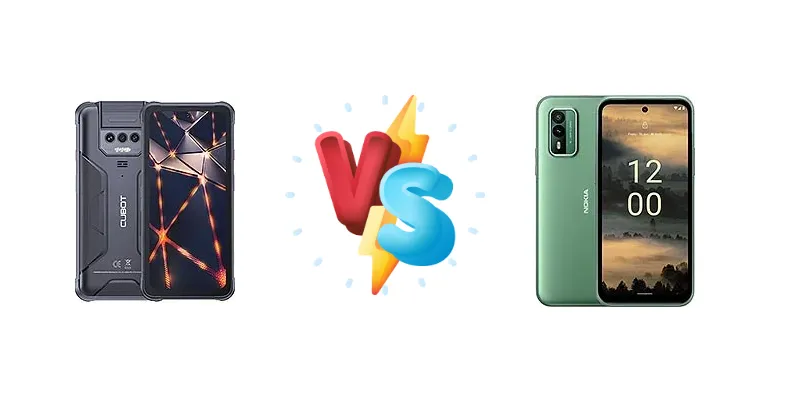
|
🏆 Quick Verdict
For users prioritizing raw affordability and aren't heavily reliant on 5G, the Cubot KingKong Power offers a compelling package. However, the Nokia XR21’s more efficient Snapdragon 695 chipset and guaranteed software updates make it the better choice for most, despite a potentially higher price point.
| PHONES | ||
|---|---|---|
| Phone Names | Cubot KingKong Power | Nokia XR21 |
| Network | ||
|---|---|---|
| 2G bands | GSM 850 / 900 / 1800 / 1900 | GSM 850 / 900 / 1800 / 1900 |
| 3G bands | HSDPA 800 / 850 / 900 / 1700(AWS) / 1900 / 2100 | HSDPA 850 / 900 / 1700(AWS) / 1900 / 2100 |
| 4G bands | 1, 2, 3, 4, 5, 7, 8, 12, 13, 17, 18, 19, 20, 26, 28, 38, 39, 40, 41, 66 | 1, 2, 3, 4, 5, 7, 8, 12, 13, 17, 20, 25, 26, 28, 32, 38, 39, 40, 41, 42, 43, 48, 66, 71 |
| 5G bands | - | 1, 2, 3, 5, 7, 20, 25, 28, 40, 41, 66, 71, 77, 78, 79 SA/NSA |
| Speed | HSPA, LTE | HSPA, LTE, 5G |
| Technology | GSM / HSPA / LTE | GSM / HSPA / LTE / 5G |
| Launch | ||
|---|---|---|
| Announced | 2023 | 2023, May 03 |
| Status | Available. Released 2023 | Available. Released 2023, June 11 |
| Body | ||
|---|---|---|
| Build | - | Glass front (Gorilla Glass Victus), plastic back, plastic frame |
| Dimensions | 169.9 x 80.2 x 20 mm (6.69 x 3.16 x 0.79 in) | 168 x 78.6 x 10.5 mm (6.61 x 3.09 x 0.41 in) |
| SIM | Nano-SIM + Nano-SIM | Nano-SIM + Nano-SIM + eSIM (max 2 at a time) |
| Weight | 382 g (13.47 oz) | 231 g (8.15 oz) |
| - | IP68/IP69K dust/water resistant (up to 1.5m for 60 min) Drop-to-concrete resistance from up to 1.8m MIL-STD-810H compliant | |
| Display | ||
|---|---|---|
| Protection | - | Corning Gorilla Glass Victus |
| Resolution | 1080 x 2400 pixels, 20:9 ratio (~405 ppi density) | 1080 x 2400 pixels, 20:9 ratio (~406 ppi density) |
| Size | 6.5 inches, 102.0 cm2 (~74.9% screen-to-body ratio) | 6.49 inches, 101.7 cm2 (~77.0% screen-to-body ratio) |
| Type | IPS LCD | IPS LCD, 120Hz, 450 nits (typ), 550 nits (HBM) |
| Platform | ||
|---|---|---|
| CPU | Octa-core (4x2.0 GHz Cortex-A73 & 4x2.0 GHz Cortex-A53) | Octa-core (2x2.2 GHz Kryo 660 Gold & 6x1.7 GHz Kryo 660 Silver) |
| Chipset | Mediatek MT8788V/WA | Qualcomm SM6375 Snapdragon 695 5G (6 nm) |
| GPU | - | Adreno 619 |
| OS | Android 13 | Android 12 |
| Memory | ||
|---|---|---|
| Card slot | microSDXC (uses shared SIM slot) | Unspecified |
| Internal | 256GB 8GB RAM | 128GB 6GB RAM |
| Main Camera | ||
|---|---|---|
| Dual | - | 64 MP, f/1.8, (wide), 1/2.0", PDAF 8 MP, f/2.2, (ultrawide), 1/4.0", 1.12µm |
| Features | LED flash | Dual-LED dual-tone flash, second LED flash, HDR, panorama |
| Triple | 48 MP, (wide), PDAF 20 MP, (night vision camera), 2 IR emitters 2 MP (macro) | - |
| Video | Yes | 1080p@30fps |
| Selfie camera | ||
|---|---|---|
| Single | 16 MP | 16 MP, f/2.4 (wide) |
| Video | Yes | 1080p@30fps |
| Sound | ||
|---|---|---|
| 3.5mm jack | - | Yes |
| 35mm jack | Unspecified | Yes |
| Loudspeaker | Yes | Yes, with stereo speakers |
| Comms | ||
|---|---|---|
| Bluetooth | 4.2, A2DP | 5.1, A2DP, LE, aptX Adaptive |
| NFC | Yes | Yes (market/region dependent) |
| Positioning | GPS, GLONASS, GALILEO | GPS (L1+L5), GLONASS (G1), BDS (B1I+B1c+B2a), GALILEO (E1+E5a), QZSS (L1+L5), NavIC (L5) |
| Radio | Unspecified | Unspecified |
| USB | USB Type-C, OTG | USB Type-C 2.0, OTG |
| WLAN | Wi-Fi 802.11 a/b/g/n/ac, dual-band | Wi-Fi 802.11 a/b/g/n/ac/6, dual-band |
| Features | ||
|---|---|---|
| Sensors | Fingerprint (side-mounted), accelerometer, gyro, proximity, compass | Fingerprint (side-mounted), accelerometer, gyro, proximity, compass, barometer |
| Battery | ||
|---|---|---|
| Charging | 33W wired Reverse wired | 33W wired, PD2.0, QC3 |
| Type | 10600 mAh | Li-Po 4800 mAh |
| Misc | ||
|---|---|---|
| Colors | Black | Midnight Black, Pine Green |
| Price | About 210 EUR | About 570 EUR |
Cubot KingKong Power
- Highly affordable price point
- Rugged design for durability
- 33W wired charging with reverse wired charging
- Older, less efficient chipset
- Likely limited software support
- Potentially lower camera quality
Nokia XR21
- More efficient Snapdragon 695 chipset
- Guaranteed software updates from Nokia
- 5G connectivity for faster data speeds
- Potentially higher price
- Rugged design may add bulk
- LCD display isn't as vibrant as OLED
Display Comparison
Neither device boasts a flagship-level display. Details regarding panel type, resolution, and refresh rate are missing for the Cubot KingKong Power, suggesting a standard LCD. The Nokia XR21 also utilizes an LCD, but its focus is on durability. Both will likely offer adequate outdoor visibility, but neither is expected to compete with OLED panels in terms of color accuracy or contrast. Bezels are likely to be substantial on both, prioritizing screen protection over a modern, edge-to-edge design.
Camera Comparison
Without detailed camera specifications, a direct comparison is difficult. However, the market segment suggests both phones will feature modest camera systems. The focus will likely be on practicality rather than photographic excellence. Expect a primary sensor on both, potentially accompanied by ultra-wide and macro lenses (the latter often being of limited utility). Image processing will likely be more aggressive on the Nokia XR21, aiming for shareable results, while the Cubot KingKong Power may prioritize speed and simplicity. Sensor size and aperture are key factors missing from the data, but will heavily influence low-light performance.
Performance
The chipset is where the most significant difference lies. The Cubot KingKong Power’s Mediatek MT8788V/WA, while an octa-core processor, utilizes older Cortex-A73 and A53 cores. This architecture, while capable, is less efficient than the Qualcomm Snapdragon 695 (SM6375) found in the Nokia XR21. The Snapdragon 695, built on a 6nm process, offers a noticeable advantage in power efficiency and sustained performance, particularly in graphically demanding tasks. The XR21’s Kryo 660 Gold cores provide a performance boost over the KingKong Power’s Cortex-A73 cores. While both phones likely have sufficient RAM for everyday tasks, the Snapdragon 695’s superior architecture will translate to smoother multitasking and a more responsive user experience.
Battery Life
Both devices offer 33W wired charging, a respectable speed for this price range. The Nokia XR21 also supports PD2.0 and QC3, offering broader compatibility with chargers and potentially faster charging speeds with compatible adapters. Battery capacity is not specified for either device, but the Snapdragon 695’s superior power efficiency in the Nokia XR21 will likely result in longer battery life despite potentially having a similar or even slightly smaller battery capacity. The Cubot KingKong Power’s less efficient chipset will require more frequent charging.
Buying Guide
Buy the Cubot KingKong Power if you need a highly affordable, extremely durable phone for basic tasks and aren't concerned with 5G connectivity or long-term software support. Buy the Nokia XR21 if you prioritize 5G, a more refined user experience with guaranteed updates, and a chipset designed for better power efficiency and sustained performance, even if it means a slightly higher investment.