
Cubot KingKong Power vs. Doogee V Max LR: A Deep Dive into Rugged Smartphone Performance
| Phones Images | |||||
|---|---|---|---|---|---|
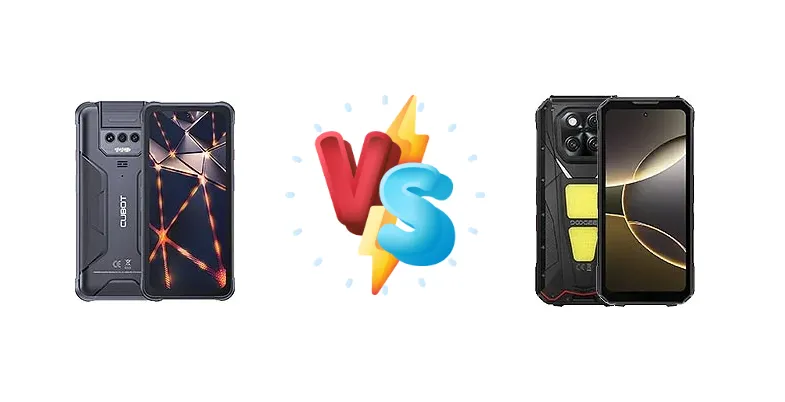
|
🏆 Quick Verdict
For most users, the Doogee V Max LR is the superior choice. Its Dimensity 7300 chipset provides a significant performance uplift over the KingKong Power’s MT8788V, and the impressive 192-26h endurance and 1100 charge cycles offer peace of mind. While the KingKong Power offers a lower entry price, the V Max LR’s longevity and speed justify the investment.
| PHONES | ||
|---|---|---|
| Phone Names | Cubot KingKong Power | Doogee V Max LR |
| Network | ||
|---|---|---|
| 2G bands | GSM 850 / 900 / 1800 / 1900 | GSM 850 / 900 / 1800 / 1900 |
| 3G bands | HSDPA 800 / 850 / 900 / 1700(AWS) / 1900 / 2100 | HSDPA 800 / 850 / 900 / 1700(AWS) / 1900 / 2100 |
| 4G bands | 1, 2, 3, 4, 5, 7, 8, 12, 13, 17, 18, 19, 20, 26, 28, 38, 39, 40, 41, 66 | 1, 2, 3, 4, 5, 7, 8, 12, 17, 18, 19, 20, 25, 26, 28, 34, 38, 39, 40, 41, 66 |
| 5G bands | - | 1, 3, 7, 28, 38, 41, 77, 78, 79 SA/NSA |
| Speed | HSPA, LTE | HSPA, LTE, 5G |
| Technology | GSM / HSPA / LTE | GSM / CDMA / HSPA / LTE / 5G |
| Launch | ||
|---|---|---|
| Announced | 2023 | 2025, September |
| Status | Available. Released 2023 | Available. Released 2025, October |
| Body | ||
|---|---|---|
| Dimensions | 169.9 x 80.2 x 20 mm (6.69 x 3.16 x 0.79 in) | 183.5 x 85.4 x 30.5 mm (7.22 x 3.36 x 1.20 in) |
| SIM | Nano-SIM + Nano-SIM | Nano-SIM + Nano-SIM |
| Weight | 382 g (13.47 oz) | 630 g (1.39 lb) |
| Display | ||
|---|---|---|
| Protection | - | Mohs level 6 |
| Resolution | 1080 x 2400 pixels, 20:9 ratio (~405 ppi density) | 1080 x 2460 pixels (~396 ppi density) |
| Size | 6.5 inches, 102.0 cm2 (~74.9% screen-to-body ratio) | 6.78 inches, 109.2 cm2 (~69.7% screen-to-body ratio) |
| Type | IPS LCD | IPS LCD, 120Hz, 500 nits |
| Platform | ||
|---|---|---|
| CPU | Octa-core (4x2.0 GHz Cortex-A73 & 4x2.0 GHz Cortex-A53) | Octa-core (2x2.6 GHz Cortex-A78 & 6x2.0 GHz Cortex-A55) |
| Chipset | Mediatek MT8788V/WA | Mediatek Dimensity 7300 (4 nm) |
| GPU | - | Mali-G615 MC2 |
| OS | Android 13 | Android 15 |
| Memory | ||
|---|---|---|
| Card slot | microSDXC (uses shared SIM slot) | microSDXC (dedicated slot) |
| Internal | 256GB 8GB RAM | 512GB 16GB RAM |
| Main Camera | ||
|---|---|---|
| Features | LED flash | Dual-LED flash, HDR, panorama |
| Triple | 48 MP, (wide), PDAF 20 MP, (night vision camera), 2 IR emitters 2 MP (macro) | 200 MP, f/2.0, (wide), 1/1.3", PDAF 20 MP, f/1.8, (night vision), 2 infrared night vision lights 8 MP, f/2.2, 119˚ (ultrawide) |
| Video | Yes | 4K@30fps, 1080p@30fps |
| Selfie camera | ||
|---|---|---|
| Single | 16 MP | 32 MP, f/2.3, (wide) |
| Video | Yes | 1080p@30fps |
| Sound | ||
|---|---|---|
| 35mm jack | Unspecified | No |
| Loudspeaker | Yes | Yes (130 dB) |
| Comms | ||
|---|---|---|
| Bluetooth | 4.2, A2DP | 5.4, A2DP, LE |
| Infrared port | - | Yes |
| NFC | Yes | Yes |
| Positioning | GPS, GLONASS, GALILEO | GPS (L1+L5), GLONASS, GALILEO, BDS |
| Radio | Unspecified | FM radio |
| USB | USB Type-C, OTG | USB Type-C |
| WLAN | Wi-Fi 802.11 a/b/g/n/ac, dual-band | Wi-Fi 802.11 a/b/g/n/ac/6e, dual-band |
| Features | ||
|---|---|---|
| Sensors | Fingerprint (side-mounted), accelerometer, gyro, proximity, compass | Fingerprint (side-mounted), accelerometer, gyro, proximity, compass |
| Battery | ||
|---|---|---|
| Charging | 33W wired Reverse wired | 45W wired 10W reverse wired |
| Type | 10600 mAh | 20500 mAh |
| Misc | ||
|---|---|---|
| Colors | Black | Black, Tarnish |
| Price | About 210 EUR | About 770 EUR |
| EU LABEL | ||
|---|---|---|
| Battery | - | 192:26h endurance, 1100 cycles |
| Energy | - | Class B |
| Free fall | - | Class A (270 falls) |
| Repairability | - | Class C |
Cubot KingKong Power
- More affordable price point
- Rugged design for durability
- Reverse wired charging capability
- Outdated chipset limits performance
- Likely lower quality display
- Slower charging speeds
Doogee V Max LR
- Powerful Dimensity 7300 chipset
- Exceptional battery life and longevity
- Faster 45W wired charging
- Higher price tag
- May be bulkier due to larger battery
- Reverse charging is slower at 10W
Display Comparison
Neither device’s display specifications are provided, so a direct comparison is limited. However, given the V Max LR’s positioning, it likely features a higher-resolution panel and potentially a higher refresh rate. The KingKong Power, targeting a lower price point, likely utilizes a more basic LCD. Both will prioritize durability with reinforced glass, but the V Max LR’s more modern chipset suggests potential for features like higher peak brightness and improved color accuracy.
Camera Comparison
Without specific camera sensor details, a detailed comparison is challenging. However, the V Max LR’s more advanced chipset likely supports more sophisticated image processing algorithms, resulting in better dynamic range and low-light performance. The KingKong Power will likely rely on simpler software processing. Both phones will likely include multiple lenses, but the V Max LR’s processing power will be crucial for extracting detail and reducing noise, especially in challenging conditions. We anticipate the V Max LR to offer a more versatile and capable camera system.
Performance
The Doogee V Max LR’s Mediatek Dimensity 7300 (4nm) represents a substantial leap in performance over the Cubot KingKong Power’s Mediatek MT8788V/WA. The Dimensity 7300 utilizes Cortex-A78 cores clocked at 2.6 GHz, offering significantly faster single-core performance than the KingKong Power’s 2.0 GHz Cortex-A73 cores. The 4nm process node further enhances efficiency, reducing heat and improving sustained performance. This translates to smoother app launches, faster multitasking, and a more enjoyable gaming experience on the V Max LR. The KingKong Power’s older chipset will struggle with demanding applications and may exhibit noticeable lag.
Battery Life
The Doogee V Max LR boasts a significant advantage in battery endurance, rated at 192-26 hours. While the KingKong Power’s capacity isn’t specified, the V Max LR’s 1100 charge cycles indicate a battery designed for long-term reliability. The V Max LR also supports 45W wired charging, significantly faster than the KingKong Power’s 33W, enabling quicker top-ups. The V Max LR’s combination of efficient chipset and fast charging provides a superior user experience, minimizing downtime and maximizing usability.
Buying Guide
Buy the Cubot KingKong Power if you prioritize absolute affordability and need a functional, durable phone for basic tasks. It’s ideal for users who primarily make calls, send texts, and occasionally use navigation apps. Buy the Doogee V Max LR if you demand smoother multitasking, enjoy mobile gaming, or require a phone that can reliably power through extended workdays or outdoor adventures without frequent charging. The V Max LR is for the power user who values performance and longevity.