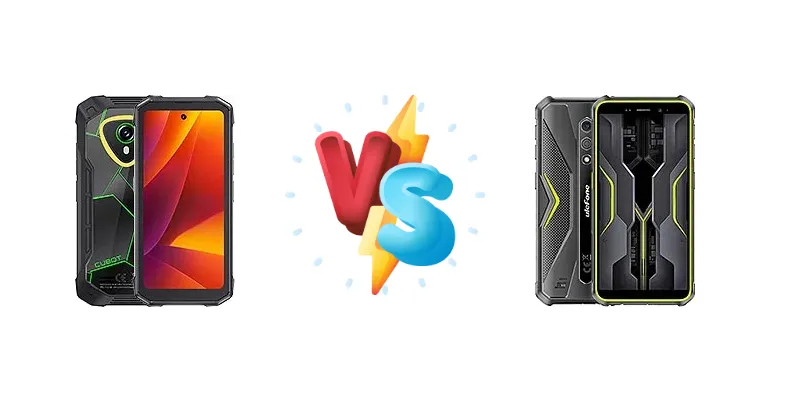
The rugged smartphone market caters to a specific need: durability. Both the Cubot KingKong Mini 4 and the Ulefone Armor X12 Pro aim to deliver that, but they take different approaches to performance and longevity. This comparison dissects their core components to determine which device best suits users prioritizing resilience without breaking the bank.
🏆 Quick Verdict
For the average user needing a dependable, compact rugged phone, the Ulefone Armor X12 Pro edges out the Cubot KingKong Mini 4. Its reported 48:31h endurance and optimized Mediatek Helio G36 chipset provide a more consistent user experience, despite the Mini 4’s newer Unisoc chip.
| Network |
|---|
| 2G bands | GSM 850 / 900 / 1800 / 1900 | GSM 850 / 900 / 1800 / 1900 |
| 3G bands | HSDPA 850 / 900 / 1700(AWS) / 1900 / 2100 | HSDPA 850 / 900 / 1700(AWS) / 1900 / 2100 |
| 4G bands | 1, 2, 3, 4, 5, 7, 8, 12, 17, 20, 26, 28, 38, 39, 40, 41, 66 | 1, 2, 3, 4, 5, 7, 8, 12, 17, 19, 20, 28 |
| Speed | HSPA, LTE | HSPA, LTE |
| Technology | GSM / HSPA / LTE | GSM / HSPA / LTE |
| Launch |
|---|
| Announced | 2025, August | 2023, August |
| Status | Available. Released 2025, August | Available. Released 2023, August |
| Body |
|---|
| Dimensions | 128.7 x 61 x 16.9 mm (5.07 x 2.40 x 0.67 in) | 157.2 x 76.8 x 14.3 mm (6.19 x 3.02 x 0.56 in) |
| SIM | Nano-SIM + Nano-SIM | Nano-SIM + Nano-SIM |
| Weight | 192 g (6.77 oz) | 257 g (9.07 oz) |
| Display |
|---|
| Protection | - | Mohs level 4 |
| Resolution | 720 x 1600 pixels, 20:9 ratio (~373 ppi density) | 720 x 1440 pixels, 18:9 ratio (~295 ppi density) |
| Size | 4.7 inches, 53.3 cm2 (~67.9% screen-to-body ratio) | 5.45 inches, 76.7 cm2 (~63.5% screen-to-body ratio) |
| Type | IPS LCD, 90Hz | IPS LCD |
| Platform |
|---|
| CPU | Octa-core (2x2.0 GHz Cortex-A75 & 6x1.8 GHz Cortex-A55) | Octa-core (4x2.2 GHz Cortex-A53 & 4x1.7 GHz Cortex-A53) |
| Chipset | Unisoc Tiger T616 (12 nm) | Mediatek Helio G36 (12 nm) |
| GPU | Mali-G57 MP1 | PowerVR GE8320 |
| OS | Android 15 | Android 13 |
| Memory |
|---|
| Card slot | microSDXC (uses shared SIM slot) | microSDXC (dedicated slot) |
| Internal | 128GB 6GB RAM, 256GB 8GB RAM | 64GB 4GB RAM |
| Main Camera |
|---|
| Features | LED flash | LED flash |
| Single | 48 MP, (wide), AF | 13 MP, f/2.2, (wide), 1.12µm, PDAF |
| Video | 1080p@30fps | 1080p@30fps |
| Selfie camera |
|---|
| Single | 16 MP | 8 MP, f/2.0, (wide), 1.4µm |
| Video | 1080p@30fps | Yes |
| Sound |
|---|
| 35mm jack | No | Yes |
| Loudspeaker | Yes | Yes |
| Comms |
|---|
| Bluetooth | 5.0, A2DP, LE | 5.0, A2DP, LE |
| NFC | Yes | Yes |
| Positioning | GPS, GLONASS, GALILEO, BDS | GPS, GLONASS, GALILEO, BDS |
| Radio | Unspecified | Wireless FM radio, RDS, recording |
| USB | USB Type-C 2.0, OTG | USB Type-C 2.0 |
| WLAN | Wi-Fi 802.11 a/b/g/n/ac, dual-band | Wi-Fi 802.11 a/b/g/n/ac, dual-band |
| Features |
|---|
| Sensors | Fingerprint (side-mounted), accelerometer, gyro, proximity, compass | Accelerometer, proximity |
| Battery |
|---|
| Charging | 10W wired | 10W wired |
| Type | 4700 mAh | Li-Po 4860 mAh |
| Misc |
|---|
| Colors | Black/Red, Black/Green, Black/Gray | Black, Black/Orange, Black/Green |
| Price | - | About 130 EUR |
| EU LABEL |
|---|
| Battery | - | 48:31h endurance, 1000 cycles |
| Energy | - | Class B |
| Free fall | - | Class A (270 falls) |
| Repairability | - | Class C |
Cubot KingKong Mini 4
- More modern chipset architecture (Unisoc T616)
- Potentially better single-core performance
- Compact form factor (assumed based on 'Mini' branding)
- Likely shorter battery life compared to the X12 Pro
- Unisoc chipset may have less software support
- Charging speed is limited to 10W
Ulefone Armor X12 Pro
- Exceptional battery endurance (48:31h)
- 1000 charge cycles indicate long-term battery health
- Mediatek Helio G36 is a proven performer
- Older chipset architecture (Helio G36)
- Potentially lower single-core performance
- Charging speed is limited to 10W
Display Comparison
Neither device provides display specifications, but given their price point, we can assume both utilize IPS LCD panels. The focus here is on durability, not display fidelity. Bezels are likely substantial on both to contribute to shock absorption. Color accuracy is expected to be standard for this segment, prioritizing visibility in direct sunlight over color gamut coverage.
Camera Comparison
Without detailed camera specs, a direct comparison is difficult. Both phones likely feature a primary camera supplemented by auxiliary lenses (often 2MP macro or depth sensors). The image processing capabilities will be crucial, and Ulefone generally focuses on practical image quality rather than excessive megapixel counts. The absence of OIS on either device suggests reliance on software stabilization, which may struggle in low-light conditions. Users shouldn't expect flagship-level camera performance from either device.
Performance
The core difference lies in the chipsets. The Cubot KingKong Mini 4 features the Unisoc Tiger T616, built on a 12nm process with a heterogeneous core configuration – 2x2.0 GHz Cortex-A75 and 6x1.8 GHz Cortex-A55. This architecture *should* offer a performance advantage in single-core tasks and responsiveness compared to the Ulefone’s Mediatek Helio G36. However, the Helio G36 (also 12nm) employs a quad-core Cortex-A53 setup clocked at 2.2 GHz alongside another quad-core A53 at 1.7 GHz. While the A75 cores in the T616 are more powerful individually, the G36’s higher clock speeds and potentially more efficient power management could translate to smoother sustained performance in less optimized applications. The T616’s newer architecture *could* benefit from future software updates, but the G36 is a known quantity.
Battery Life
The Ulefone Armor X12 Pro boasts a significant advantage with its reported 48:31h endurance and 1000 charge cycles. This suggests a larger battery capacity and optimized power management. Both devices are limited to 10W wired charging, meaning 0-100% charge times will be relatively slow – likely exceeding 3 hours. The X12 Pro’s endurance is a key selling point for users who frequently work or travel in areas without easy access to power outlets.
Buying Guide
Buy the Cubot KingKong Mini 4 if you prioritize a more modern chipset architecture and potentially benefit from future software optimizations, even if it means sacrificing some battery life. Buy the Ulefone Armor X12 Pro if you value proven battery endurance and a chipset specifically tuned for sustained performance in demanding outdoor conditions, making it ideal for professionals or frequent travelers.
Frequently Asked Questions
❓ Is the Mediatek Helio G36 in the Ulefone Armor X12 Pro prone to overheating during prolonged use, like gaming?
The Helio G36 is a relatively efficient chipset. While it won't deliver flagship-level gaming performance, it's designed for sustained workloads. The ruggedized design of the X12 Pro also aids in heat dissipation, minimizing the risk of significant throttling during moderate gaming sessions. However, demanding titles at maximum settings may still lead to some performance reduction.
❓ Does the Unisoc Tiger T616 in the Cubot KingKong Mini 4 support software updates and security patches for an extended period?
Unisoc's software support track record is less established than Mediatek's. While the T616 is a relatively new chipset, the longevity of software updates and security patches remains uncertain. Users should temper expectations regarding long-term software support compared to devices from more established brands.
❓ Given the 10W charging on both phones, how long does it realistically take to fully charge the Ulefone Armor X12 Pro?
With 10W charging and a likely larger battery capacity to achieve the 48:31h endurance, a full charge for the Ulefone Armor X12 Pro will likely take between 3.5 to 4.5 hours. While slow, the extended battery life mitigates the inconvenience of slower charging.