
Cubot KingKong Mini 4 vs. Doogee S100 Pro: A Rugged Smartphone Showdown
| Phones Images | |||||
|---|---|---|---|---|---|
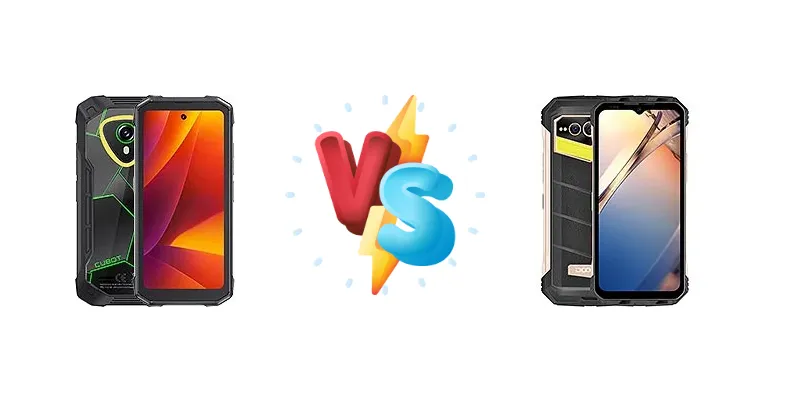
|
🏆 Quick Verdict
For most users, the Doogee S100 Pro emerges as the stronger choice. Its Mediatek Helio G99 chipset, built on a 6nm process, provides a noticeable performance advantage over the Cubot’s Unisoc Tiger T616. The 33W charging is a significant benefit, drastically reducing recharge times compared to the Mini 4’s 10W charging.
| PHONES | ||
|---|---|---|
| Phone Names | Cubot KingKong Mini 4 | Doogee S100 Pro |
| Network | ||
|---|---|---|
| 2G bands | GSM 850 / 900 / 1800 / 1900 | GSM 850 / 900 / 1800 / 1900 |
| 3G bands | HSDPA 850 / 900 / 1700(AWS) / 1900 / 2100 | HSDPA 800 / 850 / 900 / 1700(AWS) / 1900 / 2100 |
| 4G bands | 1, 2, 3, 4, 5, 7, 8, 12, 17, 20, 26, 28, 38, 39, 40, 41, 66 | 1, 2, 3, 4, 5, 7, 8, 12, 13, 17, 18, 19, 20, 25, 26, 28, 34, 38, 39, 40, 41, 66, 71 |
| Speed | HSPA, LTE | HSPA, LTE |
| Technology | GSM / HSPA / LTE | GSM / CDMA / HSPA / LTE |
| Launch | ||
|---|---|---|
| Announced | 2025, August | 2023, May 28 |
| Status | Available. Released 2025, August | Available. Released 2023, June 01 |
| Body | ||
|---|---|---|
| Dimensions | 128.7 x 61 x 16.9 mm (5.07 x 2.40 x 0.67 in) | 178.5 x 83.1 x 27.3 mm (7.03 x 3.27 x 1.07 in) |
| SIM | Nano-SIM + Nano-SIM | Nano-SIM + Nano-SIM |
| Weight | 192 g (6.77 oz) | - |
| Display | ||
|---|---|---|
| Protection | - | Corning Gorilla Glass 5 |
| Resolution | 720 x 1600 pixels, 20:9 ratio (~373 ppi density) | 1080 x 2408 pixels, 20:9 ratio (~401 ppi density) |
| Size | 4.7 inches, 53.3 cm2 (~67.9% screen-to-body ratio) | 6.58 inches, 104.3 cm2 (~70.3% screen-to-body ratio) |
| Type | IPS LCD, 90Hz | IPS LCD |
| Platform | ||
|---|---|---|
| CPU | Octa-core (2x2.0 GHz Cortex-A75 & 6x1.8 GHz Cortex-A55) | Octa-core (2x2.2 GHz Cortex-A76 & 6x2.0 GHz Cortex-A55) |
| Chipset | Unisoc Tiger T616 (12 nm) | Mediatek Helio G99 (6 nm) |
| GPU | Mali-G57 MP1 | Mali-G57 MC2 |
| OS | Android 15 | Android 12 |
| Memory | ||
|---|---|---|
| Card slot | microSDXC (uses shared SIM slot) | microSDXC (uses shared SIM slot) |
| Internal | 128GB 6GB RAM, 256GB 8GB RAM | 256GB 12GB RAM |
| Main Camera | ||
|---|---|---|
| Features | LED flash | Dual-LED flash, HDR, panorama |
| Single | 48 MP, (wide), AF | - |
| Triple | - | 108 MP, f/1.8, (wide), 1/1.52", 0.7µm, PDAF 20 MP, f/1.8, (night vision), 2 infrared night vision lights 16 MP, f/2.2, 130˚ (ultrawide) |
| Video | 1080p@30fps | 1440p, 1080p |
| Selfie camera | ||
|---|---|---|
| Single | 16 MP | 32 MP, f/2.0, (wide), 1/2.8", 0.8µm |
| Video | 1080p@30fps | 1440p, 1080p |
| Sound | ||
|---|---|---|
| 35mm jack | No | No |
| Loudspeaker | Yes | Yes, with stereo speakers |
| Comms | ||
|---|---|---|
| Bluetooth | 5.0, A2DP, LE | 5.0, A2DP, LE |
| NFC | Yes | Yes (market/region dependent) |
| Positioning | GPS, GLONASS, GALILEO, BDS | GPS (L1+L5), GLONASS, BDS, GALILEO |
| Radio | Unspecified | FM radio |
| USB | USB Type-C 2.0, OTG | USB Type-C 2.0, OTG |
| WLAN | Wi-Fi 802.11 a/b/g/n/ac, dual-band | Wi-Fi 802.11 a/b/g/n/ac, dual-band |
| Features | ||
|---|---|---|
| Sensors | Fingerprint (side-mounted), accelerometer, gyro, proximity, compass | Fingerprint (side-mounted), accelerometer, gyro, proximity, compass |
| Battery | ||
|---|---|---|
| Charging | 10W wired | 33W wired |
| Type | 4700 mAh | 22000 mAh |
| Misc | ||
|---|---|---|
| Colors | Black/Red, Black/Green, Black/Gray | Black, Black/Silver, Black/Gold |
| Price | - | About 300 EUR |
Cubot KingKong Mini 4
- Potentially more compact due to smaller chipset.
- Lower price point (likely).
- Rugged design for durability.
- Significantly slower charging (10W).
- Less powerful processor (Unisoc T616).
- Likely lower performance in demanding tasks.
Doogee S100 Pro
- Faster processor (Helio G99, 6nm).
- Much faster charging (33W).
- Improved performance for gaming and multitasking.
- Potentially slightly larger size.
- May be more expensive.
- Could generate more heat under sustained load (though 6nm helps).
Display Comparison
Neither device’s display specifications are provided, so a direct comparison is limited. However, given the price points, we can assume both utilize LCD panels. The focus here shifts to the internal hardware impacting display performance. The more powerful GPU in the Doogee S100 Pro suggests it will handle graphically intensive tasks, like video playback, with greater fluidity. Bezels are likely comparable, given the rugged design constraints of both devices.
Camera Comparison
Without detailed camera specifications, a precise comparison is difficult. However, the chipset’s image signal processor (ISP) plays a crucial role. The Helio G99’s ISP is more advanced, enabling better noise reduction, dynamic range, and image processing capabilities. This suggests the S100 Pro will produce superior photos and videos, particularly in challenging lighting conditions. The presence of a larger sensor (likely, given the chipset) would further enhance image quality. We can assume both phones will include basic camera features, but the S100 Pro will likely offer a more refined and capable photography experience.
Performance
The core difference lies in the chipsets. The Doogee S100 Pro’s Mediatek Helio G99 (6nm) is a clear upgrade over the Cubot KingKong Mini 4’s Unisoc Tiger T616 (12nm). The 6nm fabrication process inherently offers better power efficiency and thermal performance, meaning the G99 can sustain higher clock speeds for longer periods without throttling. The CPU architecture also favors the Doogee: Cortex-A76 cores (2.2 GHz) in the G99 are more efficient and powerful than the Cortex-A75 cores (2.0 GHz) in the T616. This translates to faster app loading times, smoother multitasking, and improved gaming performance. While both are octa-core, the architectural advantages of the G99 are substantial.
Battery Life
Battery capacity isn’t specified for either device, but the charging wattage reveals a significant advantage for the Doogee S100 Pro. 33W wired charging is considerably faster than the Cubot KingKong Mini 4’s 10W charging. This means the S100 Pro can replenish its battery from 0-100% in a much shorter timeframe, minimizing downtime. While a larger battery capacity on the Mini 4 could partially offset this, the charging speed difference is substantial enough to favor the S100 Pro for users who frequently need to top up their battery.
Buying Guide
Buy the Cubot KingKong Mini 4 if you prioritize extreme portability and are on a very tight budget, accepting compromises in processing power and charging speed. It’s ideal for basic communication and light tasks. Buy the Doogee S100 Pro if you need a more responsive experience for multitasking, gaming, or demanding applications, and value faster charging to minimize downtime. It’s the better option for users who actively use their phones throughout the day.