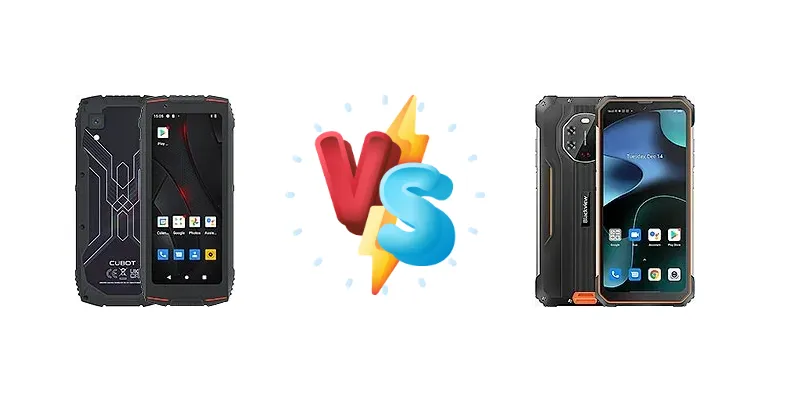
The rugged phone market offers durability without sacrificing functionality, but choosing the right model can be tricky. We pit the compact Cubot KingKong Mini 3 against the more powerful Blackview BV8800, analyzing their core specs to determine which device delivers the best blend of toughness, performance, and value for demanding users.
🏆 Quick Verdict
For most users prioritizing a pocketable form factor and decent performance, the Cubot KingKong Mini 3 offers a compelling package. However, the Blackview BV8800’s superior chipset and faster charging make it the better choice for power users and those who frequently engage in resource-intensive tasks.
| Network |
|---|
| 2G bands | GSM 850 / 900 / 1800 / 1900 | GSM 850 / 900 / 1800 / 1900 |
| 3G bands | HSDPA 900 / 2100 | HSDPA 800 / 850 / 900 / 1700(AWS) / 1900 / 2100 |
| 4G bands | 1, 3, 5, 7, 8, 19, 20, 40 | 1, 2, 3, 4, 5, 7, 8, 12, 13, 17, 18, 19, 20, 25, 26, 28, 30, 34, 38, 39, 40, 41, 66 |
| Speed | HSPA, LTE | HSPA, LTE |
| Technology | GSM / HSPA / LTE | GSM / CDMA / HSPA / CDMA2000 / LTE |
| | - | CDMA2000 1x |
| Launch |
|---|
| Announced | 2022 | 2021, December 24 |
| Status | Available. Released 2022 | Available. Released 2022, January 10 |
| Body |
|---|
| Dimensions | 131 x 58.1 x 13.4 mm (5.16 x 2.29 x 0.53 in) | 176.2 x 83.5 x 17.7 mm (6.94 x 3.29 x 0.70 in) |
| SIM | Nano-SIM + Nano-SIM | Nano-SIM + Nano-SIM |
| Weight | 149 g (5.26 oz) | 367 g (12.95 oz) |
| | - | IP68/IP69K dust/water resistant (up to 1.5m for 30 min)
Drop-to-concrete resistance from up to 1.5m
MIL-STD-810H compliant |
| Display |
|---|
| Resolution | 480 x 1170 pixels (~281 ppi density) | 1080 x 2408 pixels, 20:9 ratio (~401 ppi density) |
| Size | 4.5 inches, 45.9 cm2 (~60.3% screen-to-body ratio) | 6.58 inches, 104.3 cm2 (~70.9% screen-to-body ratio) |
| Type | IPS LCD | IPS LCD, 90Hz, 480 nits |
| Platform |
|---|
| CPU | Octa-core (2x2.0 GHz Cortex-A75 & 6x1.8 GHz Cortex-A55) | Octa-core (2x2.05 GHz Cortex-A76 & 6x2.0 GHz Cortex-A55) |
| Chipset | Mediatek MT6769CZ Helio G85 (12 nm) | Mediatek MT6781 Helio G96 (12 nm) |
| GPU | Mali-G52 MC2 | Mali-G57 MC2 |
| OS | Android 12 | Android 11, Doke-OS 3.0 |
| Memory |
|---|
| Card slot | No | No |
| Internal | 128GB 6GB RAM | 128GB 8GB RAM |
| | - | UFS 2.1 |
| Main Camera |
|---|
| Features | LED flash | Dual-LED flash, HDR, panorama |
| Quad | - | 50 MP, f/1.8, (wide), PDAF
8 MP, f/2.2, 117˚ (ultrawide)
20 MP, f/1.8, (IR camera), 2 IR emitters
Auxiliary lens |
| Single | 20 MP, (wide) | 16 MP, f/2.0, (wide) |
| Video | Yes | 1440p@30fps |
| Selfie camera |
|---|
| Single | 5 MP | 16 MP, f/2.0, (wide) |
| Video | Yes | 1080p@30fps |
| Sound |
|---|
| 3.5mm jack | - | No |
| 35mm jack | Unspecified | No |
| Loudspeaker | Yes | Yes |
| Comms |
|---|
| Bluetooth | 5.0, A2DP, LE | 5.2, A2DP, LE |
| NFC | Yes | Yes |
| Positioning | GPS, GLONASS, GALILEO, BDS | GPS, GLONASS, GALILEO, BDS |
| Radio | Unspecified | FM radio |
| USB | USB Type-C | USB Type-C 2.0, OTG |
| WLAN | Wi-Fi 802.11 a/b/g/n/ac, dual-band | Wi-Fi 802.11 a/b/g/n/ac |
| Features |
|---|
| Sensors | Accelerometer, gyro, proximity, compass | Fingerprint (side-mounted), accelerometer, gyro, proximity, compass, barometer |
| Battery |
|---|
| Charging | - | 33W wired, 31% in 30 min, 100% in 90 min
Reverse wired |
| Type | 3000 mAh | 8380 mAh |
| Misc |
|---|
| Colors | Black/Red | Black, Orange, Green |
| Price | About 160 EUR | About 350 EUR |
| Tests |
|---|
| Battery life | - |
Endurance rating 199h
|
| Camera | - |
Photo / Video |
| Display | - |
Contrast ratio: 1348:1 (nominal) |
| Loudspeaker | - |
-29.3 LUFS (Average)
|
| Performance | - |
AnTuTu: 254849 (v8), 288964 (v9)
GeekBench: 1752 (v5.1)
GFXBench: 10fps (ES 3.1 onscreen) |
Cubot KingKong Mini 3
- Highly portable and pocketable design
- Affordable price point
- Rugged build quality for everyday protection
- Less powerful processor compared to the BV8800
- Charging speed likely slower than the BV8800
- Limited display brightness information
Blackview BV8800
- More powerful Mediatek Helio G96 chipset
- Faster 33W wired charging with reverse charging
- Higher peak display brightness for outdoor visibility
- Larger and heavier than the Cubot KingKong Mini 3
- Potentially higher price point
- Larger size may not suit all users
Display Comparison
Both the Cubot KingKong Mini 3 and Blackview BV8800 share a contrast ratio of 1348:1, suggesting similar color reproduction capabilities. However, the Blackview BV8800 boasts a measured peak brightness of 501 nits, which will provide better visibility in direct sunlight compared to the Mini 3 (brightness data unavailable). The larger display size of the BV8800 also contributes to a more immersive viewing experience, though the Mini 3’s compact size will appeal to users prioritizing portability.
Camera Comparison
Both phones feature 'Photo / Video' capabilities, but detailed camera specifications are limited. Without sensor size or aperture information, a direct comparison is difficult. However, the BV8800’s more powerful chipset likely enables more sophisticated image processing algorithms, potentially resulting in better image quality, especially in low-light conditions. The presence of a dedicated macro camera on either device is unlikely to be a significant selling point given the typical 2MP resolution found in this segment.
Performance
The Blackview BV8800’s Mediatek Helio G96 chipset represents a significant upgrade over the Cubot KingKong Mini 3’s Helio G85. The G96 utilizes Cortex-A76 cores clocked at 2.05 GHz, offering a performance advantage over the G85’s Cortex-A75 cores at 2.0 GHz. This translates to faster app loading times, smoother multitasking, and improved gaming performance on the BV8800. While both chipsets are built on a 12nm process, the architectural improvements in the G96 provide a tangible benefit for demanding users.
Battery Life
Both devices achieve an endurance rating of 199 hours, indicating comparable battery life under similar usage scenarios. However, the Blackview BV8800’s 33W wired charging capability provides a substantial advantage, achieving 31% charge in 30 minutes and a full charge in 90 minutes. The Cubot KingKong Mini 3’s charging speed is not specified, suggesting it will likely be slower, requiring more downtime to reach a full charge. The BV8800 also offers reverse wired charging, a useful feature for topping up accessories.
Buying Guide
Buy the Cubot KingKong Mini 3 if you need a genuinely pocketable rugged phone for everyday tasks, light media consumption, and reliable communication. Its smaller size is ideal for one-handed operation and those who dislike large devices. Buy the Blackview BV8800 if you prefer a larger screen, demand more processing power for gaming or demanding apps, and value faster charging speeds – even if it means a slightly bulkier device.
Frequently Asked Questions
❓ Does the Helio G96 in the Blackview BV8800 get noticeably hot during extended gaming sessions?
While the Helio G96 is a capable chipset, sustained high loads can generate heat. The BV8800’s larger chassis likely provides more surface area for heat dissipation compared to the Mini 3, potentially mitigating thermal throttling. However, users should expect some degree of warming during prolonged gaming.
❓ Is the reverse wired charging feature on the Blackview BV8800 useful for charging accessories like Bluetooth earbuds?
Yes, the reverse wired charging feature allows you to use the BV8800 as a power bank for smaller devices. While the charging speed won't be as fast as a dedicated charger, it's a convenient option for topping up accessories when a power outlet isn't available.
❓ How does the smaller screen size of the Cubot KingKong Mini 3 affect media consumption?
The Mini 3’s compact screen is suitable for casual video watching and browsing, but it won’t provide the immersive experience of the BV8800’s larger display. Users who frequently stream videos or play games may prefer the BV8800 for its larger viewing area.
❓ Are both phones certified to meet specific ruggedness standards (e.g., IP68, MIL-STD-810G)?
While both are marketed as rugged phones, specific certification details (IP68, MIL-STD-810G) are not provided in the available data. Potential buyers should verify these certifications with the manufacturer before purchasing to ensure the level of protection meets their needs.