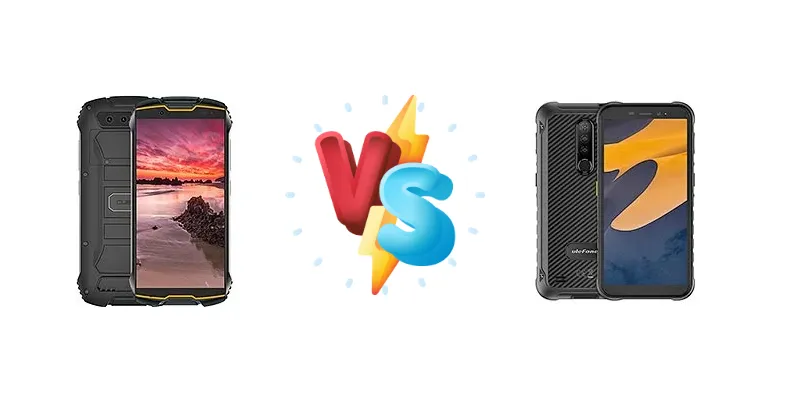
The rugged smartphone market caters to a specific need: durability. Both the Cubot KingKong Mini 2 and the Ulefone Armor X8i aim to deliver that, but at different price points and with varying levels of internal hardware. This comparison dissects their key specifications to determine which device offers the best balance of toughness and usability for the budget-conscious consumer.
🏆 Quick Verdict
For most users, the Ulefone Armor X8i emerges as the better choice. While both phones prioritize ruggedness, the X8i’s octa-core Helio A25 chipset provides a noticeable performance boost over the Mini 2’s quad-core Helio A22, making it more suitable for multitasking and demanding applications. The 10W charging is a minor drawback, but the overall experience is smoother.
| Network |
|---|
| 2G bands | GSM 850 / 900 / 1800 / 1900 | GSM 850 / 900 / 1800 / 1900 |
| 3G bands | HSDPA 900 / 2100 | HSDPA 850 / 900 / 1700(AWS) / 1900 / 2100 |
| 4G bands | 1, 3, 7, 8, 19, 20 | 1, 2, 3, 4, 5, 7, 8, 12, 17, 19, 20, 28 |
| Speed | HSPA, LTE | HSPA 21.1/5.76 Mbps, LTE Cat7 300/150 Mbps |
| Technology | GSM / HSPA / LTE | GSM / HSPA / LTE |
| | - | eMMC 5.1 |
| Launch |
|---|
| Announced | 2020. Released 2020 | 2021, September 23 |
| Status | Discontinued | Available. Released 2021, September 23 |
| Body |
|---|
| Dimensions | 119 x 58 x 12.1 mm (4.69 x 2.28 x 0.48 in) | 160.3 x 79 x 13.8 mm (6.31 x 3.11 x 0.54 in) |
| SIM | Nano-SIM + Nano-SIM | Nano-SIM + Nano-SIM |
| Weight | 122.7 g (4.34 oz) | 256 g (9.03 oz) |
| | - | IP68/IP69K dust/water resistant (up to 1.5m for 30 min)
Drop-to-concrete resistance from up to 1.2m
MIL-STD-810G compliant |
| Display |
|---|
| Resolution | 540 x 1080 pixels, 18:9 ratio (~302 ppi density) | 720 x 1440 pixels, 18:9 ratio (~282 ppi density) |
| Size | 4.0 inches, 41.3 cm2 (~59.8% screen-to-body ratio) | 5.7 inches, 83.8 cm2 (~66.2% screen-to-body ratio) |
| Type | IPS LCD | IPS LCD |
| Platform |
|---|
| CPU | Quad-core 2.0 GHz Cortex-A53 | Octa-core (4x1.8 GHz Cortex-A53 & 4x1.5 GHz Cortex-A53) |
| Chipset | Mediatek MT6761 Helio A22 (12 nm) | Mediatek MT6762D Helio A25 (12 nm) |
| GPU | PowerVR GE8320 | PowerVR GE8320 |
| OS | Android 10 | Android 11 |
| Memory |
|---|
| Card slot | microSDXC (dedicated slot) | microSDXC (uses shared SIM slot) |
| Internal | 32GB 3GB RAM | 32GB 3GB RAM |
| Main Camera |
|---|
| Features | LED flash | Dual-LED flash, HDR, panorama |
| Single | 13 MP, f/2.2, (wide) | 8 MP, f/2.4 |
| Triple | - | 13 MP, f/2.2, (wide), AF
Auxiliary lenses |
| Video | Yes | 1080p@30fps |
| Selfie camera |
|---|
| Single | 8 MP | 8 MP, f/2.4 |
| Video | Yes | 1080p@30fps |
| Sound |
|---|
| 3.5mm jack | - | Yes |
| 35mm jack | Unspecified | Yes |
| Loudspeaker | Yes | Yes |
| Comms |
|---|
| Bluetooth | 4.2, A2DP | 5.0, A2DP, LE |
| NFC | No | Yes |
| Positioning | GPS, GLONASS, GALILEO, BDS | GPS, GLONASS, GALILEO, BDS |
| Radio | Unspecified | FM radio, RDS, recording |
| USB | USB Type-C | USB Type-C 2.0 |
| WLAN | Wi-Fi 802.11 a/b/g/n | Wi-Fi 802.11 a/b/g/n/ac, Wi-Fi Direct |
| Features |
|---|
| Sensors | Accelerometer, gyro, proximity, compass | Fingerprint (rear-mounted), accelerometer, proximity, compass |
| Battery |
|---|
| Charging | - | 10W wired |
| Type | 3000 mAh | Li-Po 5080 mAh |
| Misc |
|---|
| Colors | Red/Black, Orange/Black | Black, Orange, Red |
| Price | - | About 150 EUR |
Cubot KingKong Mini 2
- Potentially more compact design
- Rugged build quality
- Lower price point (likely)
- Less powerful Helio A22 processor
- Quad-core CPU limits multitasking
- Likely slower app loading times
Ulefone Armor X8i
- More powerful Helio A25 processor
- Octa-core CPU for smoother performance
- Better multitasking capabilities
- Slower 10W charging
- Potentially larger size
- May be slightly more expensive
Display Comparison
Neither device boasts a standout display. Both likely utilize IPS LCD panels, common in this price bracket. The focus is on practicality and visibility in outdoor conditions, not color accuracy or high refresh rates. Without specific nit brightness data, it's reasonable to assume both offer adequate, but not exceptional, outdoor visibility. Bezels are likely to be substantial on both, prioritizing drop protection over a modern, edge-to-edge design.
Camera Comparison
Camera performance is likely to be similar, with both devices probably featuring basic sensors. Given the market segment, focusing on megapixel count alone is misleading. Image quality will heavily rely on software processing. The presence of a 2MP macro camera on either device is largely a marketing tactic, offering limited practical benefit due to the low resolution and lack of optical image stabilization (OIS). Expect acceptable results in good lighting conditions, but poor performance in low light.
Performance
The core difference lies in the chipset. The Ulefone Armor X8i’s Mediatek Helio A25 is a significant upgrade over the Cubot KingKong Mini 2’s Helio A22. The A25’s octa-core configuration (4x1.8 GHz Cortex-A53 & 4x1.5 GHz Cortex-A53) allows for better multitasking and smoother performance in applications. The Mini 2’s quad-core A22 (2.0 GHz Cortex-A53) will struggle with more demanding tasks. While both are 12nm chips, the architectural advantage of the A25 is clear. This translates to a more responsive user experience for the X8i, particularly when switching between apps or running multiple processes simultaneously.
Battery Life
Battery capacity is not specified, but both phones likely feature batteries in the 3000-4000 mAh range, typical for rugged devices of this size. The Ulefone Armor X8i’s 10W wired charging is slower than what’s found on some competitors. The Cubot KingKong Mini 2’s charging speed is unknown, but likely similar. Real-world battery life will depend heavily on usage patterns, but the more efficient Helio A25 in the X8i might offer slightly better longevity despite the slower charging.
Buying Guide
Buy the Cubot KingKong Mini 2 if you prioritize extreme compactness and are primarily focused on basic communication tasks like calls, texts, and light app usage. Its smaller form factor is ideal for those with limited pocket space. Buy the Ulefone Armor X8i if you need a more responsive device for everyday tasks, occasional gaming, and appreciate the benefits of an octa-core processor, even if it means a slightly larger footprint.
Frequently Asked Questions
❓ Will the Ulefone Armor X8i struggle with graphically intensive games like PUBG Mobile?
While the Helio A25 can handle some gaming, PUBG Mobile will likely require low graphics settings and a reduced frame rate for a playable experience. It's not a gaming-focused device, and demanding titles will push its limits. The Mini 2 will struggle even more.
❓ How durable are these phones, and what kind of protection do they offer?
Both phones are built to withstand drops, dust, and water immersion, adhering to IP68 or similar ruggedization standards. However, the specific drop height and water submersion depth will vary. Expect resistance to everyday accidents, but avoid intentionally subjecting them to extreme conditions.
❓ Is the 10W charging on the Ulefone Armor X8i a significant drawback?
Yes, 10W charging is relatively slow compared to modern smartphones. A full charge will take several hours. However, given the likely battery capacity (3000-4000mAh), it's manageable, especially if you charge overnight. The slower charging is a trade-off for the ruggedized design and lower price.