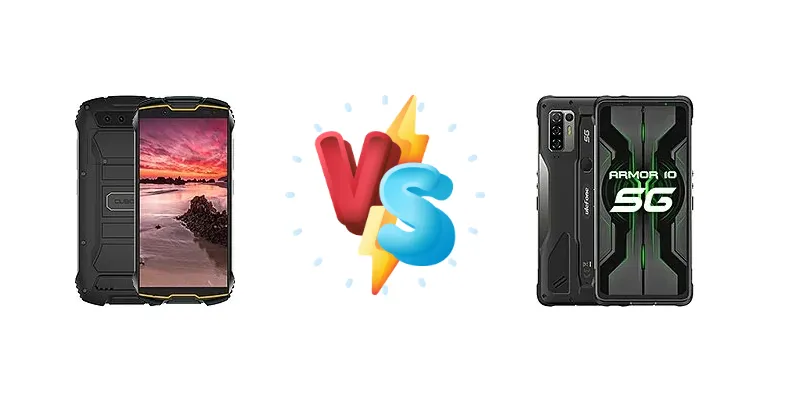
The rugged phone market caters to users needing durability, but performance and features vary wildly. We pit the budget-focused Cubot KingKong Mini 2 Pro against the more ambitious Ulefone Armor 10 5G, examining how their core components translate into real-world usability. This comparison focuses on the significant chipset differences and their impact on the user experience.
🏆 Quick Verdict
For most users, the Ulefone Armor 10 5G is the clear winner. Its Mediatek Dimensity 800 chipset delivers substantially faster performance than the Cubot KingKong Mini 2 Pro’s Helio P22, enabling smoother multitasking and more demanding applications. However, this comes at a price premium and potentially reduced battery efficiency.
| Network |
|---|
| 2G bands | GSM 850 / 900 / 1800 / 1900 | GSM 850 / 900 / 1800 / 1900 |
| 3G bands | HSDPA 900 / 2100 | HSDPA 850 / 900 / 1700(AWS) / 1900 / 2100 |
| 4G bands | 1, 3, 7, 8, 19, 20, 40 | 1, 2, 3, 4, 5, 7, 8, 12, 13, 17, 18, 19, 20, 25, 26, 28, 34, 38, 39, 40, 41, 66 |
| 5G bands | - | 1, 3, 41, 77, 78, 79 SA/NSA |
| Speed | HSPA, LTE | HSPA, LTE, 5G |
| Technology | GSM / HSPA / LTE | GSM / CDMA / HSPA / EVDO / LTE / 5G |
| | - | CDMA2000 1xEV-DO |
| Launch |
|---|
| Announced | 2022 | 2020, November 17. Released 2020, December 07 |
| Status | Available. Released 2022 | Discontinued |
| Body |
|---|
| Build | - | Front glass, aluminum back with rubber, aluminum frame |
| Dimensions | 119 x 58 x 12.5 mm (4.69 x 2.28 x 0.49 in) | 176.5 x 82.8 x 14.6 mm (6.95 x 3.26 x 0.57 in) |
| SIM | Nano-SIM + Nano-SIM | Nano-SIM + Nano-SIM |
| Weight | 122.7 g (4.34 oz) | 328 g (11.57 oz) |
| | - | IP68 dust/water resistant (up to 1.5m for 30 min)
Drop-to-concrete resistance from up to 1.2m
MIL-STD-810G compliant |
| Display |
|---|
| Protection | - | Scratch-resistant glass, oleophobic coating |
| Resolution | 540 x 1080 pixels, 18:9 ratio (~302 ppi density) | 1080 x 2400 pixels, 20:9 ratio (~395 ppi density) |
| Size | 4.0 inches, 41.3 cm2 (~59.8% screen-to-body ratio) | 6.67 inches, 107.4 cm2 (~73.5% screen-to-body ratio) |
| Type | IPS LCD | IPS LCD |
| Platform |
|---|
| CPU | Octa-core (4x2.0 GHz Cortex-A53 & 4x1.5 GHz Cortex-A53) | Octa-core (4x2.0 GHz Cortex-A76 & 4x2.0 GHz Cortex-A55) |
| Chipset | Mediatek MT6762 Helio P22 (12 nm) | Mediatek Dimensity 800 (7 nm) |
| GPU | PowerVR GE8320 | Mali-G57 MP4 |
| OS | Android 11 | Android 10, planned upgrade to Android 11 |
| Memory |
|---|
| Card slot | microSDXC (dedicated slot) | microSDXC (uses shared SIM slot) |
| Internal | 64GB 4GB RAM | 128GB 8GB RAM |
| Main Camera |
|---|
| Features | LED flash | LED flash, Panorama, HDR |
| Quad | - | 64 MP, f/1.9, 26mm (wide), 1/1.72", 0.8µm, PDAF
8 MP, f/2.2, 119˚ (ultrawide)
5 MP (macro)
Auxiliary lens |
| Single | 13 MP, f/2.2, (wide) | - |
| Video | Yes | 4K@30fps, 1080p@30fps |
| Selfie camera |
|---|
| Single | 5 MP | 16 MP, f/2.2 |
| Video | Yes | 1080p@30fps |
| Sound |
|---|
| 3.5mm jack | - | Yes |
| 35mm jack | Unspecified | Yes |
| Loudspeaker | Yes | Yes |
| Comms |
|---|
| Bluetooth | 5.0, A2DP, LE | 5.2, A2DP, LE |
| NFC | No | Yes |
| Positioning | GPS, GLONASS, GALILEO, BDS | GPS, GLONASS, GALILEO, BDS |
| Radio | Unspecified | FM radio, RDS, recording |
| USB | USB Type-C | USB Type-C 2.0, OTG |
| WLAN | Wi-Fi 802.11 a/b/g/n | Wi-Fi 802.11 a/b/g/n/ac, Wi-Fi Direct |
| Features |
|---|
| Sensors | Accelerometer, gyro, proximity, compass | Fingerprint (side-mounted), accelerometer, gyro, proximity, compass, baroceptor, coulombmeter |
| Battery |
|---|
| Charging | - | 15W wired
15W wireless |
| Type | 3000 mAh | Li-Po 5800 mAh |
| Misc |
|---|
| Colors | Black/Red, Black/Orange | Black |
| Price | - | About 420 EUR |
Cubot KingKong Mini 2 Pro
- Significantly more affordable
- Compact and pocketable design
- Rugged build quality
- Outdated Helio P22 processor
- Limited performance for demanding tasks
- No 5G connectivity
Ulefone Armor 10 5G
- Powerful Mediatek Dimensity 800 processor
- 5G connectivity for faster data speeds
- Wireless charging convenience
- Higher price point
- Potentially lower battery life under heavy load
- Larger and heavier form factor
Display Comparison
Neither device boasts a standout display. The Cubot KingKong Mini 2 Pro’s display specifications are unavailable, but given its price point, it likely utilizes a standard IPS LCD panel. The Ulefone Armor 10 5G also lacks detailed display specs, but its larger size suggests a potentially higher resolution. The key difference isn't display quality, but size; the 'Mini' in the Cubot's name indicates a more pocketable experience. Both will likely suffer in direct sunlight compared to higher-nit displays found on flagship phones.
Camera Comparison
Camera details are sparse for both devices. Without sensor size or aperture information, a direct comparison is difficult. However, the Ulefone Armor 10 5G’s higher processing power allows for more sophisticated image processing algorithms, potentially resulting in better dynamic range and noise reduction. The presence of 5G also suggests a faster image upload speed. It's reasonable to assume the Ulefone will offer a more versatile and capable camera experience, even if the hardware isn't dramatically superior.
Performance
This is where the chasm between these two phones appears. The Ulefone Armor 10 5G’s Mediatek Dimensity 800 (7nm) is a substantial upgrade over the Cubot KingKong Mini 2 Pro’s Mediatek MT6762 Helio P22 (12nm). The Dimensity 800 utilizes Cortex-A76 cores alongside A55 cores, offering significantly improved single-core and multi-core performance compared to the P22’s Cortex-A53 cores. The 7nm process node also contributes to better thermal efficiency, meaning the Ulefone is less likely to throttle under sustained load. Users who intend to play demanding games or run multiple apps simultaneously will find the Ulefone far more responsive.
Battery Life
The Ulefone Armor 10 5G offers both 15W wired and 15W wireless charging, a feature absent on the Cubot KingKong Mini 2 Pro. While the battery capacity of both devices is unknown, the Dimensity 800’s 7nm process *should* offer better power efficiency. However, the 5G connectivity and more powerful processor will also consume more power. The Ulefone’s wireless charging provides added convenience, but the 15W charging speed is relatively slow compared to modern fast-charging standards. The Cubot, lacking wireless charging, may offer slightly longer battery life during light use due to its less demanding processor.
Buying Guide
Buy the Cubot KingKong Mini 2 Pro if you prioritize extreme affordability and a genuinely compact form factor for basic tasks like calls, texts, and light app usage. Buy the Ulefone Armor 10 5G if you need 5G connectivity, significantly faster processing for gaming or productivity, and wireless charging, and are willing to pay a higher price for those features.
Frequently Asked Questions
❓ Will the Ulefone Armor 10 5G overheat during extended gaming sessions?
The Mediatek Dimensity 800’s 7nm process node is designed for improved thermal efficiency. While it will generate heat during gaming, it’s less likely to throttle as severely as the Cubot KingKong Mini 2 Pro’s Helio P22, which is built on a larger 12nm process. However, sustained gaming will still likely result in some heat buildup.
❓ Is the 5G connectivity on the Ulefone Armor 10 5G worth the extra cost if I don't have 5G coverage in my area?
If 5G coverage is unavailable, the immediate benefit is minimal. However, the Dimensity 800 also offers improved 4G LTE performance compared to the Helio P22. The 5G modem future-proofs the device for when 5G becomes more widely available, and the chipset itself provides a substantial performance boost even on 4G networks.
❓ How durable is the Cubot KingKong Mini 2 Pro compared to the Ulefone Armor 10 5G?
Both phones are marketed as rugged devices, but specific drop test ratings and certifications are unavailable. The Ulefone Armor 10 5G's larger size may allow for more internal shock absorption. However, both should withstand everyday bumps and drops better than standard smartphones.