
Cubot KingKong ES vs. Doogee S98 Pro: A Deep Dive into Rugged Smartphone Performance
| Phones Images | |||||
|---|---|---|---|---|---|
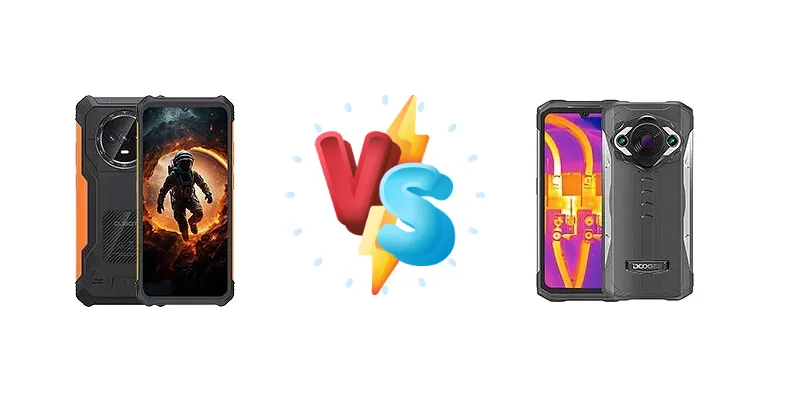
|
🏆 Quick Verdict
For users prioritizing all-day (and multi-day) battery life and cost-effectiveness, the Cubot KingKong ES is the clear winner. However, the Doogee S98 Pro’s Helio G96 chipset and 33W charging provide a noticeable performance boost and convenience for those willing to trade some endurance.
| PHONES | ||
|---|---|---|
| Phone Names | Cubot KingKong ES | Doogee S98 Pro |
| Network | ||
|---|---|---|
| 2G bands | GSM 850 / 900 / 1800 / 1900 | GSM 850 / 900 / 1800 / 1900 |
| 3G bands | HSDPA 850 / 900 / 1700(AWS) / 1900 / 2100 | HSDPA 800 / 850 / 900 / 1700(AWS) / 1900 / 2100 |
| 4G bands | 1, 2, 3, 4, 5, 7, 8, 12, 17, 20, 28, 41 | 1, 2, 3, 4, 5, 7, 8, 12, 13, 17, 18, 19, 20, 25, 26, 28, 34, 38, 39, 40, 41, 66 |
| Speed | HSPA, LTE | HSPA, LTE |
| Technology | GSM / HSPA / LTE | GSM / CDMA / HSPA / LTE |
| Launch | ||
|---|---|---|
| Announced | 2024, August 20 | 2022, May 27 |
| Status | Available. Released 2024, August | Available. Released 2022, June 06 |
| Body | ||
|---|---|---|
| Dimensions | 172.6 x 81.2 x 12.8 mm (6.80 x 3.20 x 0.50 in) | 172 x 82 x 15.5 mm (6.77 x 3.23 x 0.61 in) |
| SIM | Nano-SIM + Nano-SIM | Nano-SIM + Nano-SIM |
| Weight | 268 g (9.45 oz) | 320 g (11.29 oz) |
| Display | ||
|---|---|---|
| Protection | Mohs level 6 | Corning Gorilla Glass |
| Resolution | 720 x 1612 pixels, 20:9 ratio (~269 ppi density) | 1080 x 2340 pixels, 19.5:9 ratio (~409 ppi density) |
| Size | 6.56 inches, 103.4 cm2 (~73.8% screen-to-body ratio) | 6.3 inches, 97.4 cm2 (~69.1% screen-to-body ratio) |
| Type | IPS LCD, 90Hz | IPS LCD, 500 nits (peak) |
| Platform | ||
|---|---|---|
| CPU | Octa-core (2x1.6 GHz Cortex-A75 & 6x1.6 GHz Cortex-A55) | Octa-core (2x2.05 GHz Cortex-A76 & 6x2.0 GHz Cortex-A55) |
| Chipset | Unisoc T606 (12 nm) | Mediatek MT6781 Helio G96 (12 nm) |
| GPU | Mali-G57 MP1 | Mali-G57 MC2 |
| OS | Android 14 | Android 12 |
| Memory | ||
|---|---|---|
| Card slot | microSDXC (uses shared SIM slot) | microSDXC (dedicated slot) |
| Internal | 128GB 6GB RAM | 256GB 8GB RAM |
| Main Camera | ||
|---|---|---|
| Features | LED flash | Dual-LED flash, HDR, panorama |
| Triple | 48 MP, (wide), PDAF 2 MP (macro) Auxiliary lens | 48 MP, f/1.8, (wide), PDAF 20 MP, f/1.8, (night vision), 2 infrared night vision lights Thermal imaging camera |
| Video | Yes | 1440p, 1080p |
| Selfie camera | ||
|---|---|---|
| Single | 16 MP | 16 MP, f/2.0, (wide) |
| Video | Yes | 1080p |
| Sound | ||
|---|---|---|
| 35mm jack | No | Unspecified |
| Loudspeaker | Yes | Yes |
| Comms | ||
|---|---|---|
| Bluetooth | 5.0, A2DP, LE | 5.1, A2DP, LE |
| NFC | No | Yes |
| Positioning | GPS, GALILEO, GLONASS, BDS | GPS, GLONASS, BDS, GALILEO |
| Radio | No | FM radio |
| USB | USB Type-C | USB Type-C 2.0, OTG |
| WLAN | Wi-Fi 802.11 a/b/g/n/ac, dual-band | Wi-Fi 802.11 a/b/g/n/ac, dual-band |
| Features | ||
|---|---|---|
| Sensors | Accelerometer, proximity, compass | Fingerprint (side-mounted), accelerometer, gyro, proximity, compass |
| Battery | ||
|---|---|---|
| Charging | Wired | 33W wired 15W wireless |
| Type | 5100 mAh | 6000 mAh |
| Misc | ||
|---|---|---|
| Colors | Black/Orange | Black |
| Price | About 120 EUR | About 470 EUR |
| EU LABEL | ||
|---|---|---|
| Battery | 53:11h endurance, 1400 cycles | - |
| Energy | Class B | - |
| Free fall | Class A (270 falls) | - |
| Repairability | Class C | - |
Cubot KingKong ES
- Exceptional 53:11h battery endurance
- Cost-effective option
- Efficient Unisoc T606 chipset
- Lower processing power compared to the S98 Pro
- Slower charging speeds (wired only)
Doogee S98 Pro
- More powerful Mediatek Helio G96 chipset
- 33W wired and 15W wireless charging
- Potentially better camera image processing
- Shorter battery life compared to the ES
- Higher price point
Display Comparison
Neither device’s display specifications are provided, so a direct comparison is limited. However, given the price points, we can assume both utilize IPS LCD panels. The Doogee S98 Pro’s potential for higher peak brightness, driven by the more powerful chipset, could translate to better outdoor visibility. The absence of details like refresh rate or resolution suggests neither phone is targeting display-centric users.
Camera Comparison
Without detailed camera specifications, a comprehensive comparison is difficult. However, the chipset difference suggests the Doogee S98 Pro will likely have a more capable image signal processor (ISP), leading to better image processing and potentially improved low-light performance. The absence of sensor details necessitates caution; a larger sensor on the S98 Pro would be a significant advantage. We can assume both phones include standard features like HDR, but the S98 Pro’s processing power allows for more sophisticated computational photography techniques.
Performance
The Doogee S98 Pro’s Mediatek Helio G96 chipset represents a significant step up in processing power compared to the Cubot KingKong ES’s Unisoc T606. The G96 features a Cortex-A76 based CPU (2x2.05 GHz) versus the ES’s Cortex-A75 (2x1.6 GHz), resulting in faster application loading and smoother multitasking. While both are 12nm chips, the architectural improvements in the G96’s CPU cores and GPU provide a tangible performance advantage, particularly for gaming. The ES’s T606 prioritizes efficiency, contributing to its exceptional battery life, but at the cost of raw processing speed.
Battery Life
The Cubot KingKong ES’s standout feature is its incredible 53:11h endurance, a testament to the efficiency of the Unisoc T606 chipset and likely a larger battery capacity (though not specified). The Doogee S98 Pro, while offering 33W wired and 15W wireless charging – a significant convenience – will likely have shorter battery life due to the more power-hungry Helio G96. The 33W charging on the S98 Pro will deliver a much faster 0-100% charge time compared to the ES’s unspecified wired charging, making it ideal for users who need to quickly top up their battery.
Buying Guide
Buy the Cubot KingKong ES if you need a phone that can reliably last through extended fieldwork, camping trips, or simply want to minimize charging frequency. Its 53:11h endurance is a standout feature. Buy the Doogee S98 Pro if you prioritize smoother multitasking, occasional gaming, and the convenience of both wired and wireless charging, accepting a shorter battery life as a trade-off.