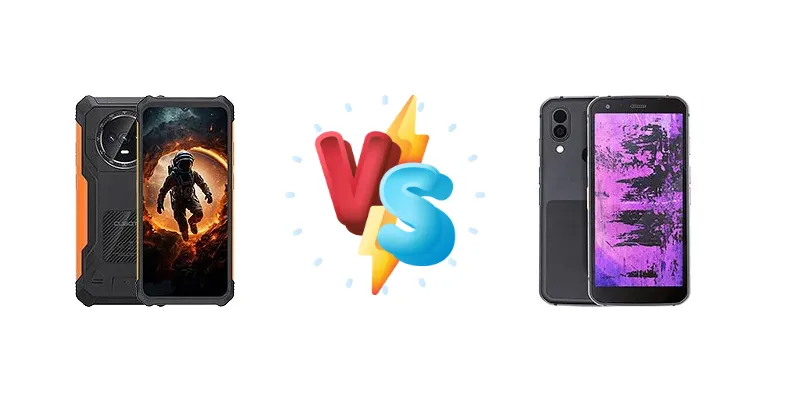
The rugged smartphone market caters to a specific need: durability. Both the Cubot KingKong ES and the Cat S62 Pro aim to deliver on that promise, but they approach it with different internal hardware and target slightly different user priorities. The KingKong ES focuses on maximizing battery life with a newer, power-efficient chipset, while the S62 Pro leverages Qualcomm's established Snapdragon 660 for a potentially smoother overall experience.
🏆 Quick Verdict
For the average user prioritizing long-term battery endurance and value, the Cubot KingKong ES emerges as the winner. Its 53:11h endurance significantly surpasses what the Cat S62 Pro can likely achieve, and the Unisoc T606 offers a respectable performance profile for everyday tasks. However, users needing proven Qualcomm performance may prefer the S62 Pro.
| Network |
|---|
| 2G bands | GSM 850 / 900 / 1800 / 1900 | GSM 850 / 900 / 1800 / 1900 |
| 3G bands | HSDPA 850 / 900 / 1700(AWS) / 1900 / 2100 | HSDPA 850 / 900 / 1700(AWS) / 1900 / 2100 |
| 4G bands | 1, 2, 3, 4, 5, 7, 8, 12, 17, 20, 28, 41 | 1, 2, 3, 4, 5, 7, 8, 20, 28, 38, 40 |
| Speed | HSPA, LTE | HSPA 42.2/5.76 Mbps, LTE (2CA) Cat13 400/150 Mbps |
| Technology | GSM / HSPA / LTE | GSM / HSPA / LTE |
| Launch |
|---|
| Announced | 2024, August 20 | 2020, June 28. Released 2020, August 17 |
| Status | Available. Released 2024, August | Discontinued |
| Body |
|---|
| Build | - | Glass front (Gorilla Glass 6), plastic back, aluminum frame |
| Dimensions | 172.6 x 81.2 x 12.8 mm (6.80 x 3.20 x 0.50 in) | 158.5 x 76.7 x 11.9 mm (6.24 x 3.02 x 0.47 in) |
| SIM | Nano-SIM + Nano-SIM | · Nano-SIM· Nano-SIM + Nano-SIM |
| Weight | 268 g (9.45 oz) | 248 g (8.75 oz) |
| | - | IP68/IP69 dust/water resistant (up to 1.5m for 35 mins)
Drop-to-concrete resistance from up to 1.8m
MIL-STD-810H compliant |
| Display |
|---|
| Protection | Mohs level 6 | Corning Gorilla Glass 6 |
| Resolution | 720 x 1612 pixels, 20:9 ratio (~269 ppi density) | 1080 x 2160 pixels, 18:9 ratio (~424 ppi density) |
| Size | 6.56 inches, 103.4 cm2 (~73.8% screen-to-body ratio) | 5.7 inches, 83.8 cm2 (~69.0% screen-to-body ratio) |
| Type | IPS LCD, 90Hz | IPS LCD |
| Platform |
|---|
| CPU | Octa-core (2x1.6 GHz Cortex-A75 & 6x1.6 GHz Cortex-A55) | Octa-core (4x2.2 GHz Kryo 260 Gold & 4x1.8 GHz Kryo 260 Silver) |
| Chipset | Unisoc T606 (12 nm) | Qualcomm SDM660 Snapdragon 660 (14 nm) |
| GPU | Mali-G57 MP1 | Adreno 512 |
| OS | Android 14 | Android 10 |
| Memory |
|---|
| Card slot | microSDXC (uses shared SIM slot) | microSDXC (dedicated slot) |
| Internal | 128GB 6GB RAM | 128GB 6GB RAM |
| Main Camera |
|---|
| Dual | - | 12 MP, f/1.8, (wide), 1/2.55", 1.4µm, dual pixel PDAF
FLIR thermal camera (Lepton 3.5 module) |
| Features | LED flash | Thermal imaging, heat palettes, temp. spot meter, LED flash |
| Triple | 48 MP, (wide), PDAF
2 MP (macro)
Auxiliary lens | - |
| Video | Yes | 1080p@30fps, gyro-EIS |
| Selfie camera |
|---|
| Single | 16 MP | 8 MP |
| Video | Yes | 1080p@30fps |
| Sound |
|---|
| 3.5mm jack | - | No |
| 35mm jack | No | No |
| Loudspeaker | Yes | Yes |
| Comms |
|---|
| Bluetooth | 5.0, A2DP, LE | 5.0, A2DP, LE |
| NFC | No | Yes |
| Positioning | GPS, GALILEO, GLONASS, BDS | GPS, GLONASS, GALILEO, BDS |
| Radio | No | FM radio |
| USB | USB Type-C | USB Type-C 2.0, OTG |
| WLAN | Wi-Fi 802.11 a/b/g/n/ac, dual-band | Wi-Fi 802.11 a/b/g/n/ac, dual-band, Wi-Fi Direct |
| Features |
|---|
| Sensors | Accelerometer, proximity, compass | Fingerprint (rear-mounted), accelerometer, gyro, proximity, compass |
| Battery |
|---|
| Charging | Wired | - |
| Type | 5100 mAh | Li-Ion 4000 mAh |
| Misc |
|---|
| Colors | Black/Orange | Black |
| Price | About 120 EUR | About 530 EUR |
| EU LABEL |
|---|
| Battery | 53:11h endurance, 1400 cycles | - |
| Energy | Class B | - |
| Free fall | Class A (270 falls) | - |
| Repairability | Class C | - |
Cubot KingKong ES
- Exceptional battery life (53:11h endurance)
- High battery cycle count (1400 cycles)
- Power-efficient Unisoc T606 chipset
- Potentially better value for money
- Unisoc chipset may have limited app compatibility
- Performance may be lower than Snapdragon 660
Cat S62 Pro
- Proven Qualcomm Snapdragon 660 performance
- Established brand reputation for ruggedness
- Potentially smoother multitasking
- Likely better camera software optimization
- Lower battery endurance compared to KingKong ES
- Less efficient 14nm process
- Potentially higher price
Display Comparison
Neither device's display specifications are provided, so we must infer. Cat phones historically prioritize visibility in bright sunlight, suggesting the S62 Pro likely features a higher peak brightness than the KingKong ES. However, the KingKong ES, being a newer device, may benefit from more modern color calibration techniques. Bezels are likely similar, given the rugged design constraints of both phones. Without specific data, it's difficult to definitively declare a winner; the S62 Pro's brand history suggests a focus on outdoor usability.
Camera Comparison
Camera specifications are absent, so analysis relies on brand positioning. Cat phones often emphasize practicality over photographic excellence. The S62 Pro likely features a competent camera system geared towards documenting work or outdoor activities. The KingKong ES, targeting a broader audience, may prioritize camera features for social media sharing. Without sensor size or aperture data, it’s impossible to determine which phone captures better images. The inclusion of OIS (Optical Image Stabilization) on either device would be a significant advantage, but is unknown.
Performance
The Cat S62 Pro’s Qualcomm Snapdragon 660 (14nm) boasts a higher clock speed (2.2 GHz vs 1.6 GHz) and a more mature architecture than the Cubot KingKong ES’s Unisoc T606 (12nm). The Snapdragon 660’s Kryo 260 Gold cores are designed for performance, while the T606 utilizes a mix of Cortex-A75 and A55 cores. While the Snapdragon 660 has a performance advantage, the T606’s 12nm process *should* offer better power efficiency. This translates to potentially smoother multitasking and gaming on the S62 Pro, but longer battery life on the KingKong ES. The Unisoc T606's newer architecture may also benefit from software optimizations not available on the older Snapdragon 660.
Battery Life
The Cubot KingKong ES’s standout feature is its exceptional 53:11h endurance and 1400 charge cycles. This dramatically exceeds typical smartphone battery life. While the Cat S62 Pro’s battery capacity is unknown, the Snapdragon 660’s 14nm process is less efficient than the T606’s 12nm. The KingKong ES’s wired charging capability is standard, but the S62 Pro may offer faster charging speeds, potentially mitigating the difference in overall endurance. The longevity promised by the 1400 charge cycles of the KingKong ES is a significant advantage for long-term users.
Buying Guide
Buy the Cubot KingKong ES if you need a phone that can genuinely last for days on a single charge, and if your workload consists primarily of communication, navigation, and light media consumption. It’s ideal for outdoor enthusiasts, field workers, or anyone who frequently finds themselves away from power outlets. Buy the Cat S62 Pro if you prefer the established reliability of the Qualcomm Snapdragon platform, potentially benefiting from better app compatibility and smoother multitasking, even at the cost of some battery life.
Frequently Asked Questions
❓ Will the Unisoc T606 in the Cubot KingKong ES struggle with demanding apps like Asphalt 9 or heavy multitasking?
While the Snapdragon 660 in the Cat S62 Pro has a performance edge, the Unisoc T606 is capable of handling most everyday tasks and moderately demanding games. However, users who frequently engage in intensive gaming or run multiple resource-heavy applications simultaneously may experience some slowdowns on the KingKong ES. The S62 Pro is the better choice for those scenarios.
❓ How does the 1400 charge cycle claim of the Cubot KingKong ES translate to real-world usage?
The 1400 charge cycle claim suggests the KingKong ES’s battery will retain a significant portion of its original capacity even after years of regular use. This is a substantial advantage over typical smartphones, which experience noticeable battery degradation after a few hundred cycles. It means the phone will remain usable for a longer period without requiring a battery replacement.
❓ Is the Cat S62 Pro likely to receive more software updates and security patches than the Cubot KingKong ES?
Historically, Cat phones have benefited from more consistent software support and security updates compared to many smaller brands like Cubot. This is due to Cat’s established partnerships and commitment to enterprise-level support. While Cubot is improving, the S62 Pro is likely to receive updates for a longer duration.