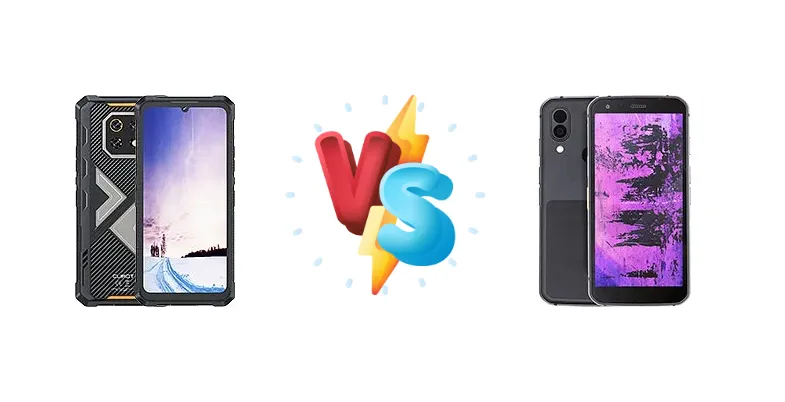
The rugged smartphone market caters to a specific need: durability. The Cubot KingKong ES 3 enters as a newer, budget-focused contender, boasting impressive battery endurance, while the Cat S62 Pro represents a more established brand with a Qualcomm Snapdragon chipset. This comparison dissects their core differences to determine which device delivers the best balance of toughness and usability.
🏆 Quick Verdict
For the average user prioritizing all-day (and multi-day) battery life and value, the Cubot KingKong ES 3 emerges as the winner. Its 61-hour endurance significantly surpasses what the Cat S62 Pro can likely achieve, despite the latter’s more established chipset. However, users needing proven software support and potentially smoother performance in demanding tasks may prefer the Cat S62 Pro.
| Network |
|---|
| 2G bands | GSM 850 / 900 / 1800 / 1900 | GSM 850 / 900 / 1800 / 1900 |
| 3G bands | HSDPA 850 / 900 / 1700(AWS) / 1900 / 2100 | HSDPA 850 / 900 / 1700(AWS) / 1900 / 2100 |
| 4G bands | 1, 2, 3, 4, 5, 7, 8, 12, 17, 20, 26, 28, 38, 40, 41, 66 | 1, 2, 3, 4, 5, 7, 8, 20, 28, 38, 40 |
| Speed | HSPA, LTE | HSPA 42.2/5.76 Mbps, LTE (2CA) Cat13 400/150 Mbps |
| Technology | GSM / HSPA / LTE | GSM / HSPA / LTE |
| Launch |
|---|
| Announced | 2025, August | 2020, June 28. Released 2020, August 17 |
| Status | Available. Released 2025, August | Discontinued |
| Body |
|---|
| Build | - | Glass front (Gorilla Glass 6), plastic back, aluminum frame |
| Dimensions | 177.4 x 83.7 x 15.3 mm (6.98 x 3.30 x 0.60 in) | 158.5 x 76.7 x 11.9 mm (6.24 x 3.02 x 0.47 in) |
| SIM | Nano-SIM + Nano-SIM | · Nano-SIM· Nano-SIM + Nano-SIM |
| Weight | 352 g (12.42 oz) | 248 g (8.75 oz) |
| | - | IP68/IP69 dust/water resistant (up to 1.5m for 35 mins)
Drop-to-concrete resistance from up to 1.8m
MIL-STD-810H compliant |
| Display |
|---|
| Protection | Mohs level 6 | Corning Gorilla Glass 6 |
| Resolution | 720 x 1600 pixels, 20:9 ratio (~260 ppi density) | 1080 x 2160 pixels, 18:9 ratio (~424 ppi density) |
| Size | 6.75 inches, 110.0 cm2 (~74.1% screen-to-body ratio) | 5.7 inches, 83.8 cm2 (~69.0% screen-to-body ratio) |
| Type | IPS LCD, 90Hz | IPS LCD |
| Platform |
|---|
| CPU | Octa-core (2x1.8 GHz Cortex-A75 & 6x1.6 GHz Cortex-A55) | Octa-core (4x2.2 GHz Kryo 260 Gold & 4x1.8 GHz Kryo 260 Silver) |
| Chipset | Unisoc T615 (12 nm) | Qualcomm SDM660 Snapdragon 660 (14 nm) |
| GPU | Mali-G57 MP1 | Adreno 512 |
| OS | Android 15 | Android 10 |
| Memory |
|---|
| Card slot | microSDXC (uses shared SIM slot) | microSDXC (dedicated slot) |
| Internal | 256GB 6GB RAM | 128GB 6GB RAM |
| Main Camera |
|---|
| Dual | - | 12 MP, f/1.8, (wide), 1/2.55", 1.4µm, dual pixel PDAF
FLIR thermal camera (Lepton 3.5 module) |
| Features | LED flash | Thermal imaging, heat palettes, temp. spot meter, LED flash |
| Triple | 48 MP, (wide), PDAF
2 MP (macro)
Auxiliary lens | - |
| Video | Yes | 1080p@30fps, gyro-EIS |
| Selfie camera |
|---|
| Single | 16 MP | 8 MP |
| Video | Yes | 1080p@30fps |
| Sound |
|---|
| 3.5mm jack | - | No |
| 35mm jack | No | No |
| Loudspeaker | Yes | Yes |
| Comms |
|---|
| Bluetooth | 5.0, A2DP, LE | 5.0, A2DP, LE |
| NFC | Yes | Yes |
| Positioning | GPS, GALILEO, GLONASS, BDS | GPS, GLONASS, GALILEO, BDS |
| Radio | No | FM radio |
| USB | USB Type-C | USB Type-C 2.0, OTG |
| WLAN | Wi-Fi 802.11 a/b/g/n/ac, dual-band | Wi-Fi 802.11 a/b/g/n/ac, dual-band, Wi-Fi Direct |
| Features |
|---|
| Sensors | Accelerometer, proximity, compass | Fingerprint (rear-mounted), accelerometer, gyro, proximity, compass |
| Battery |
|---|
| Charging | 33W wired | - |
| Type | 10200 mAh | Li-Ion 4000 mAh |
| Misc |
|---|
| Colors | Black | Black |
| Price | About 160 EUR | About 530 EUR |
| EU LABEL |
|---|
| Battery | 61:01h endurance, 1300 cycles | - |
| Energy | Class E | - |
| Free fall | Class C (90 falls) | - |
| Repairability | Class C | - |
Cubot KingKong ES 3
- Exceptional battery life (61+ hours)
- Modern 12nm Unisoc T615 chipset
- Fast 33W wired charging
- High battery cycle count (1300)
- Brand recognition is lower than Cat
- Software support may be limited
Cat S62 Pro
- Established brand reputation for ruggedness
- Qualcomm Snapdragon 660 offers proven performance
- Potentially better software optimization
- Likely more robust build quality
- Battery life likely significantly shorter than Cubot
- Older 14nm chipset is less power efficient
Display Comparison
Neither device’s display specifications are provided, but given their rugged focus, expect durable, likely IPS LCD panels. The Cat S62 Pro, being a slightly older device, may have lower peak brightness compared to newer panels. The absence of high refresh rates is expected in this segment, prioritizing power efficiency. Bezels are likely to be substantial on both to contribute to drop protection.
Camera Comparison
Camera details are absent, but in this price bracket, sensor size and image processing are critical. We can assume both phones will feature multiple rear cameras, but the quality will heavily depend on the main sensor’s resolution and aperture. The Cat S62 Pro, given its brand positioning, might have slightly more refined image processing algorithms. Expect both to struggle in low-light conditions without dedicated night modes. The inclusion of a 2MP macro lens on either device is likely a marketing gimmick with limited practical value.
Performance
The core difference lies in the chipsets. The Cubot KingKong ES 3 utilizes the Unisoc T615 (12nm), an octa-core processor with a mix of Cortex-A75 and A55 cores. This architecture aims for a balance of performance and efficiency. The Cat S62 Pro features the Qualcomm Snapdragon 660 (14nm), also an octa-core chip, but with Kryo 260 cores. While the Snapdragon 660’s cores have a higher peak clock speed (2.2 GHz vs 1.8 GHz), the newer 12nm process of the Unisoc T615 *should* offer better thermal efficiency. This means the KingKong ES 3 might sustain performance for longer under load, despite the Snapdragon 660’s theoretical advantage. The Snapdragon 660 benefits from Qualcomm’s established software optimization, potentially leading to smoother overall experience.
Battery Life
The Cubot KingKong ES 3’s 61:01h endurance is a standout feature. This translates to multiple days of typical use. The 33W wired charging is respectable, offering a reasonable recharge time. The Cat S62 Pro’s battery capacity is unknown, but given the Snapdragon 660’s power consumption and the device’s age, it’s unlikely to match the KingKong ES 3’s endurance. While charging speed is not specified, it’s likely to be slower than the Cubot’s 33W solution. The KingKong ES 3’s 1300 charge cycles also suggest a longer lifespan before significant battery degradation.
Buying Guide
Buy the Cubot KingKong ES 3 if you need exceptional battery life for extended outdoor work, travel, or simply dislike frequent charging. It’s ideal for users who prioritize longevity and affordability over peak performance. Buy the Cat S62 Pro if you prefer a brand with a longer track record in rugged devices, potentially benefit from better software optimization, and require consistent performance for moderate multitasking and app usage.
Frequently Asked Questions
❓ Will the Unisoc T615 in the Cubot KingKong ES 3 struggle with demanding games like PUBG?
While the Unisoc T615 isn't a flagship chipset, it's capable of running PUBG at medium settings. However, expect some frame drops during intense action. The 12nm process should help mitigate thermal throttling, allowing for sustained performance, but it won't match the experience on a Snapdragon 800-series device.
❓ How does the Cat S62 Pro’s ruggedness compare to the Cubot KingKong ES 3, considering drop and water resistance?
Both phones are built to withstand harsh conditions, but the Cat S62 Pro benefits from Cat’s long-standing expertise in rugged devices. While specific certifications aren’t provided, Cat phones typically meet MIL-STD-810H standards for shock, vibration, and temperature extremes. The KingKong ES 3 likely meets similar standards, but the Cat S62 Pro may have a more refined and tested design.
❓ Is the 33W charging on the Cubot KingKong ES 3 significantly faster than what the Cat S62 Pro offers?
Yes, 33W charging is considerably faster than the charging speeds typically found on older rugged phones like the Cat S62 Pro. Expect the KingKong ES 3 to charge from 0-100% in around 2-3 hours, while the Cat S62 Pro may take significantly longer, potentially exceeding 4 hours.