
Cubot KingKong ES 3 vs. Blackview BV8800: A Deep Dive into Rugged Smartphone Endurance
| Phones Images | |||||
|---|---|---|---|---|---|
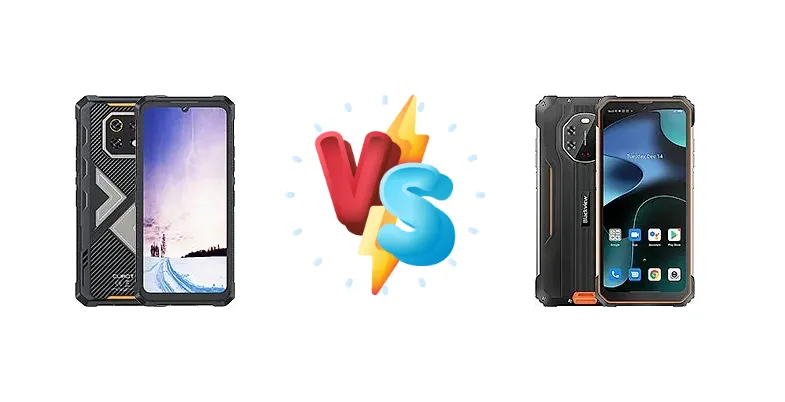
|
🏆 Quick Verdict
For the average user prioritizing longevity and consistent performance, the Cubot KingKong ES 3 is the clear winner. Its astounding 61:01h endurance rating significantly outpaces the Blackview BV8800’s 199h, making it ideal for extended trips or demanding work environments. While the BV8800 offers a more potent processor, the ES 3’s battery life is a game-changer.
| PHONES | ||
|---|---|---|
| Phone Names | Cubot KingKong ES 3 | Blackview BV8800 |
| Network | ||
|---|---|---|
| 2G bands | GSM 850 / 900 / 1800 / 1900 | GSM 850 / 900 / 1800 / 1900 |
| 3G bands | HSDPA 850 / 900 / 1700(AWS) / 1900 / 2100 | HSDPA 800 / 850 / 900 / 1700(AWS) / 1900 / 2100 |
| 4G bands | 1, 2, 3, 4, 5, 7, 8, 12, 17, 20, 26, 28, 38, 40, 41, 66 | 1, 2, 3, 4, 5, 7, 8, 12, 13, 17, 18, 19, 20, 25, 26, 28, 30, 34, 38, 39, 40, 41, 66 |
| Speed | HSPA, LTE | HSPA, LTE |
| Technology | GSM / HSPA / LTE | GSM / CDMA / HSPA / CDMA2000 / LTE |
| - | CDMA2000 1x | |
| Launch | ||
|---|---|---|
| Announced | 2025, August | 2021, December 24 |
| Status | Available. Released 2025, August | Available. Released 2022, January 10 |
| Body | ||
|---|---|---|
| Dimensions | 177.4 x 83.7 x 15.3 mm (6.98 x 3.30 x 0.60 in) | 176.2 x 83.5 x 17.7 mm (6.94 x 3.29 x 0.70 in) |
| SIM | Nano-SIM + Nano-SIM | Nano-SIM + Nano-SIM |
| Weight | 352 g (12.42 oz) | 367 g (12.95 oz) |
| - | IP68/IP69K dust/water resistant (up to 1.5m for 30 min) Drop-to-concrete resistance from up to 1.5m MIL-STD-810H compliant | |
| Display | ||
|---|---|---|
| Protection | Mohs level 6 | - |
| Resolution | 720 x 1600 pixels, 20:9 ratio (~260 ppi density) | 1080 x 2408 pixels, 20:9 ratio (~401 ppi density) |
| Size | 6.75 inches, 110.0 cm2 (~74.1% screen-to-body ratio) | 6.58 inches, 104.3 cm2 (~70.9% screen-to-body ratio) |
| Type | IPS LCD, 90Hz | IPS LCD, 90Hz, 480 nits |
| Platform | ||
|---|---|---|
| CPU | Octa-core (2x1.8 GHz Cortex-A75 & 6x1.6 GHz Cortex-A55) | Octa-core (2x2.05 GHz Cortex-A76 & 6x2.0 GHz Cortex-A55) |
| Chipset | Unisoc T615 (12 nm) | Mediatek MT6781 Helio G96 (12 nm) |
| GPU | Mali-G57 MP1 | Mali-G57 MC2 |
| OS | Android 15 | Android 11, Doke-OS 3.0 |
| Memory | ||
|---|---|---|
| Card slot | microSDXC (uses shared SIM slot) | No |
| Internal | 256GB 6GB RAM | 128GB 8GB RAM |
| - | UFS 2.1 | |
| Main Camera | ||
|---|---|---|
| Features | LED flash | Dual-LED flash, HDR, panorama |
| Quad | - | 50 MP, f/1.8, (wide), PDAF 8 MP, f/2.2, 117˚ (ultrawide) 20 MP, f/1.8, (IR camera), 2 IR emitters Auxiliary lens |
| Single | - | 16 MP, f/2.0, (wide) |
| Triple | 48 MP, (wide), PDAF 2 MP (macro) Auxiliary lens | - |
| Video | Yes | 1440p@30fps |
| Selfie camera | ||
|---|---|---|
| Single | 16 MP | 16 MP, f/2.0, (wide) |
| Video | Yes | 1080p@30fps |
| Sound | ||
|---|---|---|
| 3.5mm jack | - | No |
| 35mm jack | No | No |
| Loudspeaker | Yes | Yes |
| Comms | ||
|---|---|---|
| Bluetooth | 5.0, A2DP, LE | 5.2, A2DP, LE |
| NFC | Yes | Yes |
| Positioning | GPS, GALILEO, GLONASS, BDS | GPS, GLONASS, GALILEO, BDS |
| Radio | No | FM radio |
| USB | USB Type-C | USB Type-C 2.0, OTG |
| WLAN | Wi-Fi 802.11 a/b/g/n/ac, dual-band | Wi-Fi 802.11 a/b/g/n/ac |
| Features | ||
|---|---|---|
| Sensors | Accelerometer, proximity, compass | Fingerprint (side-mounted), accelerometer, gyro, proximity, compass, barometer |
| Battery | ||
|---|---|---|
| Charging | 33W wired | 33W wired, 31% in 30 min, 100% in 90 min Reverse wired |
| Type | 10200 mAh | 8380 mAh |
| Misc | ||
|---|---|---|
| Colors | Black | Black, Orange, Green |
| Price | About 160 EUR | About 350 EUR |
| Tests | ||
|---|---|---|
| Battery life | - | Endurance rating 199h |
| Camera | - | Photo / Video |
| Display | - | Contrast ratio: 1348:1 (nominal) |
| Loudspeaker | - | -29.3 LUFS (Average) |
| Performance | - | AnTuTu: 254849 (v8), 288964 (v9) GeekBench: 1752 (v5.1) GFXBench: 10fps (ES 3.1 onscreen) |
| EU LABEL | ||
|---|---|---|
| Battery | 61:01h endurance, 1300 cycles | - |
| Energy | Class E | - |
| Free fall | Class C (90 falls) | - |
| Repairability | Class C | - |
Cubot KingKong ES 3
- Exceptional battery life (61:01h endurance)
- Potentially lower operating temperatures due to efficient chipset
- 1300 charge cycles suggest long-term battery health
- Performance may be limited for demanding tasks
- Display specifications are unknown
Blackview BV8800
- More powerful processor (Helio G96) for gaming and multitasking
- Faster charging speeds (100% in 90 minutes)
- Reverse wired charging capability
- Significantly shorter battery life (199h endurance)
- Potential for thermal throttling under heavy load
Display Comparison
The Blackview BV8800 boasts a measured peak brightness of 501 nits and a 1348:1 contrast ratio, providing a reasonably vibrant viewing experience. However, the Cubot KingKong ES 3’s display specifications are not provided, making a direct comparison difficult. Given the BV8800’s contrast ratio is nominal, it suggests the panel isn’t exceptionally tuned. For users who spend significant time outdoors, the BV8800’s brightness is adequate, but the ES 3’s display quality remains an unknown factor.
Camera Comparison
Both devices feature 'Photo / Video' capabilities, but lack detailed camera specifications. Without sensor size, aperture, or image processing details, a meaningful comparison is impossible. The presence of a 2MP macro camera on many phones in this segment suggests both devices likely include one, but its utility is limited due to the small sensor size and lack of optical image stabilization (OIS). Image quality will likely depend more on software processing than hardware differences.
Performance
The Blackview BV8800’s MediaTek Helio G96 chipset, featuring a 2x2.05 GHz Cortex-A76 and 6x2.0 GHz Cortex-A55 configuration, offers a noticeable performance advantage over the Cubot KingKong ES 3’s Unisoc T615. The G96’s Cortex-A76 cores are architecturally superior to the T615’s Cortex-A75 cores, resulting in faster application loading and smoother multitasking. However, the Unisoc T615’s 12nm process node is comparable to the G96’s, suggesting similar thermal efficiency. The G96 is better suited for gaming, while the T615 excels at power efficiency.
Battery Life
The Cubot KingKong ES 3’s 61:01h endurance rating is a standout feature, dwarfing the Blackview BV8800’s 199h. This translates to days of use on a single charge for the ES 3, while the BV8800 will likely require daily charging. Both phones support 33W wired charging, but the BV8800 charges to 31% in 30 minutes and 100% in 90 minutes, while the ES 3’s charging speed is not specified. The BV8800 also offers reverse wired charging, a feature absent on the ES 3, allowing it to charge other devices.
Buying Guide
Buy the Cubot KingKong ES 3 if you need a phone that can reliably last for days on a single charge, and your primary use case revolves around communication, navigation, and basic productivity. Buy the Blackview BV8800 if you prioritize gaming, video editing, or other processor-intensive tasks, and are willing to compromise on battery life for increased performance and faster charging speeds.