
Cubot KingKong AX vs Doogee V20S: A Deep Dive into Rugged Smartphone Performance
| Phones Images | |||||
|---|---|---|---|---|---|
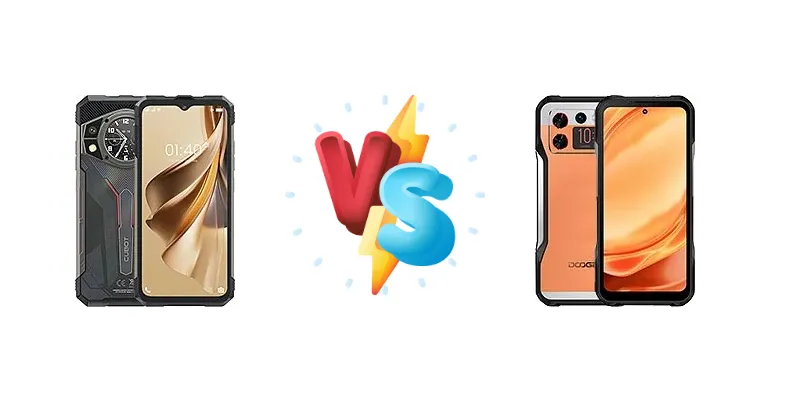
|
🏆 Quick Verdict
For the average user prioritizing sustained performance and future-proofing, the Doogee V20S emerges as the better choice. Its Mediatek Dimensity 6020, fabricated on a more efficient 7nm process, provides a slight edge in overall system responsiveness and potential for software updates, despite both phones sharing the same CPU core configuration.
| PHONES | ||
|---|---|---|
| Phone Names | Cubot KingKong AX | Doogee V20S |
| Network | ||
|---|---|---|
| 2G bands | GSM 850 / 900 / 1800 / 1900 | GSM 850 / 900 / 1800 / 1900 |
| 3G bands | HSDPA 800 / 850 / 900 / 1700(AWS) / 1900 / 2100 | HSDPA 800 / 850 / 900 / 1700(AWS) / 1900 / 2100 |
| 4G bands | 1, 2, 3, 4, 5, 7, 8, 12, 13, 17, 18, 19, 20, 25, 26, 28, 38, 39, 40, 41, 66 | 1, 2, 3, 4, 5, 7, 8, 12, 13, 17, 18, 19, 20, 25, 26, 28, 34, 38, 39, 40, 41, 66 |
| 5G bands | - | 1, 3, 5, 7, 8, 20, 28, 38, 40, 41, 77, 78, 79 |
| Speed | HSPA, LTE | HSPA, LTE, 5G |
| Technology | GSM / HSPA / LTE | GSM / CDMA / HSPA / LTE / 5G |
| Launch | ||
|---|---|---|
| Announced | 2024, March | 2024, March |
| Status | Available. Released 2024, April | Available. Released 2024, March |
| Body | ||
|---|---|---|
| Dimensions | 172 x 80.9 x 12.7 mm (6.77 x 3.19 x 0.5 in) | 170.9 x 81.9 x 14 mm (6.73 x 3.22 x 0.55 in) |
| SIM | Nano-SIM + Nano-SIM | Nano-SIM + Nano-SIM |
| Weight | 296 g (10.44 oz) | - |
| Display | ||
|---|---|---|
| Protection | Mohs level 6 | Corning Gorilla Glass |
| Resolution | 1080 x 2408 pixels, 20:9 ratio (~401 ppi density) | 1080 x 2408 pixels, 20:9 ratio (~410 ppi density) |
| Size | 6.58 inches, 104.3 cm2 (~75.0% screen-to-body ratio) | 6.43 inches, 99.6 cm2 (~71.2% screen-to-body ratio) |
| Type | IPS LCD, 120Hz | AMOLED, 500 nits (peak) |
| Platform | ||
|---|---|---|
| CPU | Octa-core (2x2.2 GHz Cortex-A76 & 6x2.0 GHz Cortex-A55) | Octa-core (2x2.2 GHz Cortex-A76 & 6x2.0 GHz Cortex-A55) |
| Chipset | Mediatek Helio G99 (6 nm) | Mediatek Dimensity 6020 (7 nm) |
| GPU | Mali-G57 MC2 | Mali-G57 MC2 |
| OS | Android 14 | Android 13 |
| Memory | ||
|---|---|---|
| Card slot | microSDXC (uses shared SIM slot) | microSDXC (uses shared SIM slot) |
| Internal | 256GB 12GB RAM | 256GB 12GB RAM |
| Main Camera | ||
|---|---|---|
| Dual | 100 MP, (wide), PDAF 5 MP (macro) Auxiliary lens | - |
| Features | LED flash | Dual-LED flash, HDR, panorama |
| Triple | - | 50 MP, f/1.8, (wide), PDAF 8 MP, f/2.2, 123˚ (ultrawide) 24 MP, f/1.8, (night vision), 2 infrared night vision lights |
| Video | Yes | 1440p, 1080p |
| Selfie camera | ||
|---|---|---|
| Single | 32 MP | 20 MP, f/2.0, (wide) |
| Video | Yes | 1080p |
| Sound | ||
|---|---|---|
| 35mm jack | Unspecified | No |
| Loudspeaker | Yes | Yes |
| Comms | ||
|---|---|---|
| Bluetooth | 5.2, A2DP, LE | 5.1, A2DP, LE |
| NFC | Yes | Yes |
| Positioning | GPS, GLONASS, GALILEO, BDS | GPS, GLONASS, BDS, GALILEO |
| Radio | Unspecified | FM radio |
| USB | USB Type-C, OTG | USB Type-C 2.0, OTG |
| WLAN | Wi-Fi 802.11 a/b/g/n/ac, dual-band | Wi-Fi 802.11 a/b/g/n/ac, dual-band |
| Features | ||
|---|---|---|
| Sensors | Fingerprint (side-mounted), accelerometer, gyro, proximity, compass | Fingerprint (side-mounted), accelerometer, gyro, proximity, compass |
| Battery | ||
|---|---|---|
| Charging | 33W wired | 33W wired Reverse wired |
| Type | 5100 mAh | 6000 mAh |
| Misc | ||
|---|---|---|
| Colors | Black | Black, Orange |
| Price | About 240 EUR | About 300 EUR |
| EU LABEL | ||
|---|---|---|
| Battery | 30:30h endurance, 900 cycles | - |
| Energy | Class E | - |
| Free fall | Class A (270 falls) | - |
| Repairability | Class C | - |
Cubot KingKong AX
- Exceptional 30:30h battery endurance
- 900 charge cycle rating for long-term battery health
- Potentially lower price point
- Older Helio G99 chipset may throttle under sustained load
- Likely less efficient power management compared to the V20S
Doogee V20S
- More efficient Mediatek Dimensity 6020 chipset
- Reverse wired charging for added convenience
- Potentially better image processing capabilities
- Battery endurance likely lower than the Cubot KingKong AX
- May be slightly more expensive
Display Comparison
Both devices lack detailed display specifications in the provided data. However, given their price points, we can anticipate both utilizing IPS LCD panels. The absence of LTPO or AMOLED technology suggests neither will offer adaptive refresh rates. The real-world difference will likely come down to color calibration and peak brightness, which are currently unknown. Bezels are expected to be relatively substantial, typical of rugged designs prioritizing drop protection.
Camera Comparison
Detailed camera specifications are absent. Given the market segment, we can expect both phones to feature a multi-camera setup, likely with a primary sensor, an ultrawide, and potentially a macro lens. The absence of information regarding sensor size, aperture, or optical image stabilization (OIS) makes a direct comparison impossible. However, the image signal processor (ISP) within the Dimensity 6020 of the Doogee V20S is likely more advanced, potentially leading to better image processing and low-light performance. We would advise caution regarding any 2MP macro lenses, as their utility is often limited.
Performance
Both the Cubot KingKong AX and Doogee V20S employ an Octa-core CPU configuration with 2x2.2 GHz Cortex-A76 and 6x2.0 GHz Cortex-A55 cores. However, the underlying chipsets differ significantly. The Doogee V20S utilizes the Mediatek Dimensity 6020, built on a 7nm process, while the Cubot KingKong AX features the Helio G99 (6nm). While the CPU cores are identical, the 7nm process of the Dimensity 6020 generally translates to improved power efficiency and thermal management compared to the 6nm Helio G99. This means the V20S is likely to sustain peak performance for longer periods without significant throttling. The GPU performance is also expected to be slightly better on the V20S due to the more modern chipset.
Battery Life
The Cubot KingKong AX boasts a remarkable 30:30h endurance rating, suggesting exceptional battery life. While the Doogee V20S’s battery capacity is not specified, the more efficient Dimensity 6020 chipset could partially offset the AX’s advantage. Both phones support 33W wired charging, but the Doogee V20S adds the convenience of reverse wired charging, allowing it to function as a power bank for other devices. The 900 charge cycles rating for the Cubot KingKong AX indicates a focus on long-term battery health.
Buying Guide
Buy the Cubot KingKong AX if you prioritize maximum battery endurance and are primarily focused on everyday tasks like communication and light media consumption. Its 30:30h endurance rating is a significant advantage for users frequently away from power outlets. Buy the Doogee V20S if you value a more modern chipset architecture, the convenience of reverse wireless charging, and a potentially smoother experience with more demanding applications, even if it means slightly less battery life.