
Cubot KingKong Ace 2 vs Doogee S98 Pro: A Deep Dive into Rugged Performance
| Phones Images | |||||
|---|---|---|---|---|---|
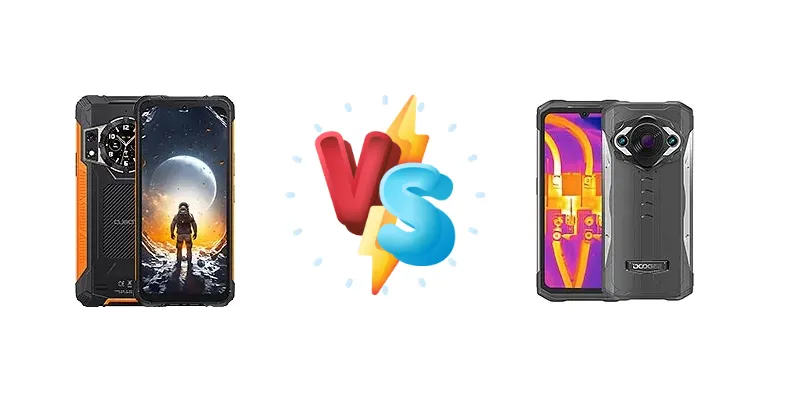
|
🏆 Quick Verdict
For the average user prioritizing long-lasting battery life and a proven chipset, the Cubot KingKong Ace 2 emerges as the winner. While the Doogee S98 Pro boasts faster charging and a slightly more powerful processor, the Ace 2’s exceptional 43:59h endurance and 900 charge cycles provide a more reliable experience for extended use.
| PHONES | ||
|---|---|---|
| Phone Names | Cubot KingKong Ace 2 | Doogee S98 Pro |
| Network | ||
|---|---|---|
| 2G bands | GSM 850 / 900 / 1800 / 1900 | GSM 850 / 900 / 1800 / 1900 |
| 3G bands | HSDPA 850 / 900 / 1700(AWS) / 1900 / 2100 | HSDPA 800 / 850 / 900 / 1700(AWS) / 1900 / 2100 |
| 4G bands | 1, 2, 3, 4, 5, 7, 8, 12, 17, 20, 28, 41 | 1, 2, 3, 4, 5, 7, 8, 12, 13, 17, 18, 19, 20, 25, 26, 28, 34, 38, 39, 40, 41, 66 |
| Speed | HSPA, LTE | HSPA, LTE |
| Technology | GSM / HSPA / LTE | GSM / CDMA / HSPA / LTE |
| Launch | ||
|---|---|---|
| Announced | 2024 | 2022, May 27 |
| Status | Available. Released 2024 | Available. Released 2022, June 06 |
| Body | ||
|---|---|---|
| Dimensions | 173.9 x 81.8 x 12.7 mm (6.85 x 3.22 x 0.5 in) | 172 x 82 x 15.5 mm (6.77 x 3.23 x 0.61 in) |
| SIM | Nano-SIM + Nano-SIM | Nano-SIM + Nano-SIM |
| Weight | 283 g (9.98 oz) | 320 g (11.29 oz) |
| Display | ||
|---|---|---|
| Protection | Mohs level 6 | Corning Gorilla Glass |
| Resolution | 720 x 1612 pixels, 20:9 ratio (~269 ppi density) | 1080 x 2340 pixels, 19.5:9 ratio (~409 ppi density) |
| Size | 6.56 inches, 103.4 cm2 (~72.7% screen-to-body ratio) | 6.3 inches, 97.4 cm2 (~69.1% screen-to-body ratio) |
| Type | IPS LCD, 90Hz | IPS LCD, 500 nits (peak) |
| Platform | ||
|---|---|---|
| CPU | Octa-core (2x2.0 GHz Cortex-A75 & 6x1.8 GHz Cortex-A55) | Octa-core (2x2.05 GHz Cortex-A76 & 6x2.0 GHz Cortex-A55) |
| Chipset | Mediatek Helio G85 (12 nm) | Mediatek MT6781 Helio G96 (12 nm) |
| GPU | Mali-G52 MC2 | Mali-G57 MC2 |
| OS | Android 14 | Android 12 |
| Memory | ||
|---|---|---|
| Card slot | microSDXC (uses shared SIM slot) | microSDXC (dedicated slot) |
| Internal | 128GB 6GB RAM | 256GB 8GB RAM |
| Main Camera | ||
|---|---|---|
| Dual | 48 MP, (wide), PDAF 2 MP (macro) Auxiliary lens | - |
| Features | LED flash | Dual-LED flash, HDR, panorama |
| Triple | - | 48 MP, f/1.8, (wide), PDAF 20 MP, f/1.8, (night vision), 2 infrared night vision lights Thermal imaging camera |
| Video | Yes | 1440p, 1080p |
| Selfie camera | ||
|---|---|---|
| Single | 16 MP | 16 MP, f/2.0, (wide) |
| Video | Yes | 1080p |
| Sound | ||
|---|---|---|
| 35mm jack | Unspecified | Unspecified |
| Loudspeaker | Yes | Yes |
| Comms | ||
|---|---|---|
| Bluetooth | 5.0, A2DP, LE | 5.1, A2DP, LE |
| NFC | Yes | Yes |
| Positioning | GPS, GLONASS, GALILEO, BDS | GPS, GLONASS, BDS, GALILEO |
| Radio | Unspecified | FM radio |
| USB | USB Type-C, OTG | USB Type-C 2.0, OTG |
| WLAN | Wi-Fi 802.11 a/b/g/n/ac, dual-band | Wi-Fi 802.11 a/b/g/n/ac, dual-band |
| Features | ||
|---|---|---|
| Sensors | Fingerprint (side-mounted), accelerometer, proximity, compass | Fingerprint (side-mounted), accelerometer, gyro, proximity, compass |
| Battery | ||
|---|---|---|
| Charging | 18W wired | 33W wired 15W wireless |
| Type | 5100 mAh | 6000 mAh |
| Misc | ||
|---|---|---|
| Colors | Black/Orange, Black/Green | Black |
| Price | - | About 470 EUR |
| EU LABEL | ||
|---|---|---|
| Battery | 43:59h endurance, 900 cycles | - |
| Energy | Class C | - |
| Free fall | Class A (270 falls) | - |
| Repairability | Class C | - |
Cubot KingKong Ace 2
- Exceptional battery endurance (43:59h)
- High battery cycle count (900 cycles)
- Proven and efficient Helio G85 chipset
- Slower charging speed (18W)
- Potentially less responsive for demanding tasks
Doogee S98 Pro
- Faster charging (33W wired, 15W wireless)
- More powerful Helio G96 chipset
- Slightly improved CPU architecture
- Lower battery endurance (unspecified)
- Potentially shorter battery lifespan
Display Comparison
Neither device’s display specifications are provided, so a direct comparison is limited. However, given the price points, we can expect both to utilize IPS LCD panels. The focus here will be on durability, with both likely featuring Gorilla Glass or similar protection. The absence of high refresh rate or LTPO technology suggests neither prioritizes a premium visual experience, focusing instead on robustness and power efficiency.
Camera Comparison
Without detailed camera specifications, a comprehensive comparison is impossible. However, the market segment suggests both phones will feature multi-camera setups with a primary sensor, ultrawide, and potentially macro/depth sensors. The absence of information regarding sensor size and aperture makes it difficult to assess image quality. It’s likely both phones will rely heavily on software processing to enhance images, and the quality will depend on the sophistication of their algorithms. We can assume neither will compete with flagship camera performance.
Performance
The Doogee S98 Pro holds a slight edge in raw processing power, utilizing the Mediatek Helio G96 chipset with a CPU configuration of 2x2.05 GHz Cortex-A76 and 6x2.0 GHz Cortex-A55 cores. This contrasts with the Cubot KingKong Ace 2’s Helio G85, featuring 2x2.0 GHz Cortex-A75 and 6x1.8 GHz Cortex-A55 cores. The Cortex-A76 cores in the G96 represent an architectural improvement over the A75 cores in the G85, translating to better single-core performance and improved efficiency. However, the real-world difference will be noticeable primarily in graphically intensive tasks and multitasking, not necessarily in everyday usage. The G85 is a well-established and efficient chipset, providing a solid experience for most users.
Battery Life
This is where the Cubot KingKong Ace 2 truly shines. Its reported 43:59h endurance is exceptional for a rugged phone, indicating a highly optimized power management system. The 900 charge cycles suggest a battery designed for longevity. The Doogee S98 Pro, while offering faster 33W wired and 15W wireless charging, doesn’t disclose endurance figures. The faster charging is beneficial for quick top-ups, but the Ace 2’s extended battery life minimizes the need for frequent charging. The wireless charging capability of the S98 Pro is a convenience feature the Ace 2 lacks.
Buying Guide
Buy the Cubot KingKong Ace 2 if you need a phone that can genuinely last for days on a single charge, and value proven reliability over bleeding-edge processing power. This is ideal for travelers, field workers, or anyone who frequently finds themselves away from power outlets. Buy the Doogee S98 Pro if you prioritize faster charging speeds – including wireless – and want a slightly more responsive experience for demanding applications, accepting that battery life will be comparatively shorter.